
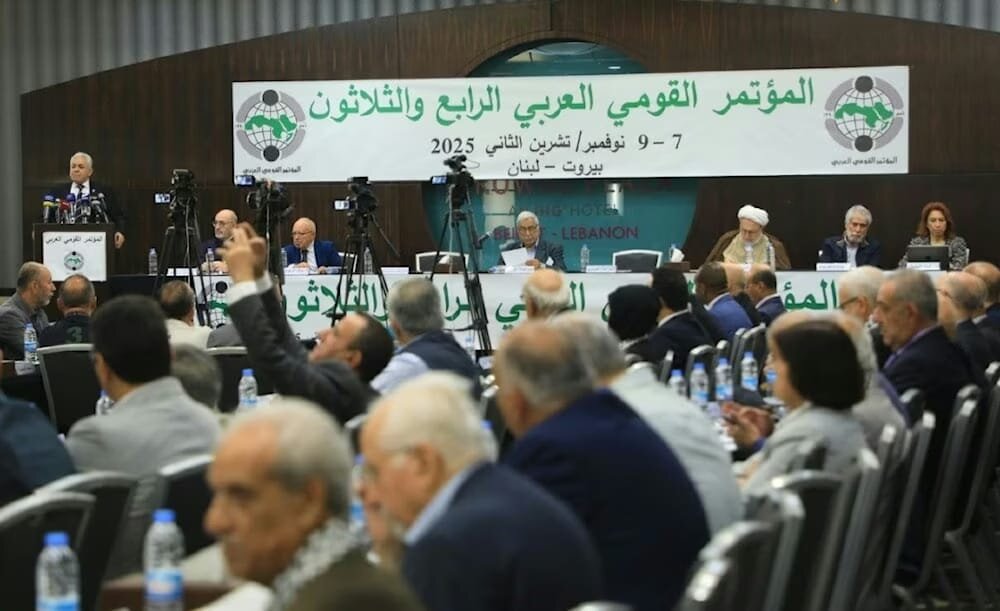
BEIRUT — The 34th Arab National Congress opened in Beirut on Friday, attended by more than 250 politicians, intellectuals and academic luminaries from across the Arab world.
The purpose of the gathering was to reassess the Arab nationalist project, articulate a collective strategy to counter Western hegemony and normalization with Israel, and reaffirm support for resistance movements in Palestine, Lebanon, Yemen, and other sites of conflict.
On behalf of Hezbollah Secretary-General Sheikh Naim Qassem, the party’s head of Arab relations, Ammar al-Mousawi, asserted that Hezbollah “does not regret its decision to support Gaza,” calling it “one of the most honorable and noble choices in the history of the resistance.”
Al-Musawi said the Al-Aqsa flood operation was a “moment of unparalleled steadfastness and dignity,” adding: “Two years after the operation, the enemy is still struggling in chaos and fighting a war with the full support of the West, led by the United States, but has been unable to take back any prisoners except through negotiations.”
Foreign Minister Al Moussawi criticized Western leaders who “rushed to the Israeli entity after the operation,” noting that their actions revealed that the Zionist regime is “an integral part of the Western colonial system.”
He recalled that “even US President Donald Trump praised Israeli soldiers in Congress and affirmed full cooperation in the war waged against the peoples of the region.”
Al Mousawi stressed that the conflict is not just with Israel, but is “a Western colonial war that seeks to weaken the region,” and argued that Hezbollah’s participation in the Gaza front is a “conscious, moral, national choice.”
Foreign Minister Al-Moussawi praised the role of resistance fronts in Lebanon, Iran, Yemen, and Iraq, particularly Ansarullah in Yemen, for its “strategic contribution in encircling Zionist entities and striking deep into occupied territories.”
Ansarala leader Sayyed Abdulmalik al-Houthi also said in a televised address that his enemy Israel was trying to impose “a new Middle East under Zionist control” and warned that “in the midst of two years of open aggression, some are still ignoring their responsibilities.”
Al Houthi stressed that the axis of resistance from Gaza to Lebanon “forced the enemy to halt its aggression through the indomitable spirit and the golden formula of military and people.”
He praised Hezbollah’s “pioneering and decisive role” in support and condemned attempts to “distort Iran’s supporting role for the Arab cause.”
The Yemeni leader called on Arab countries to “maintain and strengthen all power elements to defeat Israel’s plans and protect regional sovereignty.”
Addressing the conference, Palestinian Islamic Jihad Secretary-General Ziad al-Nahre said that despite the unprecedented destruction, “the resistance remains on the ground with its weapons intact,” stressing that “all factions were united militarily and politically,” and that this unity made possible their fortitude “against overwhelming aggression.”
Other speakers reiterated the centrality of resistance and Arab unity. Ma’an Bashour, founding president of the Arab National Forum, said: “The idea of resistance remains the core guarantee of the restoration of the Arab nation.”
Conference Secretary-General Hamdeen Sabbahi also stressed that “our task today is to refute the narrative of national defeat,” asserting that “the Arab state has won and the day of Palestinian liberation is drawing near.”
George Ibrahim Abdallah, a Lebanese revolutionary and former political prisoner, concluded the conference by calling it “an act of resolute defiance against imperial plots targeting the region.”