
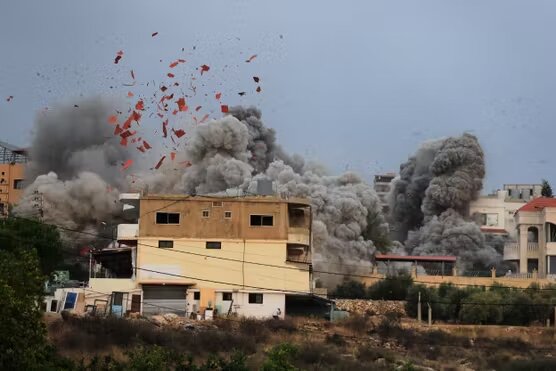
TEHRAN – Israel’s recent deadly airstrikes in southern Lebanon are not a violation of the ceasefire. These are a continuation of war strategies disguised as security enforcement.
Almost a year after a ceasefire was signed with Hezbollah, Israel has turned it into a unilateral authorization to bomb, occupy and intimidate. Thursday’s attack, which killed at least one person and injured several others, occurred just hours after Hezbollah reaffirmed its right to resist, exposing the reality that Israel is not responding to threats, but fabricating them. Disarmament is not the goal. That’s an excuse.
ceasefire in name only
The Israeli military said Thursday’s attack targeted Hezbollah military facilities and accused the group of refusing to disarm under the terms of a November 2024 deal. But Hezbollah has consistently said it remains committed to the ceasefire and will not disarm while Israel continues to violate Lebanon’s sovereignty with near-daily attacks.
President Joseph Aoun condemned Thursday’s airstrike as a “full-scale crime under international humanitarian law” and said Israel’s actions target civilians and criminalize terrorism. “Almost a year has passed since the ceasefire went into effect, and during this time Israel has spared no effort to demonstrate its rejection of any negotiated settlement,” he added.
Israeli strategy: intimidation and control
Experts see Thursday’s strike as a clear escalation — especially since it comes just hours after Hezbollah released an open letter reaffirming its right to resist. Israeli warplanes also flew low over Beirut’s southern suburbs, a tactic widely seen as psychological warfare.
UNIFIL, the UN peacekeeping force in Lebanon, warned that the Israeli attack threatens civilians and undermines the Lebanese army’s efforts to assert control of the southern territory. The United States continues to pressure Lebanon to disarm Hezbollah, but it has done little to curb Israel’s repeated ceasefire violations.
Hezbollah’s position: defense, not surrender
Hezbollah responded by rejecting any political negotiations with Israel, saying such negotiations were “not in the national interest.” The group reaffirmed its right to defend Lebanon from enemies who “impose war and do not stop attacks.”
Since the ceasefire went into effect in November last year, Israel has stationed troops in five areas in southern Lebanon and has carried out regular attacks. Hezbollah insists that Israel is using the disarmament process to tighten its grip on Lebanese territory and that resistance is a duty, not a choice.
one-sided violence
Israeli Prime Minister Benjamin Netanyahu, wanted by the International Criminal Court for war crimes in Gaza, warned a week ago that operations in Lebanon could escalate. Defense Minister Israel Katz echoed this threat, saying, “Maximum enforcement will continue and be further strengthened.”
This stance reflects Israel’s actions in the Gaza Strip, where a ceasefire with Hamas has not stopped daily attacks. Israel continues to unilaterally determine what constitutes a violation and often responds with force against civilians.
Lebanon rebels
President Aoun has signaled a shift. In late October, he ordered the Lebanese army to counter further incursions after Israeli forces crossed the border and killed a city official in a night raid. The military has little involvement in the conflict, but Aoun, a former military commander, appears to have lost patience with Israeli violations.
Under the ceasefire terms, the Lebanese army is tasked with disarming Hezbollah in the south by the end of the year. But Hezbollah maintains that continued Israeli attacks and occupation make disarmament impossible and dangerous.
Aggression by design
Israel’s actions in Lebanon are not about protecting borders. They are about control, coercion, and continuing to weaken Lebanon. Hezbollah’s call for disarmament is not a step toward peace, but a tactic to eliminate the only force capable of resisting Israeli aggression.
The Lebanese leadership is also beginning to react. But without international pressure on Israel, the violence will continue. The actual ceasefire is a unilateral arrangement, with Israel bombing at will and the Lebanese government expected to remain silent. In this context, Hezbollah’s position is not only justified, but essential.