
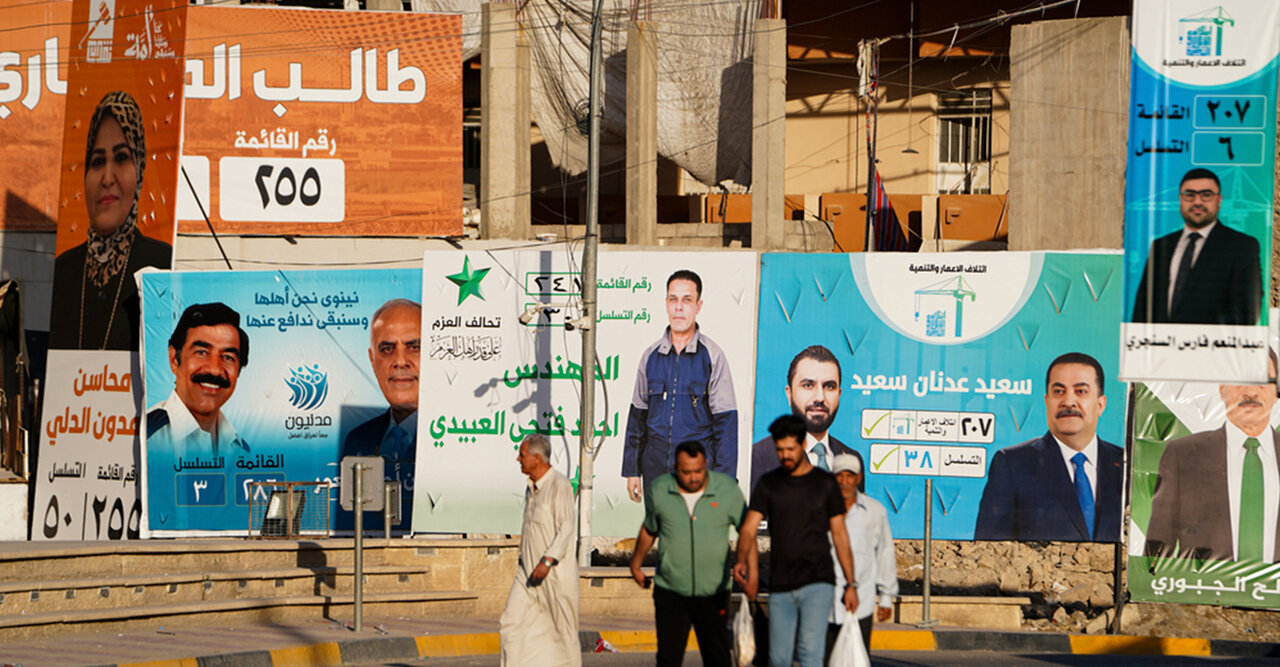
TEHRAN – Iraq will hold its sixth parliamentary elections on November 11, with potentially the most consequential results since 2003.
More than 7,000 candidates from 31 coalitions, 38 political parties and 75 independent lists are vying for 329 seats in the House of Representatives (also known as the Council of Representatives), with Baghdad holding the largest share with 71 seats.
The election comes amid economic instability, regional tensions following the Zionist regime’s genocidal campaign in Gaza and aggression against other regional countries, and a renewed debate over the direction of the Iraqi state.
The Independent High Electoral Commission disqualified more than 800 candidates and distributed 1.5 million new biometric voter cards ahead of the vote.
Prime Minister Mohammad Al-Sudani heads the Alliance for Reconstruction and Development, campaigning under the slogan “Growth, Integrity, Service.” His focus on rebuilding infrastructure and curbing corruption earned him a reputation as a staunch technocrat.
Sudani is building a strong coalition of 54 sitting parliamentarians, including key politicians such as Fareh al-Fayad (chairman of the Popular Mobilization Forces), Ahmed al-Assadi (current minister of labor and leader of the Bilad Sumerian party), and members of veteran politician Ayad Allawi’s civil movement.
Former prime minister Nouri al-Maliki, who heads the coalition, remains a polarizing but dominant figure within the coordination framework. Other Shiite leaders, Qais al-Khazali of the Sadiqun List, Ammar al-Hakim of al-Hikmah and Hadi al-Amiri of the Badr Organization, are contesting separately, underscoring the growing competition within Iraq’s largest political bloc.
In Sunni circles, former parliament speaker Mohammed al-Harbousi from Taqadum city has attracted attention by running from the capital, Baghdad, rather than his traditional home in Anbar province, aiming to expand his influence nationwide.
He faces competition from the al-Siyada, al-Azm, Tafawok, and al-Qiyada coalitions, which have benefited from a new Sunni political mobilization following the passage of an amnesty law that freed thousands of prisoners.
The main conflict in the Kurdistan region is between the Kurdistan Democratic Party (KDP), led by the Barzani family, and the Patriotic Union of Kurdistan (PUK).
Both parties remain dominant in their respective strongholds of Erbil and Suleymaniyah, but tensions over oil revenues, governance and disputed territories such as Kirkuk continue ahead of the vote, raising concerns about whether a united Kurdish front can be presented in Baghdad.
This is Iraq’s most expensive vote to date, with the election cost estimated at $9 billion. Observers report increasing outside involvement, with the United States, Persian Gulf Arab states, and other regional countries pouring money into Iraqi politics to shape outcomes, which is prohibited by election law.
The revised electoral law, which reduces the number of constituencies from 83 to 18, could favor established large coalition governments and weaken the power of independents who performed well in 2021.
Conspicuously absent from the ballot paper is Muqtada al-Sadr’s Sadrist movement, which is boycotting the election. Al-Sadr’s supporters won 73 seats after the last election in 2021, but he was unable to form a coalition government and ultimately resigned from politics following the introduction of the 2023 Electoral Law.
Instead, he operates outside the formal political process and portrays himself as an anti-corruption reformer.
Analysts say al-Sadr seeks to influence politics through grassroots religious, philanthropic and social networks rather than directly engaging parliament.
However, a boycott could significantly reduce turnout in Shiite-majority provinces such as Baghdad and the south, potentially benefiting well-organized blocs like al-Sudani and energizing Sunni and other parties whose voter bases appear to be more motivated.
On the other hand, several prominent former Sadrists are running as independent candidates, potentially drawing support from voters who previously supported the Sadrist movement.
Elections are also held under strong foreign pressure. The US government has pressured Baghdad to limit the influence of resistance groups, including the Popular Mobilization Forces, using sanctions and controls on dollar remittances.
It is believed that no coalition can secure a majority on its own, making post-election cooperation essential. Mr al-Sudani’s chances of remaining prime minister depend largely on whether the coordination framework remains cohesive.
Much is at stake as Iraq heads to the polls. The elections will decide whether the country can move towards more stability and effective governance, or fall back into the political gridlock that has stalled reform and progress for years.