
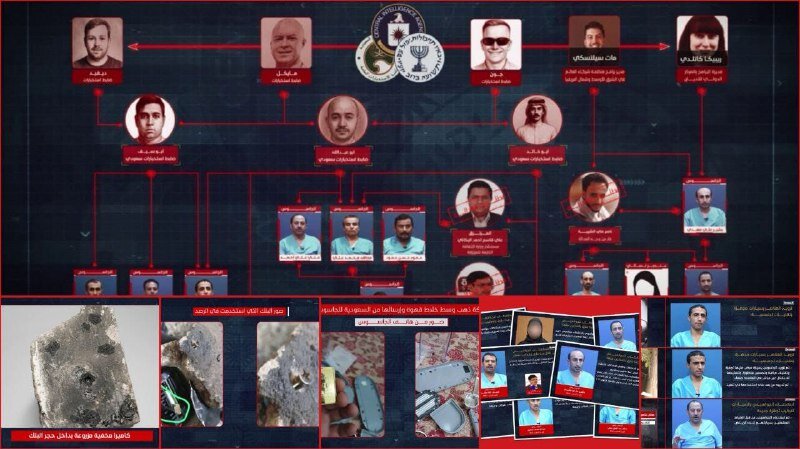
BEIRUT – Yemen’s Interior Ministry on Saturday announced significant intelligence developments, revealing the dismantling of a sophisticated spy network operating under a joint operations room controlled by the U.S. Central Intelligence Agency (CIA), Israel’s Mossad, and Saudi intelligence.
The network, commanded from Riyadh, is said to be one of the most dangerous spy organizations to emerge in recent years, and aims to destabilize Yemen from within through coordinated intelligence, surveillance and sabotage operations.
President Mahdi al-Mashat, Chairman of Yemen’s Supreme Political Council, hailed the achievement as a “divine victory” and stressed that the success of the operation reflects improved capabilities to detect, interdict and dismantle espionage activities aimed at undermining Yemen’s security and unity.
He noted that the United States, Israel and Saudi Arabia are targeting Yemen’s position in the regional resistance, and said: “This operation reveals the scale of aggression aimed at undermining Yemen’s staunch support for Palestine.”
According to the Interior Ministry, the spy network had been under long-term surveillance and surveillance until security forces carried out a coordinated operation code-named “And Their Plots Will Fail,” after a Koranic verse that symbolizes the failure of enemy plots.
The operation resulted in the arrest of dozens of operatives, the seizure of state-of-the-art spy equipment, and exposed the joint chain of command linking on-the-ground operatives in Yemen to police in Riyadh, Tel Aviv and Washington.
The ministry explained that the network’s structure is multi-layered and compartmentalized, with small independent cells operating separately to avoid detection.
These cells of local collaborators performed intelligence gathering, surveillance of military and civilian personnel, and transmission of sensitive data to overseas operations rooms.
Officials said some of the information collected was used to direct airstrikes against civilian targets such as markets, hospitals and residential areas, resulting in casualties for Yemenis during the past years of war.
The captured collaborators confessed to having undergone specialized training in Saudi Arabia under the supervision of American, Israeli, and Saudi military officers.
The training included techniques for disguise, encryption, and accurate reporting, and some agents used humanitarian or development projects as cover for their espionage operations.
The Interior Ministry released parts of an interrogation showing that the spies were paid through secret financial channels, including cash deliveries and gold shipments brokered by Saudi officials.
The arrested collaborators included operatives who monitored Yemeni military command posts, rocket launch sites, and security buildings, as well as filmed public institutions and residential areas that were later targeted by coalition airstrikes.
The ministry said the confession provides undeniable evidence that the U.S.-Israel-Saudi alliance continues to wage a coordinated intelligence war against Yemen, despite fluctuations in openly hostile relations.
“The core of regional information collaboration”
Following the announcement, Yemeni security experts emphasized the strategic and political significance of the operation, saying it exposed Saudi Arabia’s central role in regional intelligence cooperation alongside Israel and the United States.
Security expert Brigadier General Abed al-Sharki said in a television interview that the discovery “confirms that Saudi Arabia has become a key center for the normalization and coordination of Zionist and American projects in the region.”
He added that intelligence cooperation between Riyadh and Tel Aviv dates back decades, but has now evolved into open cooperation targeting countries resisting US and Israeli domination.
Similarly, Colonel Najeeb al-Ansi, director of the Yemeni Security Media Center, said the revelation of this joint spy network indicates a failure in the enemy’s intelligence capabilities, as well as a military failure.
He said the operation was a “strategic intelligence victory” that strengthened public confidence in Yemen’s security institutions and demonstrated their high professionalism and readiness.
Both experts stressed that the operation would send a strong message to foreign intelligence services that Yemen is no longer a vulnerable target.
“The Yemeni state has moved from defense to deterrence,” al-Ansi said, adding that “the country’s intelligence services are now able to work proactively to neutralize threats before they materialize.”
message of deterrence
The Interior Ministry reiterated in a statement that Yemeni territory will not become a playground for foreign intelligence services. It warned that any attempt to infiltrate or disrupt the country’s security would be met with “an iron fist and punishment that will not spare traitors.” Officials stressed that the success of the operation was the result of “the vigilance of the Yemeni people and the loyalty of the security forces,” emphasizing the unity of the government and people in defending national sovereignty.
Observers see this event as a turning point in Yemen’s ongoing conflict with the US-Israel-Saudi coalition. It represents not only an intelligence victory, but also a political assertion of independence and deterrence.
The revelation of a Riyadh-based spy network aimed at destabilizing Yemen’s interior highlights the broader reality that Yemen has evolved from a target of aggression to an actor capable of shaping the regional balance of power.