
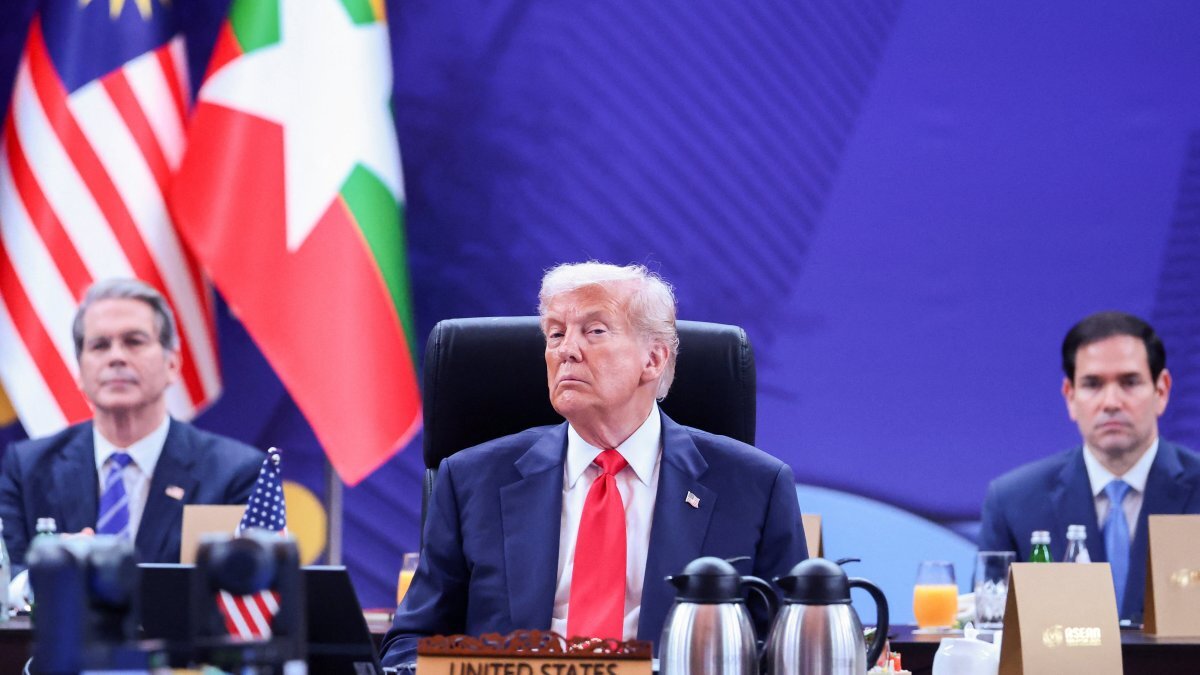
TEHRAN – President Donald Trump’s attendance at the 47th ASEAN Summit in Kuala Lumpur marks a symbolic and eloquent reorientation of US foreign policy. After two decades of overreach and strategic exhaustion in West Asia, Washington appears to be seeking a new phase in projecting power. Dynamic, contested, and economically important, Southeast Asia provides an environment in which the United States can regain visibility while avoiding the enormous political and military costs of intervention in the Middle East.
Since 2001, US policy in West Asia has cost trillions of dollars and eroded its moral and political capital. Washington is overburdened by its invasions of Iraq and Afghanistan, its long shadow wars in Syria and Yemen, and its failed attempts to isolate Iran.
Although the United States claims to avoid direct confrontation, its direct involvement in the 12-day war against Iran in cooperation with Israel shows that the United States remains a stakeholder in instability that it can no longer control. On November 6, President Trump admitted to reporters that “I bore a great deal of responsibility” for the war started by Israel. US B-2 bombers attacked Iranian nuclear facilities in Fordow, Natanz, and Isfahan.
President Trump’s visit to Malaysia must therefore be read as part of a recalibration attempt to shift attention from an arena of wars of attrition to an arena that promises influence through diplomacy and economic partnership rather than endless war.
President Trump’s speech at the ASEAN summit emphasized “economic freedom” and “regional security,” words carefully chosen to appeal to local elites and counter Chinese influence. Malaysia, Vietnam, the Philippines, and Thailand all sit in a delicate balance, with deep ties to Chinese trade yet wary of China’s dominance. President Trump sought to remind these states that the United States remains an essential balancing force by proposing new defense cooperation, trade incentives, and technology partnerships. But underlying this rhetoric lies the familiar objective of maintaining US dominance through the fragmentation of alternative blocs such as BRICS+ and the Regional Comprehensive Economic Partnership (RCEP).
For Iran and other actors in West Asia, this development has complex implications. On the other hand, Washington’s focus on Southeast Asia could ease immediate military pressure on the Persian Gulf. The United States could redeploy naval and intelligence resources eastward, placing regional security more directly in the hands of local powers. On the other hand, Iran must recognize that this “transformation” does not mean withdrawal. The United States has no intention of leaving the Middle East. We are globalizing our containment strategy. By increasing cooperation with ASEAN member states, Washington will create an economic cordon separating both China and Iran from the vital maritime route connecting the Indian and Pacific oceans.
President Trump’s emphasis on “freedom of navigation” in the South China Sea reflects the United States’ old claims in the Strait of Hormuz. The same logic used to justify a naval presence near Iran is now being exported to the Indo-Pacific. This shows how American strategic thinking views the region not as independent, but as interconnected fronts in a single competition for influence. Iran’s energy partnership with China, especially under the 25-year Comprehensive Cooperation Agreement, indirectly links Tehran to Southeast Asia’s security calculations. Therefore, a visit to ASEAN should not be misunderstood as a regional substitute. This is an extension of the same contest but in a new way.
From the Iranian government’s perspective, the appropriate response is not vigilance or complacency, but adaptation. There is room for strategy in the new geography of competition. As Washington seeks to curry favor with ASEAN governments, Iran could deepen ties with countries unwilling to choose sides. Malaysia and Indonesia, with their large Muslim populations and histories of non-alignment, are natural partners for a dialogue rooted in South-South cooperation rather than bloc politics. Iran’s expansion into organizations such as the Shanghai Cooperation Organization (SCO) has strengthened its position as a bridge between West Asia and the Pacific world.
Still, President Trump’s appearance in ASEAN highlights the important truth that the United States is moving from direct intervention to indirect encirclement. The rhetoric of partnership conceals a strategy of selective militarization and economic dependence. In this sense, Southeast Asia could become for Washington what the Persian Gulf once was, a hub for an alliance aimed at both regional autonomy and containing rival powers. The difference is that this time the US is acting out of weakness rather than confidence.
Ultimately, Trump’s foray into ASEAN politics exposes the contradictions of an empire in transition. America is seeking rebirth without considering its past failures. It speaks of “shared prosperity” while maintaining coercive measures of sanctions and military pressure. For Iran and the broader axis of resistance, the lessons are clear. The stage may change, but the logic of domination remains the same. The way forward lies in strengthening cross-regional cooperation from Tehran to Kuala Lumpur and building an order immune to such periodic interventions. President Trump’s visit to Malaysia is not the birth of a new century for the United States. It is the latest chapter in a long setback in the guise of the Axis.