
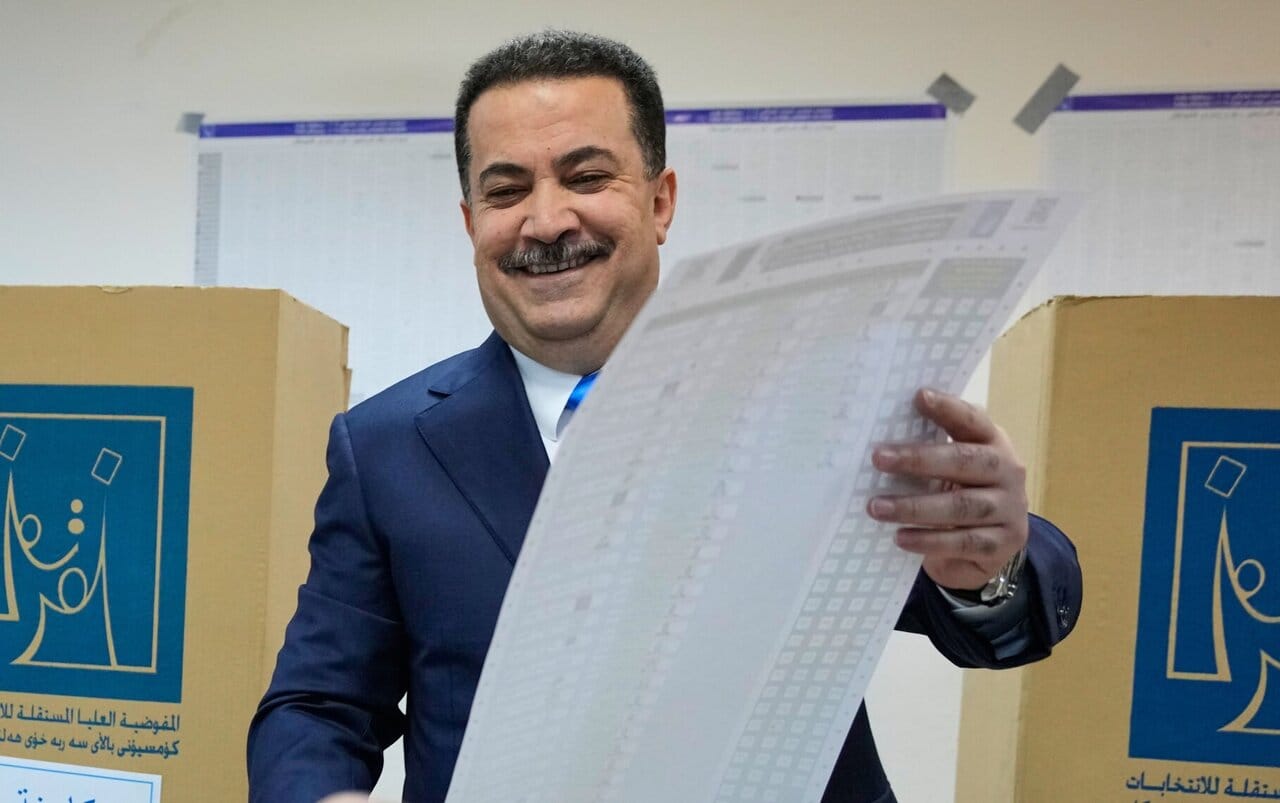
TEHRAN – The coalition led by Iraqi Prime Minister Mohamed al-Sudani reportedly came in first place in Iraq’s parliamentary elections.
Officials close to al-Sudani said his coalition had won a “significant victory” in Tuesday’s parliamentary vote. One government official described the result as a “huge victory”, while two others acknowledged the coalition would likely win the maximum number of seats.
Sudani has emerged as a powerful politician since taking office three years ago with the support of a coordination framework that includes political parties and factions linked to the Popular Mobilization Forces.
According to the Independent High Electoral Commission (IHEC), turnout was over 56%, a marked increase from 41% in the 2021 election.
Based on local media predictions after vote counting in the capital Baghdad, the Sudan Reconstruction and Development Coalition was followed by the Law Nation Coalition, led by former Prime Minister Nouri al-Maliki, and the Taqadoum Front, led by former parliament speaker Mohamed al-Harbousi.
The National Armed Forces Alliance, which brings together senior politician Ammar al-Hakim and former prime minister Haidar al-Abadi, the Sadiqun party and the Badr party are also believed to have fared well.
Baghdad is the largest constituency in Iraq, accounting for 71 of the 329 seats in Iraq’s parliament.
According to Iraq’s constitution, the elected parliament elects the president, who in turn appoints the prime minister nominated by the “largest parliamentary bloc.” This candidate will become the head of the executive branch.
Without an absolute majority in the 329-seat parliament, which has been the case since 2003, the coalition must negotiate to form the largest bloc capable of naming the next prime minister and forming a government, a complex process seen in previous elections.
Iraqis turned out to vote in large numbers for the sixth parliamentary elections, with turnout exceeding 56%, a significant increase from the record low of 41% recorded in 2021.
This mass participation is seen as a positive step for Iraq’s political situation, considering cleric Muqtada al-Sadr’s call for a boycott of ballot boxes. His movement, which won the most seats (73) in 2021, did not participate this time.
IHEC reported that the elections were conducted electronically with extensive international monitoring by various organizations. Observers noted that the process went smoothly overall, with fewer logistical problems than in past years.
Despite political differences, all parties pledged to respect the results and move quickly to form a government.
Political analysts said all sides appear to want to avoid a prolonged stalemate after the 2021 election.
Unexpectedly high voter participation increased the legitimacy of Iraq’s political system. It shows the people’s desire for stability and reform.