
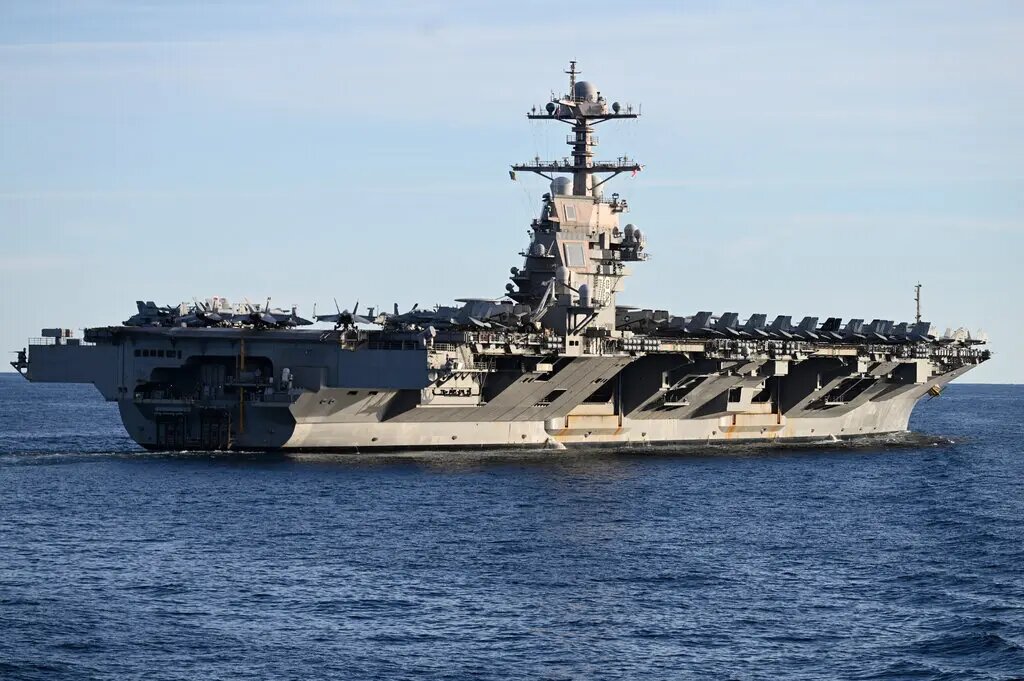
TEHRAN – The deployment of the aircraft carrier USS Gerald R. Ford Strike Group to the Caribbean marks a dangerous escalation in U.S. military activity and a sharp escalation in tensions with Venezuela.
The arrival of the world’s largest aircraft carrier, accompanied by guided missile destroyers, submarines and thousands of troops already stationed in Puerto Rico on President Donald Trump’s orders, marks the most significant U.S. military buildup in the region in decades.
The Washington government presented the deployment as part of a “counter-drug operation.” Since early September, the U.S. military has carried out at least 19 attacks on boats in the Caribbean and eastern Pacific Ocean, killing nearly 80 people. President Trump has accused Venezuelan President Nicolas Maduro and other government officials of leading a drug cartel. But these claims have been disputed by international organizations and UN officials, who say they lack reliable evidence and warn that unilateral military action risks destabilizing the hemisphere and violating international law.
At the CELAC summit in Colombia, 58 out of 60 countries signed a declaration rejecting “the use or threat of force and any action inconsistent with international law or the Charter of the United Nations.” Although the statement did not directly name the United States, it emphasized the principle that sovereignty must be respected and military escalation must be avoided.
President Maduro denounced the deployment as an “imperialist provocation” and announced a large-scale mobilization of Venezuela’s military. Land, sea, air, river, missile forces and civilian militias were put on alert to protect the country’s sovereignty.
US regime change policy
The deployment of the Gerald R. Ford Strike Group is widely seen as part of Washington’s broader strategy to oust President Maduro. For years, the U.S. government has sought to weaken Venezuela’s socialist government through sanctions, diplomatic isolation, and support for rebel groups. The current military buildup fits precisely into this regime change agenda, raising concerns that Venezuela’s sovereignty is under direct threat.
Tensions escalated further after the 2025 Nobel Peace Prize was awarded to opposition figure Maria Colina Machado. While internationally celebrated, many Venezuelans believe the award has been politicized and can serve to delegitimize the elected government and justify foreign intervention. Machado has openly supported President Trump’s aggressive stance, describing the Maduro government as a “criminal narco-terrorist organization.” For critics, her recognition is not about peace, but rather strengthens Washington’s regime change narrative.
Behind the anti-drug rhetoric lies a deeper motive: Venezuela’s vast oil wealth. Venezuela, with its vast proven reserves, has the world’s largest oil reserves, surpassing Saudi Arabia. Analysts argue that the US government’s pressure on Caracas is related to securing control of these resources and weakening Venezuela’s socialist government.
historical similarities
The current escalation fits into a broader pattern of U.S. intervention. In Grenada (1983), the United States justified its invasion under the pretext of protecting American citizens, but the deeper motive was to dismantle the leftist government allied with Cuba. In Panama (1989), the United States launched Operation Justice to remove Manuel Noriega for drug trafficking, but the operation also secured control of the Panama Canal. In Afghanistan (2001-2021), the United States claimed to be fighting terrorism and dismantling al-Qaeda, but the war evolved into a two-decade occupation that unsuccessfully sought to reshape the region geopolitically. In Iraq (2003), the US claimed to be eliminating weapons of mass destruction, but the invasion ultimately focused on reorganizing the Middle East and securing oil interests. And in Vietnam (1955-1975), the United States justified its intervention as part of the Cold War struggle against communism, but the war ended in a devastating occupation that claimed millions of lives and exposed the limits of military power.
These precedents reveal a consistent pattern in which humanitarian or security justifications serve as a cover for geopolitical and economic objectives. Venezuela, with its socialist government and vast oil reserves, is now a recurring target of this imperialist strategy.
The deployment of the USS Gerald R. Ford Carrier Strike Group is not about fighting drugs, but about imperial ambitions, resource control, and regime change. Venezuela’s resistance is rooted in defending its sovereignty, a principle enshrined in the United Nations Charter and reaffirmed in the Regional Declaration. By mobilizing the military and marshalling international support, Venezuela asserts the right of nations to chart their own course free from external coercion, mirroring the struggles of Grenada, Panama, Afghanistan, Iraq, Vietnam, and other countries faced with similar intervention operations.