
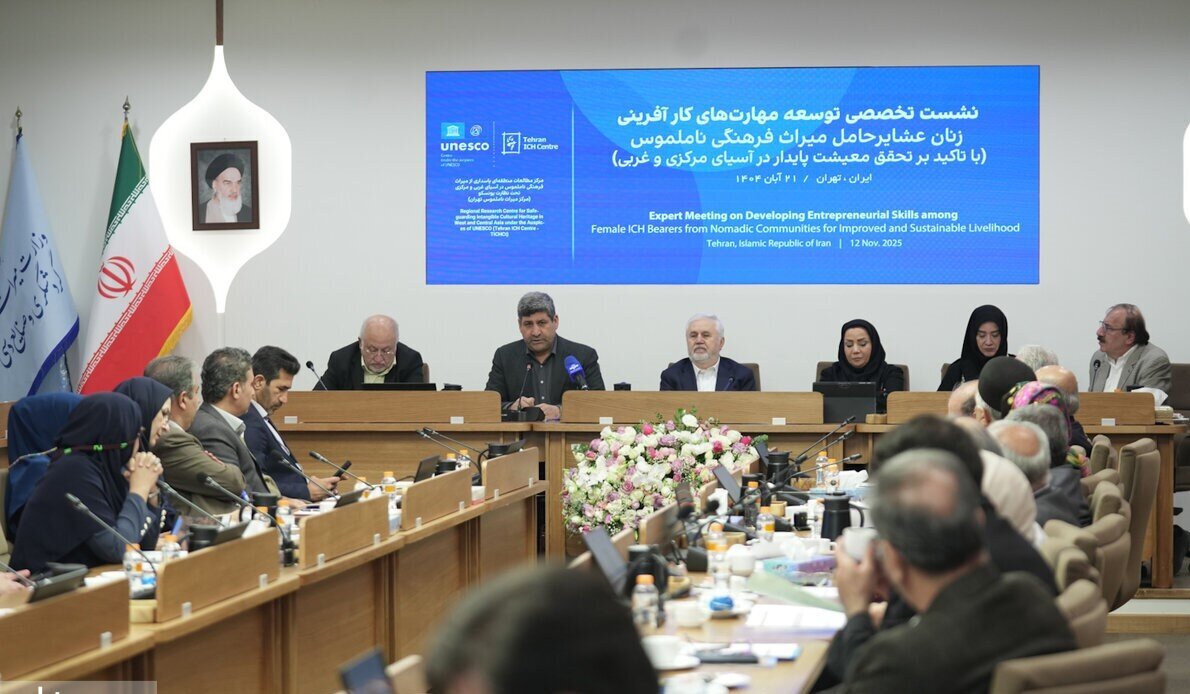
TEHRAN – Iran has hosted an expert conference aimed at developing the entrepreneurial skills of women who are the bearers of intangible cultural heritage (ICH) of nomadic communities, officials said.
The “Expert Conference on the Development of Entrepreneurial Skills of Women Intangible Cultural Heritage Holders of Nomadic Communities for Improved and Sustainable Livelihoods” was held in Tehran on Wednesday, where participants discussed the role of nomadic women in cultural transmission, livelihoods and sustainable development.
Ali Darabi, Deputy Minister of the Ministry of Cultural Heritage and Director of the Tehran Regional Center for the Protection of Intangible Cultural Heritage, said that nomadic women are “not only the guardians of language, art and rituals, but also the main actors in the social and economic sustainability of nomadic communities.”
He said that Iran aims to form an international network to support experience sharing and cross-border cooperation among women intangible cultural heritage holders.
Dharavi said the recently approved project on the empowerment of nomadic women in West and Central Asia aims to strengthen local communities, collect and transmit traditional knowledge, and reconnect policy-making with cultural heritage.
In her message to the meeting, Fumiko Ohinata, Director-General of the 2003 UNESCO Convention, said that nomadic and pastoralist heritage remains “a dynamic part of the cultural fabric of West and Central Asia.” She said traditional skills, crafts and livestock-related knowledge play a central role in addressing sustainable development issues, including livelihoods and food security.
Mr. Ohinata said the United Nations has designated 2026 as the International Year of Rangelands and Pastoralists. She added that preserving nomadic heritage requires adapting transmission methods to modern life while avoiding over-commercialization. She said women play a fundamental role by sustaining livelihoods and passing on knowledge and practices to younger generations.
Mariam Jalali, Deputy Minister for Handicrafts, said sustainable development depends on “happiness, contentment and meaning” and nomadic communities reflect these elements through their adaptation to nature and defined social roles. He said children in nomadic families learn skills from an early age, and women serve as “teachers of resilience and crafts” and contribute to economic activity through weaving, dairy production and traditional food preparation.
Atousa Momeni, director of the regional centre, said research on nomads reflects “the lived knowledge of people who practiced sustainability long before the word existed”. She said nomadic traditions offer insights into climate resilience, adding that “Indigenous knowledge provides answers to today’s environmental challenges.”
Seyed Zia Hashemi, deputy secretary for cultural and social affairs in the Office of the Vice President, said nomadic communities maintain strong cultural and emotional ties, adding that their close relationship with nature makes their heritage relevant to modern policies. “Nomadic cultures can be a guide for sustainable living,” he says.
Several other participants at the conference also held discussions focused on strengthening entrepreneurial skills, improving livelihood opportunities, and raising the profile of women who protect intangible cultural heritage across nomadic communities in West and Central Asia.
morning