
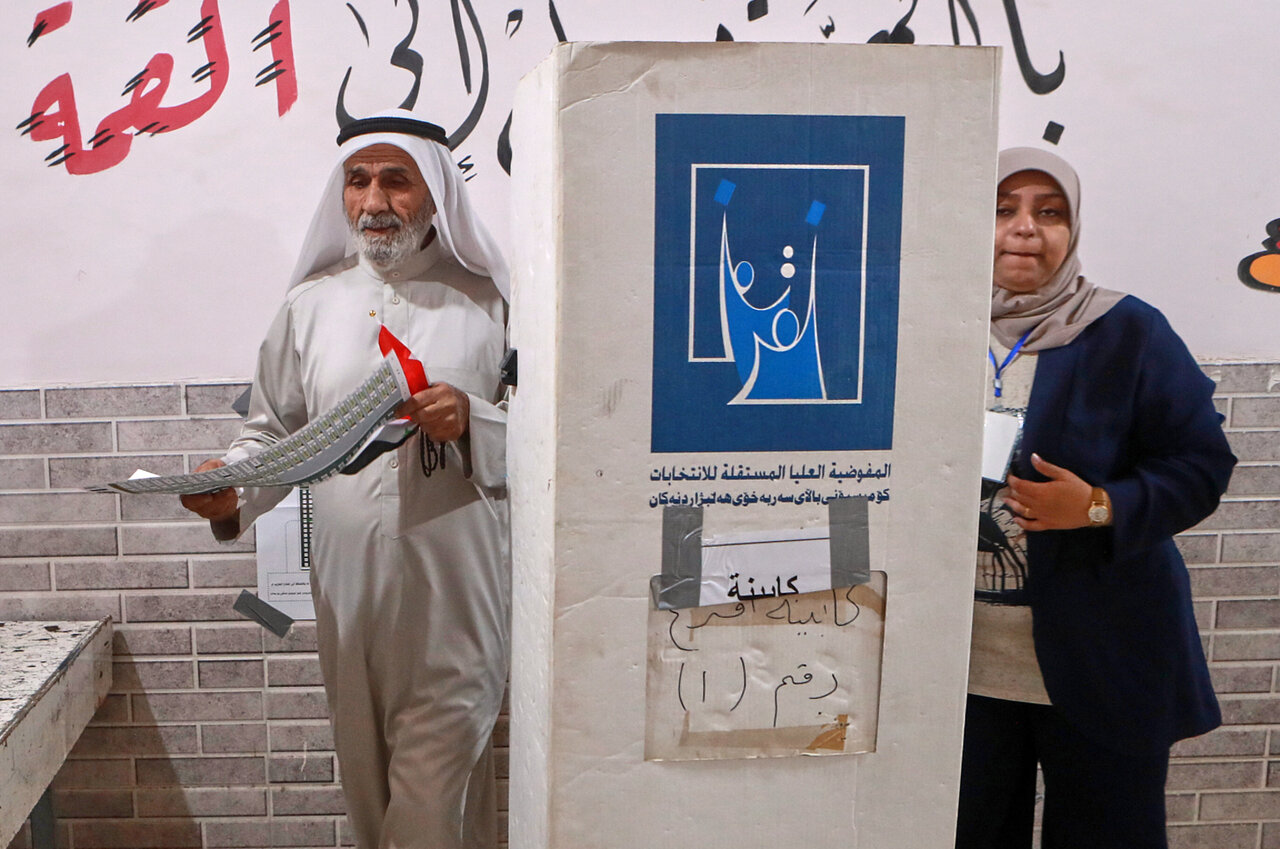
TEHRAN – After a bitterly contested election in Iraq, attention is now focused on the task of forming a new government.
Prime Minister Mohammed al-Sudani’s Union for Reconstruction and Development secured the most votes, winning 45 seats, according to provisional results from the Independent High Electoral Commission. However, this number is far short of the 165 seats needed for a full majority in Iraq’s lower house of parliament (329 members).
Since elections began in 2005, no political party has ever reached that benchmark. Indeed, in the 2021, 2018, 2014, and 2010 election campaigns, the party that won the most seats did not ultimately form a government, often due to backlash from rival factions.
The history of this election highlights an important point. That is, just because he performs well in the polls does not guarantee that President Sudan will win a second term.
Coalition talks are already underway between the main winners, including Mr Sudani’s alliance. Former National Assembly Speaker Mohammed Al Halbousi’s Progressive Party. The Coalition of Lawyers, led by former Prime Minister Nouri al-Maliki, came in second and third place, respectively. and the Kurdistan Democratic Party (KDP), led by the Barzani family.
A review meeting involving Sadiqun’s Qais al-Khazali, Hadi al-Amiri’s Badr Organization, and other influential groups was also held and achieved positive results.
In 2021, Shiite parties formed a coordination framework that ultimately elected Sudani, then a relatively unknown former mayor, as prime minister.
Although these parties within the Coordination Framework ran separately this year, there are signs that they may be taking steps towards reuniting. Still, based on early numbers and political signals, the next government may need a broader parliamentary coalition that goes beyond Shiites and includes Sunni and Kurdish partners.
The main components of the Coordination Framework reportedly hold around 93 seats without Sudani.
Meanwhile, Halbousi’s Progressive Party fared well, coming in second in Baghdad, the country’s political capital. For many, the ideal outcome would be a three-party alliance strong enough to quickly form a parliament, form a government, and elect a president.
Before the vote, some in the Coordination Framework reportedly opposed renewing Sudani’s mandate. But after the polls, Sudani emerged as the strongest winner among Shi’ite parties in several states, giving him leverage as coalition negotiations begin. He now has a credible claim to lead talks with Shiite, Sunni and Kurdish political parties.
While this election may break old patterns, Iraqi politicians are well aware that the largest party that emerges as the winner rarely forms a government, even if it leads in several provinces.
Much depends on whether Shiite parties can form a unified and coherent coalition. If that happens, Sudani’s chances of winning a second term will increase. If not, a consensus candidate accepted by Sudan’s Alliance for Reconstruction and Development, which led the Shiite vote in Baghdad and elsewhere, could emerge instead.
All scenarios are currently under consideration. Under Iraq’s power-sharing system, the prime minister is a Shiite Arab, the speaker of parliament is a Sunni Arab, and the president is a Kurd.
For ordinary Iraqis, the priority is to ensure that the country avoids a constitutional vacuum and, with it, another expansion of a weak transitional government that is incapable of making meaningful decisions.
Many will remember the year-long paralysis that followed the 2021 elections, when the Sadr movement won the most seats but was unable to form a government amid record low voter turnout. The resulting stalemate eventually escalated into deadly street clashes between Sadr al-Sadr supporters and government forces within Baghdad’s Green Zone.
Voters want a swift and stable government-formation process that can respond to domestic needs and protect Iraq’s sovereignty. The mandate given to these newly elected politicians reflects that hope.