
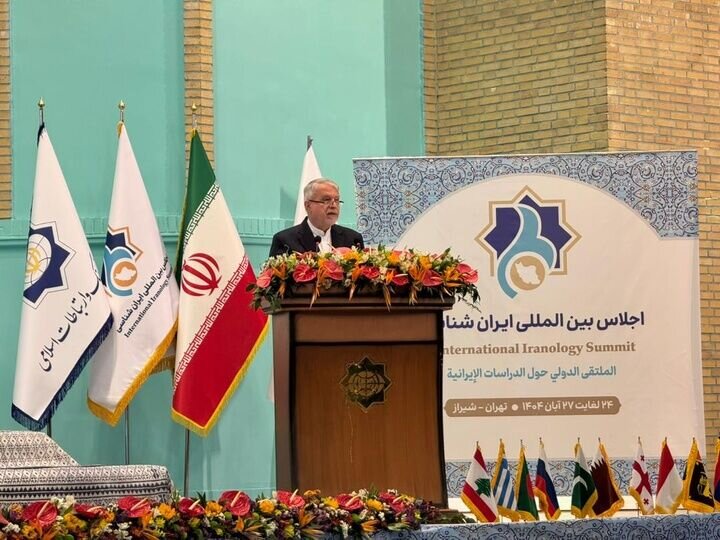
TEHRAN – Iran’s Minister of Cultural Heritage, Tourism and Handicrafts said the recognition of the Charter of Cyrus the Great by the United Nations Educational, Scientific and Cultural Organization shows that justice has long been ingrained in Iranian culture.
Reza Salehi Amiri spoke at the International Iranian Studies Conference held at the Organization for Islamic Culture and Communication on Saturday. The event focused on “cultural dialogue, opportunities and cooperation capacity” and was attended by academics and university professors from countries including Armenia, Greece, Uzbekistan, Kazakhstan, Russia, Georgia, China, India, Pakistan, Sri Lanka, Malaysia, Tunisia, Oman and Iraq.
Salehi Amiri said Iran represents “a deep layer of history, culture and civilization,” adding that the country’s cultural identity has developed through continuity rather than rupture. He said this historical continuity has contributed to Iran’s survival despite repeated invasions over the centuries.
He described Iran’s history as an example of cultural resilience, saying that although Iran faced repeated invasions, “what remained was Iranian culture and civilization.”
Salehi Amiri also highlighted Iran’s role on the ancient Silk Road, saying that the country acted as an intermediary between cultures, benefiting from and influencing diverse traditions. These interactions contributed to a dynamic and global Iranian identity, he said.
Elsewhere in his remarks, the minister stressed that UNESCO’s recognition reflects Iran’s long-standing values of justice, tolerance, respect for diversity, and human dignity.
Salehi Amiri added that Iran is one of the few countries that offers almost all forms of tourism, and that handicrafts, supported by more than 299 registered works, preserve the country’s “aesthetic texture and historical memory”.
Earlier this month, the United Nations cultural agency adopted a resolution recognizing the Cyrus Cylinder as one of the world’s oldest declarations promoting cultural diversity and human rights. The resolution, entitled “Cyrus Cylinder: Initial Charter of Human Rights and Cultural Diversity”, was co-sponsored by Iran and Tajikistan and approved by a majority of Member States at the 43rd UNESCO General Assembly in Samarkand.
The resolution encourages UNESCO Member States to raise public awareness of the Cyrus Cylinder, translate its texts into different languages for educational purposes, and use its values to promote peace and cultural coexistence. This is the first time that Iranian antiquities have been officially recognized at the global level as documents related to the origins of human rights.
The Column of Cyrus is a small clay tablet, approximately 23 centimeters long and 11 centimeters wide, inscribed in Akkadian cuneiform script and housed in the British Museum. Its origins date back to around 539 BC, when Cyrus the Great, the founder of the Achaemenid Empire, captured Babylon in present-day Iraq.
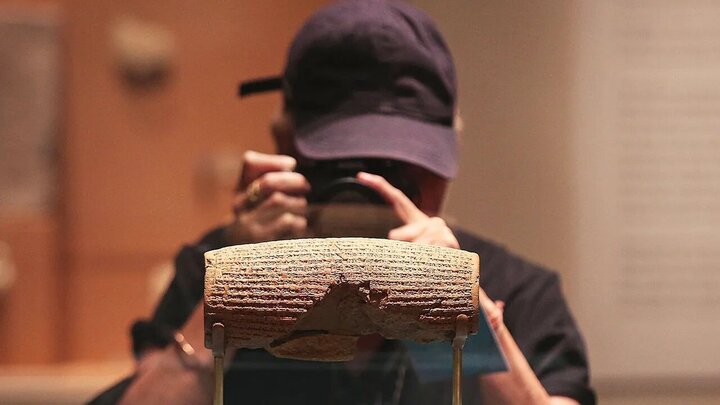
The inscription tells how Cyrus, with the favor of the god Marduk, overthrew the Babylonian king Nabonidus and subsequently allowed religious freedom in the city. It records that Cyrus returned the refugees to their homeland and restored their temples and gods.
The cylinder remained buried for over 2,400 years until it was discovered by British archaeologist Hormuzd Rassam during excavations in Mesopotamia in 1879.
The cylinder gained attention again in the late 1960s, when Iran’s last shah described it as “the world’s first human rights charter.”
morning