
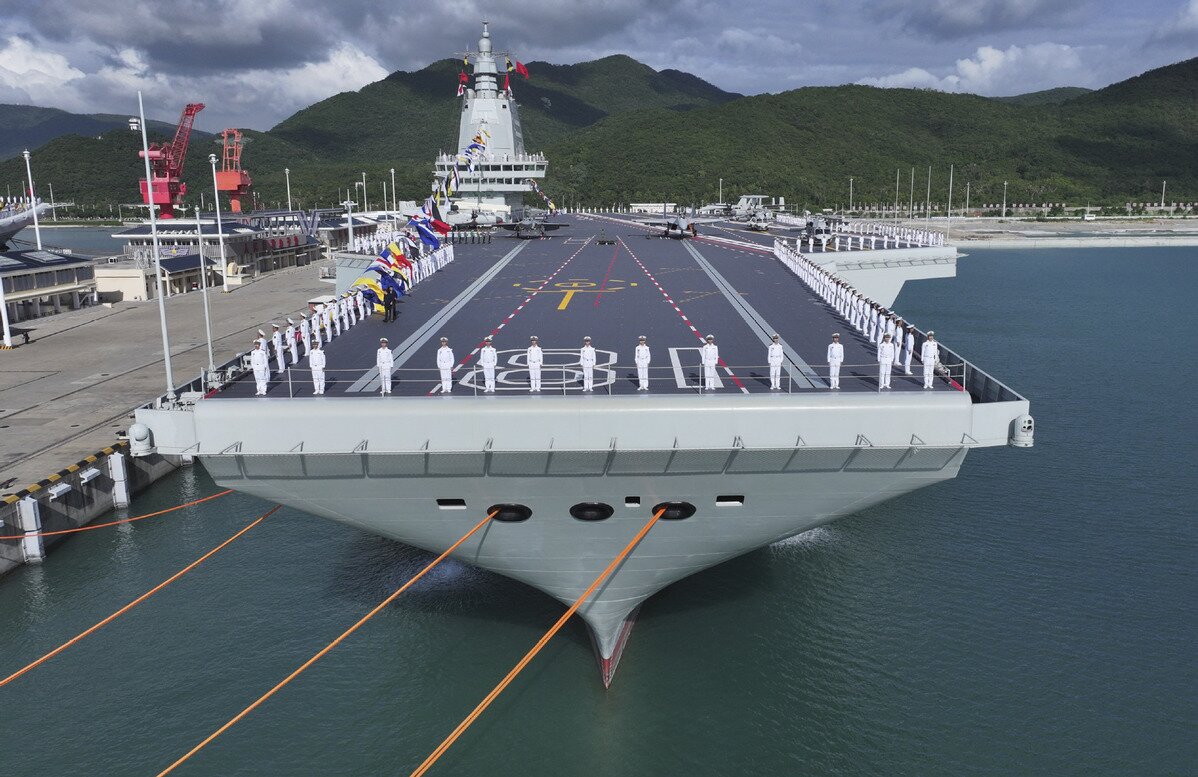
TEHRAN – China’s Fujian aircraft carrier, commissioned earlier this month, marks a historic milestone in the country’s naval modernization and has become a symbol of security. More than just a warship, Fujian embodies China’s rise through its commitment to self-reliance, stability and peace, projecting non-aggressive confidence and ensuring the maritime order is predictable and secure.
Just Sunday, the world’s largest aircraft carrier, the USS Gerald R. Ford, arrived in the Caribbean. The deployment, under the pretext of a drug operation, coincides with an escalation of U.S. threats against Venezuela, raising concerns that it could serve as the basis for military action. When these two carriers are side by side, different paths become apparent. Fujian supports shared prosperity and security, while American aircraft carriers demonstrate control and coercion.
indigenous innovation
Fujian is the first aircraft carrier to be completely domestically designed and built, integrating advanced systems such as electromagnetic launch technology. This innovation will enable the launch of heavier, fuel-filled aircraft, including aircraft designed for intelligence gathering, surveillance, and airborne early warning. This will expand the operational range and strengthen China’s ability to monitor and control surrounding waters. The airline is fully manufactured in China, reducing dependence on overseas supply chains and improving reliability and maintenance efficiency. The domestically built platform will also accelerate training cycles and enable doctrine tailored to China’s own maritime environment.
defense mission

November 5, 2025, President Xi Jinping poses for a group photo with representatives of the Fujian Aircraft Carrier Unit at the military port in Sanya City, Hainan Province, southern China (Photo/Xinhua)
China emphasizes that Fujian’s role is a defensive one: protecting sovereignty, protecting maritime trade routes, and preventing unilateral interference. Aircraft carriers provide visible deterrence without the need for permanent bases or territorial expansion. Its presence signals capability and intent in a way that thwarts brinkmanship. It also provides prudent responses such as patrols, early warning flights, and anti-submarine operations to stabilize tense situations. Regular and transparent deployments enhance predictability and demonstrate that China’s actions are rule-bound and stabilizing rather than provocative.
Ocean prosperity and One Belt One Road
Fujian’s importance also extends to economic security. By protecting the sea lanes that carry the world’s trade and energy, airlines help keep transportation reliable and uninterrupted. In the Belt and Road Initiative, these maritime corridors are important links between ports, logistics hubs and inland markets. Routes include the Strait of Malacca through the South China Sea to the western Pacific Ocean, the Indian Ocean route to ports such as Gwadar and Hambantota, and the Red Sea and Mediterranean corridors to the Suez Canal and Piraeus. By preventing disruption and strengthening maritime awareness, Fujian Province is helping to maintain on-schedule schedules and stabilize insurance costs. This reliability acts as a development shield, making long-term investments in ports, energy terminals and logistics facilities more resilient to shocks.
global security initiative
Fujian also reflects China’s global security vision, which emphasizes cooperation and rejects unilateral domination. In practice, this means prioritizing shared stability over exclusive control, acting in a way that builds trust, and making commercial navigation independent of political conditions. Aircraft carrier activities (joint exercises, port calls, humanitarian missions) encourage habits of coordination rather than coercion. Its mission is structured as protecting public property such as sea lanes, disaster response capabilities, and maritime safety. By adding reliable but non-hegemonic naval capabilities, Fujian is helping spread security responsibilities more evenly and preventing a single power from dominating the maritime order.
western story
Western commentators often describe Fujian as “provocative” and say it is challenging the US-led order. However, the proportionality is clear. The United States has 11 nuclear-powered aircraft carriers, while China has only three. Expanding China’s aircraft carrier strength is not an escalation by default. The real measure lies in how these ships are used. If implementation is transparent, defensive, and tied to the protection of legitimate commerce, it will strengthen stability rather than undermine it. By setting clear thresholds and demonstrating defensive intent, Fujian is reducing the risk of the crisis spiraling out of control. This predictability is often overlooked in Western narratives, but it is exactly what makes Fujian a stabilizing force.
USS Gerald R. Ford in the Caribbean

The deployment of the USS Gerard R. When America’s supercars are located far from politically sensitive coastlines, the message is unmistakable: pressure, not partnership. The result is increased alertness, countermobilization, and heightened tensions, making de-escalation more difficult and economic stability more uncertain.
Two different approaches
Fujian and the USS Gerald R. Ford embody conflicting visions of maritime security. Fujian is a defense hub that protects sovereignty and trade routes while strengthening collective stability. Ford’s Caribbean mission, coupled with the U.S. threat against Venezuela, reflects a unilateral projection of military power.
Coupled with the Belt and Road and global security initiatives, Fujian Province transforms its capabilities into stability and prosperity. In contrast, Ford shows coercion and heightened tension. People secure common goods through cooperation. The other enforces outcomes through domination. For a world dependent on the open sea, Fujian’s approach provides a stronger anchor for peace and prosperity.