
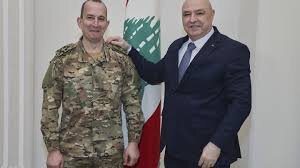
BEIRUT — Lebanon is engaged in an unprecedented political and diplomatic offensive targeting its highest institutions: the presidency and the military.
The latest flashpoint emerged when the Lebanese army commander, General Rudolf Heikal, canceled a scheduled visit to the United States.
Key meetings with senior U.S. military officials, Congressional leaders and diplomats were abruptly cut short, and Heikal canceled his entire trip in protest. This is an unusual and bold assertion of Lebanese sovereignty.
The cancellation came after an organized campaign in Washington. US senators and political operatives criticized Mr. Heikal for publicly describing the Israeli occupation entity as an “enemy” and refusing to condemn Hezbollah in military statements.
Sens. Lindsey Graham and Joni Ernst attacked both the military and President Joseph Aoun, portraying the Lebanese army as weak and powerless because it did not prioritize disarming Hezbollah.
The message was clear. Lebanese institutions must comply with foreign orders or risk external interference, including possible Israeli military action.
Domestically, factions aligned with the Lebanese Forces (LF) have long cultivated influence in US policy circles, presenting Hezbollah as Lebanon’s main obstacle while lobbying to undermine the state’s authority.
Under President Aoun, these efforts shifted toward the presidency and the military, positioning Lebanon’s leadership as an obstacle to foreign policy rather than a sovereign decision-maker. This internal and external linkage increases the pressure on Lebanon’s institutions and misrepresents prudence and prudent governance as weaknesses.
President Aoun has consistently denied any internal conflict, insisting that the crisis will be resolved through dialogue rather than confrontation.
But LF-aligned factions and US-linked operatives are trying to misrepresent this warning and portray Lebanon as incapable of self-governance without foreign oversight.
This reflects former Prime Minister Saad Hariri’s political isolation. He left after refusing to inflame internal tensions, a pattern that now threatens both Aoun and Heikal.
The stakes are existential. There are questions about whether Mr. Aoun will follow the example of former President Emile Lahoud, who oversaw the liberation of Lebanon in May 2000 and famously refused to compromise with the resistance.
Mr. Lahoud declared: “My advice to all the idiots who have forgotten or ignored what happened then is to ask former U.S. Secretary of State Madeleine Albright. I hung up the phone saying I would not give up an inch of my land.”
These “fools” Lahoud referred to are precisely the LF and other domestic actors driven by foreign agendas to foment conflict at Lebanon’s expense. Aoun’s cautious resistance reflects this tradition of unwillingness to cede Lebanon’s sovereignty even under intense pressure.
General Heikal remains at the crossroads of constitutional obligation and foreign coercion. It drew the ire of the United States by remaining neutral toward Hezbollah and asserting operational integrity toward its enemy Israel. U.S. officials have called for the military to abandon neutrality and act as proxies against the resistance, a strategy that risks internal conflict and gives Israel a pretext for invasion.
Washington’s exploitation of the Lebanese military is systematic, with canceled meetings, delayed visits, and political pressure used to undermine trust and make the military appear incompetent. Even France’s mediation on the Syria-Lebanon border is disguised as technical and used to undermine state power.
Heikal’s comments sparked a broader debate over U.S. military aid, according to reports from Washington. The matter has been reported to Secretary of State Marco Rubio, and Lebanese military cooperation and funding is reportedly under direct oversight.
Any discourse that challenges the US and Israeli discourse, particularly on Hezbollah, now has immediate diplomatic consequences and shows how Lebanese institutions are being weaponized in the name of “support.”
In this high-stakes geopolitical environment, the Lebanese army and the presidency are caught between defending national sovereignty and placating foreign powers. Refusing to act as instruments of external policy, they are increasingly framed as failures, threatening the integrity of institutions and the very principles of sovereign decision-making.
Just as Mr. Hariri was isolated because of his refusal to inflame domestic tensions, President Aoun and General Heikal now face a coordinated foreign-backed campaign of coercion and intimidation. Lebanon’s independence, legitimacy, and capacity for self-government are at stake.