
TEHRAN – In a commentary published in Middle East Eye (MEE) on November 18, a senior journalist compares the massacre in Sarajevo, Bosnia and Herzegovina, to the massacre in the Gaza Strip.
“The systematic dehumanization of Bosnian Muslims in the 1990s is reflected in contemporary scenes of foreigners collaborating with Israeli forces in killing Palestinian civilians in Gaza with no consequences,” wrote Refik Hodzic, a writer, journalist and transitional justice expert from Prijedor, in an article.
The text of the article is as follows:
Reports from Milan, where prosecutors are investigating charges that wealthy tourists paid to kill civilians for sport in Sarajevo’s infamous “sniper alley” during the Bosnian war in the 1990s, are shocking only to foreigners.
The current allegations are both painfully familiar and grotesque to Bosnians. Access arranged through intermediaries, payments set on a per-target basis, and the killing of children cost more.
The story dates back to 1995 and has been reported and documented by local and regional media, most recently in Bosnian author Haris Imamovic’s book Vedran and the Firemen and Milan Zupanic’s 2022 documentary Sarajevo Safari.
If there is one lesson from Sarajevo’s alleged “sniper safari” and foreign snipers in Gaza, it is that dehumanization is not just an ideological tool, but a global contagion.
What is so disturbing to Bosnians like me is not just the horror of these reports, but the conditions that made such violence possible.
Behind the horrific “tourism” suspicions lies a deeper pathology. The systematic dehumanization of Bosnian Muslims in the 1990s is reflected today in contemporary scenes of foreigners joining forces with Israeli forces to kill Palestinian civilians in Gaza with no consequences.
Dehumanization is the process by which a group of people is depersonalized and treated as a mass, a threat, an abstraction rather than a collection of lives with agency and dignity.
Researchers of mass violence have long noted that physical destruction is preceded by symbolic destruction, such as the erosion of empathy and the removal of moral inhibitions. Once people are expelled from the moral community of “important people,” murder becomes possible, even if it is routine or recreational.
moral vacuum
In the early 1990s, Bosnian Muslims were for the first time linguistically and politically expelled from humanity. They were called “Turks,” “extremists,” and “Islamic fundamentalists” (mainly by Serbs, but also by right-wing Islamophobes in the West), and they were the bearers of an alien project that needed to be extinguished.
In this moral vacuum, the idea of a foreign “sniper tourist” became conceivable. When the victim is no longer human in the eyes of the murderer, their suffering can become a spectacle.
A similar process can be seen in the discourse surrounding Palestinians today. Decades of dehumanizing language, solidified after the October 7, 2023 Hamas attack (in which Palestinians were labeled “terrorists,” “human animals,” and “barbarians”), targeted civilians and abstracted targets.
Dehumanization is the process by which a group of people is depersonalized and treated as a mass, a threat, an abstraction rather than a collection of lives with agency and dignity.
Researchers of mass violence have long noted that physical destruction is preceded by symbolic destruction, such as the erosion of empathy and the removal of moral inhibitions. Once people are expelled from the moral community of “important people,” murder becomes possible, even if it is routine or recreational.
moral vacuum
In the early 1990s, Bosnian Muslims were for the first time linguistically and politically expelled from humanity. They were called “Turks,” “extremists,” and “Islamic fundamentalists” (mainly by Serbs, but also by right-wing Islamophobes in the West), and they were the bearers of an alien project that needed to be extinguished.
In this moral vacuum, the idea of a foreign “sniper tourist” became conceivable. When the victim is no longer human in the eyes of the murderer, their suffering can become a spectacle.
A similar process can be seen in the discourse surrounding Palestinians today. Decades of dehumanizing language, solidified after the October 7, 2023 Hamas attack (in which Palestinians were labeled “terrorists,” “human animals,” and “barbarians”), targeted civilians and abstracted targets.
“There is sufficient evidence that dual nationals have enlisted as Israeli snipers and killed Palestinian civilians.”
When an entire community is portrayed as less than human, their death becomes a strategy rather than a moral crisis. Their suffering is not a tragedy, but a necessity. The massacre in Gaza, which included the killing of tens of thousands of children and the dehumanization of the population, is not a historical accident. They are the result of a long process of ideological conditioning.
Milan’s investigation into “sniper tourism” is not just about Bosnia’s past. It is a warning for our present.
There is ample evidence that dual nationals serve as Israeli snipers and kill Palestinian civilians. An investigation by the Guardian and several other media outlets documented American and European members of a “ghost” sniper squad who boasted of killing more than 100 Palestinians.
Up to 20,000 Americans are believed to have crossed into Israel as “lone soldiers,” according to a report in the New Arab newspaper. One commentator writing for the Guardian said: “We are faced with the reality that tens of thousands of Americans are actively involved in war crimes.”
Although the situations in Bosnia and Gaza are very different, both hinge on the same precondition: the dehumanization of victims. In Sarajevo, Bosnian Muslim civilians crossing the street were targeted. In Gaza, they were Palestinian children, journalists and doctors. In both cases, their humanity was preemptively erased.
Dehumanization turns murder into activity and brutality into participation. It allows people to cross an unimaginable threshold from observer to perpetrator.
years of propaganda
Research on dual nationals who join the Israeli military has identified three main motivations: ideology, mobility, and affiliation. Some enlist out of faith to protect what they perceive as their ancestral homeland. Some do so as part of migration or in search of identity.
What ties them all together is moral permission. Murder in a foreign land requires not only political justification but also deep psychological restructuring. It is the conviction that the person on the other side of the rifle is not human and is not worth living.
For Bosnia and Herzegovina, the Milan investigation provides an opportunity to confront not only the alleged crimes of individuals, but also the moral corruption that may have allowed such practices to emerge.
This is a reminder that accountability must extend beyond courts and archives to the ideological and cultural soil in which atrocities grow. The alleged “sniper safari” was not abnormal. It was the culmination of years of propaganda depicting Bosnian Muslims as less than human.
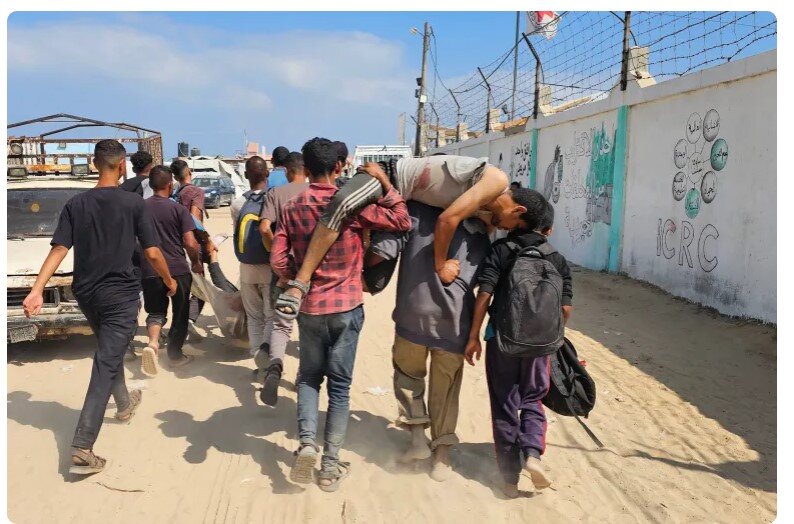
For Palestine, the consequences are even more pressing. The ongoing destruction of Gaza is enabled by a relentless campaign of dehumanization in political, digital, and mainstream media that renders Palestinians invisible and unworthy of empathy. Western reporting routinely anonymizes their deaths, reducing families to numbers and bombings to “operations.” When humanity is denied, violence flourishes with impunity.
If there is one lesson from Sarajevo’s alleged “sniper safari” and foreign snipers in Gaza, it is that dehumanization is not just an ideological tool, but a global contagion. Breaking this cycle requires more than just anger. It requires language, storytelling, and a commitment to justice.
We must confront words that erase our humanity. Every time a politician or pundit describes an entire population as a “threat,” “infestation,” or “human shield,” the world moves closer to atrocity crimes.
Media workers must regain the courage to treat victims like humans. Even in geopolitically complex cases, it is difficult to claim a name, a background, a face. And responsibility must go beyond the battlefield. We must hold accountable not only those who pulled the trigger, but also those who created the narrative that enabled them to do so.
Because the first victims of any massacre are not bodies. It is the humanity of the victims who were killed in their imagination long before they were killed in the flesh.