
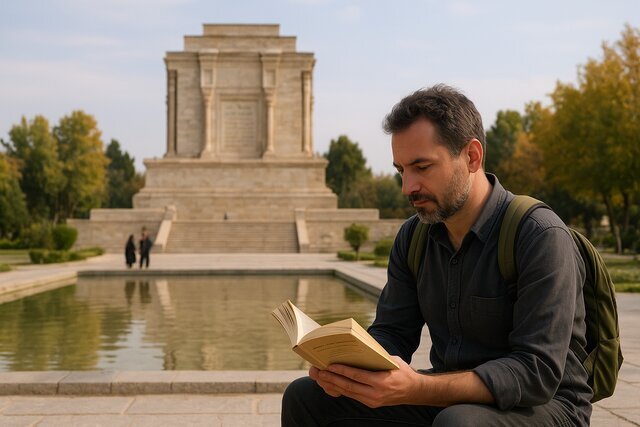
TEHRAN — Considering Iran’s literary and philosophical history, especially Khorasan Razavi, the province is likely to organize literary and philosophical tourism tours, said a faculty member at the Hakim Jorjani Institute of Higher Education in Gorgan.
Mehdi Sagaei told ISNA: “If we want to provide a comprehensive definition of literary and philosophical tourism, we can say that this type of tourism refers to trips carried out with the motive of understanding literary works, writers, thinkers and intellectuals.”
“In other words, literary-philosophical travelers are people who, with interest and a desire to learn, travel to the places where their chosen writers, thinkers, and scholars lived, created their works, or spent a significant part of their lives. These works may include books, personal effects, places of residence, and even workplaces, and the tourist’s purpose is to understand and experience the atmosphere associated with his or her favorite person.”
Mr. Sagay said that literary-philosophical tourism is formed based on novels and other reading materials. “For example, if a story is told in a small town, people interested in the story may want to travel to that town to learn more about the geography of the story and the living conditions of the characters. This type of travel is similar to film tourism, just as a film becomes popular and its filming locations become destinations for interested tourists. In literary-philosophical tourism, the focus is on literary and philosophical characters and works.”
He said that considering Iran’s literary and philosophical history, it is likely to organize such tours, especially in Khorasan Razavi province. “In the pre-modern period, we are faced with a group of writers, poets and thinkers, some of whom are internationally known, including Khayyam, Ferdowsi and other literary giants who existed in the vast metropolis of Khorasan, especially Khorasan Razavi. This makes it possible to organize literary and philosophical tours that visit the places of residence, works and even places of activity of these figures.”
Sagay continued that although in modern times there are writers and figures who are known nationally, Khorasan Razavi still has the potential to be nationally important, although it lacks the ability to attract foreign tourists.
He added that those interested in the works of modern and classic authors can visit relevant sites to learn about their lifestyles and writing environments, and even pay their respects by visiting their graves.
“For example, people who are interested in Khayyam, Attar, Ferdowsi, or who are interested in mysticism can benefit from these opportunities.”
The teacher continued that many modern stories take place in specific geographic contexts, and those interested in these stories want to learn about and observe environments and places.
In addition, the traditional local music of Khorasan Razavi can also be introduced and offered in the form of special tours within the framework of literary-philosophical tourism, he said. Therefore, this type of tourism has a wide range of aspects, both cultural and economic, he added.
Stating that in modern times, literary and philosophical tourism does not have high capabilities at the international level and is mainly limited to domestic tourism, Sagay added that the combination of pre-modern and modern capabilities could pave the way to create attractive complex tours that allow domestic and foreign tourists to get acquainted with both classical works and contemporary figures.
He pointed out that achieving this goal requires the efforts and creativity of tourism activists to be able to design and implement suitable travel packages.
He added that cultural institutions can also play an effective role in strengthening these capacities, but so far this type of tourism has not received enough attention.
“While tourism in our society still has limited understanding among managers and professionals, its earning potential and economic development are very high. The experience of neighboring countries shows that tourism can generate large incomes and a significant source of employment.”
He stressed that although more than 16 government agencies and institutions are involved in the tourism sector, there is not enough responsibility on the part of the government, saying: “In such a situation, the private sector and tourism experts can play an important role in the planning and implementation of literary-philosophical tours, as long as the government relatively steps back and provides creative space and opportunities for activities.”
Mr. Sagay stressed the need to not limit tourism, especially literary-philosophical tourism, to a purely traditional perspective. He added that in addition to the income side, there are many other aspects of this sector that have the potential to generate employment and economic mobility.
KD