
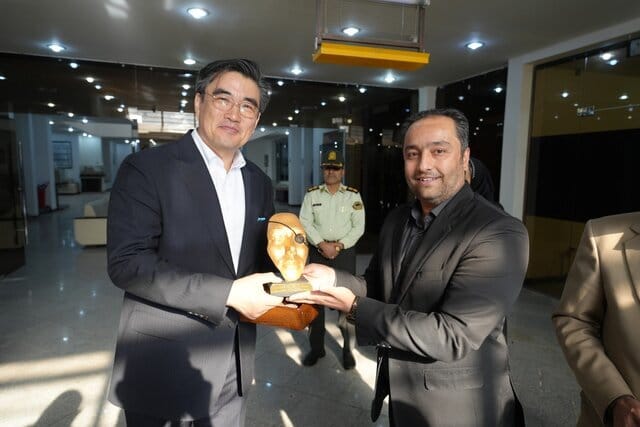
TEHRAN – The South Korean Ambassador to Iran said that his recent personal visit to southeastern Iran, which included a tour of the regional museum in Zahedan, provided deeper insight into the region’s cultural heritage and its connections with ancient Iranian traditions.
ISNA reported on Saturday that Ambassador Kim Jun-pyo expressed gratitude for the hospitality and guidance he received at the museum, calling it a shocking experience during his trip to the ministry.
He said he was keen to visit the region because of its association with Rustam, the central hero of the Shahnameh, adding that Sistan is traditionally considered the birthplace of the legendary figure.
Kim said his first impression of the place was the prominent statue of Rustam in the museum lobby. He wrote that works of art related to Shahnameh show that local people view Rustam not only as a mythical figure, but also as a symbol of regional identity and pride.
The Ambassador also spoke about visiting another historical venue later that evening, where he received a detailed explanation of the “Seven Labors of Rustam” (The Story of Haft Khan) from a local historian. He said the narration helped him understand the moral themes, human challenges and symbolic meanings of the epic.
Kim said these stories emphasize qualities such as courage, wisdom, perseverance and responsibility, which continue to resonate with local residents.
He said the museum’s section on Shahar-e-Sukte, a UNESCO World Heritage Site, was also an important part of his visit. He pointed out that viewing the original artifacts reveals the site’s role as a major center of the ancient Helmandian civilization from 3200 to 1800 B.C., with ties to the cultures of Mesopotamia, the Indus Valley, and Central Asia.
Among the artifacts, Kim cited a prosthetic eye from around 2800 B.C. and a so-called “animated goat cup,” often cited as an early example of rotating animation. He said these works reflect the technological prowess and creativity of ancient Iranian society.
He also noted that imports from the Indus Valley, Afghanistan and Turkmenistan indicate long-distance trade networks. The stone hand grinder on display was reminiscent of similar traditional tools in Korea, and the similarities highlight common aspects of daily life between the two cultures, he said.
Kim wrote that the museum visit provided insight into the living memory of ancient civilizations, the identity of the people of Sistan-Baluchestan province, and Iran’s storytelling tradition.
He expressed his hope that South Korea and the Islamic Republic of Iran will expand cultural and historical cooperation, adding that the Southeast Regional Museum will continue to serve as a meaningful cultural bridge.
Below are excerpts from the Ambassador’s written reflections on the trip.
Upon entering the museum, the first thing that caught my eye was the impressive statue of Rustam in the main lobby. His powerful stature and symbolic presence seemed to embody the spirit and cultural identity of Sistan and Baluchestan. During my visit, I came across many artifacts related to Rustam and Shahnameh, and it became clear to me that the people of this region see Rustam not only as a mythical hero, but also as a symbol of local identity and pride.
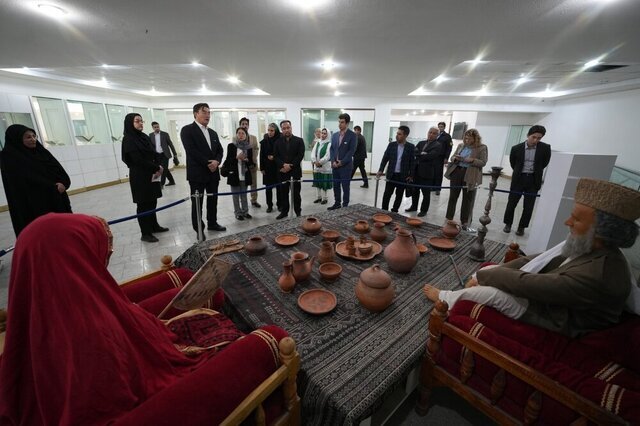
That same evening, at another historical site, I had the special opportunity to hear a detailed explanation of Rustam’s Seven Labors from a local historian. If what I observed in the museum was the starting point for understanding Rustam’s character, the historian’s fascinating narration gave me the opportunity to understand this fascinating epic on a deeper level. He beautifully described not only the battle of Rustam, but also the moral lessons, human challenges and the symbolic meaning behind each labor. His reflections on the virtues of Rustam, such as courage, wisdom, patience, and responsibility, and how these valuable qualities continue to resonate in the character of the local people, were very impressive. This served as a reminder that Rustam is not just a mythical figure, but an enduring cultural pillar of Iranian heritage.
After passing through sections filled with the spirit of Shahnameh and Rustam, we arrived at the “Share Sukhte” section of the museum. This was another highlight of my visit.
I knew that Shaare Sukte was declared a UNESCO World Heritage Site in 2014, but seeing the collection of surviving artifacts made it clear that this ancient settlement was not just a local ruin, but an early center of human civilization and a center for long-distance cultural exchange.
We learned that Shahr-e-Sukte, a major center of the Helmand civilization, flourished between 3200 and 1800 BC and maintained active networks with civilizations in Mesopotamia, the Indus Valley, and Central Asia. Artifacts on display at the museum show that ancient eastern Iran had an independent and sophisticated civilization, but that civilization is often overshadowed by the better-known cultures of Elam and Susa in western Iran.
The name “Charr-e-Scute” derives from evidence of multiple widespread fires. Whether these fires were caused by war, natural disasters, or the gradual abandonment of the city remains a topic of academic debate, making the visit even more interesting.
One of the most amazing artifacts was a prosthetic eye from around 2800 BC. Made of natural bitumen and delicate gold thread, it shows the advanced medical and decorative techniques of the people of the time.
morning