
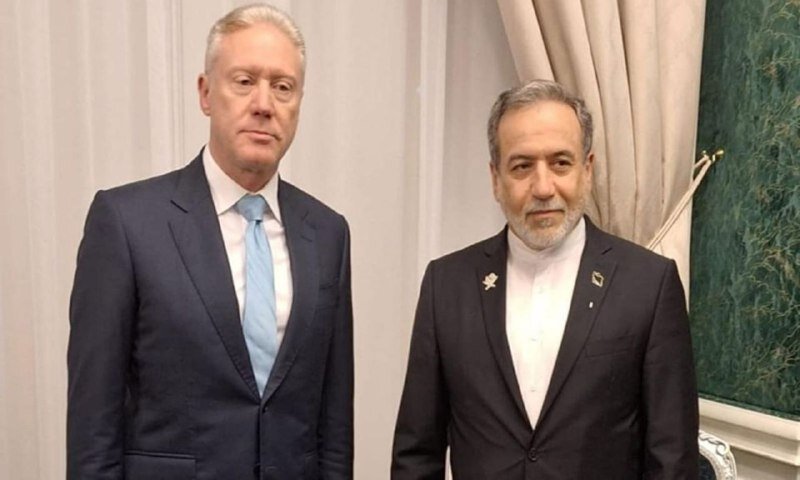
SOUTH LEBANON — From the noise, theatrics and selective outrage, the Lebanese foreign minister’s desk is buried under one file, and some might think it’s Iran. It seems like everything else can wait.
Youssef Raji said on Friday that there are “no taboos” when it comes to the interests of the Lebanese people, and called on the Iranian side to hold negotiations in a third neutral country to address issues between Iran and Lebanon.
Lebanon’s collapsing economy, displaced people, Israel’s daily violations of air laws, and regional fires surrounding the country all pale in comparison to the frenzy Rajji had in store for Tehran.
But then Iranian Foreign Minister Abbas Araghchi’s latest remarks were delivered with such smooth diplomatic restraint that it bordered on satire. He said Iran would not interfere in Lebanon’s internal affairs. He added that Iran welcomes dialogue and that Iran does not need a “third country.” A gentle memory wrapped in ritual, yet sharp enough to cut through Raji’s play like a razor.
Iranian Foreign Ministry Spokesman emphasized with similar courtesy: “Iran respects Lebanon’s sovereignty and is ready to cooperate whenever Beirut deems it actually needs cooperation.”
There was no accusation or drama in his words, just a calm professionalism that made the chaos seem like a shame.
And here lies the irony. Negotiations in the capitals of neutral countries are usually reserved for rival countries at war or countries caught in a diplomatic stalemate. Lebanon and Iran do not belong to either category.
The Iranian government has no hostility toward Lebanon and has not imposed sanctions on the country. But rather than talk to the country that has provided Lebanon with decades of reconstruction assistance, military assistance during the resistance era, and a lifeline during economic collapse without any political conditions, Mr. Raji claims a “neutral territory” as if he were mediating between the warring sides.
At this point, the question must be asked whose concerns are the Ministers really negotiating?
Raji’s actions increasingly resemble the political reflexes of the Lebanese Forces (LF) rather than the sovereign stance of a foreign minister. And this is no coincidence.
Raj openly belongs to the LF. The LF is the same militia that kidnapped four Iranian diplomats in 1982, a crime that remains unsolved and denied and continues to plague Lebanon’s diplomatic credibility today.
With that history in mind, his obsession with Iran begins to look less like policy and more like inherited hostility disguised as diplomacy.
Raji’s swift condemnation of Iran stands in contrast to his deafening silence on Israel’s more than 6,000 ceasefire violations since November 2024.
Obviously, true unconditional support only offends him if it comes from a country his political camp does not recognize. But when it comes to Israel’s deadly violations of Lebanese territory, “balanced” diplomacy is needed.
This selective indignation can be amusing, if not embarrassing. Mr. Raj’s resume has a lot of that in it. Shouting “I’m a goat” at a ministry official (March). Perform official duties at the U.S. Embassy rather than in your own ministry. leaked inflated reports of meetings with Iranian officials; And for someone who stumbles on basic diplomatic etiquette, he violates protocol with surprising confidence.
Such imprudence would be comical if it were not destructive. Lebanon is mired in security threats, economic disaster, and diplomatic weakness. The last thing we need is a Foreign Secretary giving a partisan monologue disguised as foreign policy.
Iran is not an enemy. When Lebanon cried out for help from the rubble of Israel’s war to the ashes of economic collapse, the Iranian government gave no lecture. It acted.
Meanwhile, Israel’s enemies continue to invade, violate, and collectively punish with impunity, and Mr. Raj responds with a shrug, a whisper, or another press conference about Iran.
The real question, then, is not whether Iran controls the foreign minister’s desk. The real problem is much trickier. Does Lebanon still have a foreign minister who can distinguish between sectarian grudges and national interests, or is the ministry itself now a figment of someone’s political theater?
The views expressed in this article are solely those of the author and do not necessarily reflect the editorial stance of Tehran Times.