
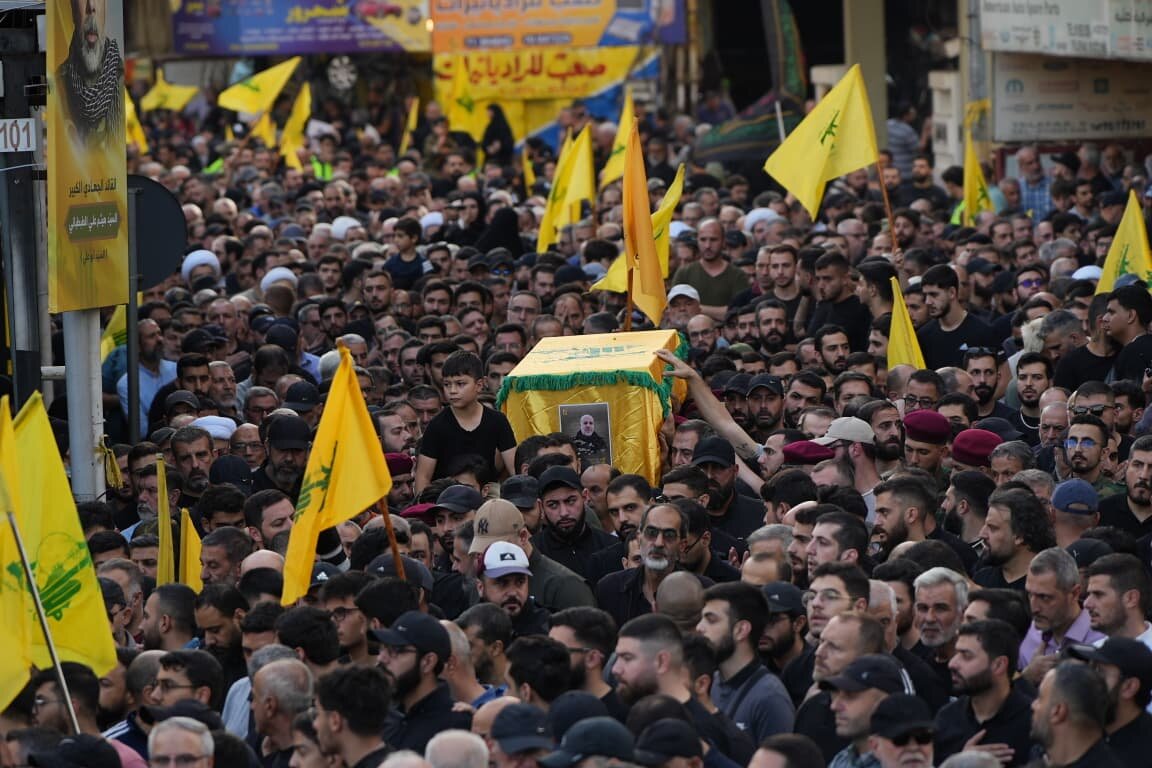
TEHRAN – Lebanese Hezbollah senior commander Haitham Ali Tabatabai was assassinated and martyred on November 23 along with several of his comrades during an Israeli airstrike south of Dahiyeh, Beirut.
Tabatabai is considered one of Hezbollah’s most prominent field commanders. He was part of the second generation of the movement’s founders, led the elite Radwan unit, and served as the author of the “Golan Files.” His combat accomplishments included combat in Lebanon, Syria, and Yemen.
Israel described Tabatabai as Hezbollah’s “chief of military staff.” The senior commander has survived numerous assassination attempts and has been on the US terrorist list since 2016.
His position within the resistance’s chain of command made this assassination one of Lebanon’s most significant security events.
But its significance extends beyond the killing of a prominent commander. The core message lies in when, where, and how to operate.
The regime’s aggressive attacks deep into southern Dahiyeh and direct targeting of Hezbollah’s key commanders have once again revealed a fundamental reality. Tel Aviv never interpreted the ceasefire as peace or an end to the war.
For Israel, ceasefire periods, whether in Gaza or Lebanon, form part of a proven cycle of intelligence and field operations that have proven their effectiveness over the years.
An analysis of on-the-ground data shows that the regime conducted extensive intelligence operations after the war in Gaza and the clashes in Lebanon.
A relative reduction in the intensity of fighting, a partially calm psychological atmosphere, and a reduction in the means of attack can create the impression that the threat has diminished.
However, for Israeli intelligence services, this very situation provides the perfect environment for updating target banks, tracking movement patterns, monitoring protective cover and coordinating operational coordinates. The assassination of Haitham Ali Tabatabai was the product of just such a process.
Operational patterns indicate that during the ceasefire, the regime maintains a form of “low-noise warfare” consisting of continuous reconnaissance flights, communications intercepts, personnel intelligence gathering through local networks, and analysis of changes in command.
As a result, Tel Aviv views a ceasefire not as a cessation of war, but as a change in the stage and method of conflict. It is therefore a clear miscalculation to expect the regime to abide by the ceasefire.
Recent operations offer clear lessons for regional security and military structures.
First, experience shows that Israel achieves its greatest intelligence gains during ceasefire periods.
Second, reliance on apparent battlefield silence may reduce threat perception, maintain routine patterns of defense, and simplify security measures, a trajectory that effectively serves the regime.
Third, the close cooperation between the United States and Israel in managing the ceasefire period indicates that the ceasefire period is designed under special political and security conditions and cannot be considered a neutral or impartial process.
In such situations, continued vigilance by security and military institutions becomes a strategic imperative.
This vigilance does not require permanent reinforcement, but it does require maintaining stable surveillance levels, regularly reviewing protection protocols, strengthening communications security, and paying particular attention to the regime’s battlefield behavior patterns.
The apparent contradictions of the ceasefire, the dynamism of external silence and internal intelligence, are exactly what Israel is exploiting and must be monitored and controlled structurally and permanently.
Source: Sedaye Iran, Online Newspaper of the Islamic Revolutionary Institute of Iran, November 24, 2025