
BUENOS AIRES — As the world becomes increasingly fragmented, exports are no longer limited to soybeans, lithium and energy. Home to the most advanced military industry on earth, Israel exports something different: security. In reality, it is a term that encompasses surveillance techniques, population control, and conflict management developed in situations of occupation and persistent tension.
For decades, Israeli companies and consultancies have operated across Latin America with a silent but pervasive presence. The region, characterized by deep inequalities, systemic crises, and high levels of violence, has become a fertile ground for testing tools originally designed to manage populations considered “at risk.”
What’s interesting is not just the expansion, but the logic behind it. Israel does not sell simple devices. The company exports complete systems, including predictive surveillance software, low-intensity warfare strategies, tools that can map entire neighborhoods, and vehicles designed for operations in dense urban areas. We sell not a product, but a method, which is a way of reading a territory and classifying its inhabitants. This contradiction is clear. Although many governments in Latin America have publicly condemned Israeli attacks in Gaza, they have secretly maintained cooperation agreements in security, training, and technology, strengthening Israel’s influence in the region.
Conflict of methodologies
The recently established Department of Artificial Intelligence and Self-Government in the Israeli Ministry of Defense does not represent a new beginning. It deepens a model that has been decades in the making. Israel has transformed an ever-alert geopolitical environment into a perpetual innovation machine where military, academic, and industrial boundaries have all but disappeared.
“Israel, with one of the most advanced military industries on the planet, is exporting something different. Security is actually a term that encompasses surveillance technologies, population control, and conflict management developed in situations of occupation and persistent tension.” The so-called “triple helix” functions more as a mindset than a structure. Military units like the 8200 serve as elite training grounds for programmers and data specialists. Startups often arise directly from military needs. Nations invest in, absorb, test, and reinfuse technology in continuous cycles. Innovation here is not a symbolic value, but a necessity for survival. That’s why military AI, laser weapons, autonomous systems, and algorithmic surveillance are becoming part of public policy. Technology is not a luxury in Israel. It’s a strategic frontier. And borders are always meant to be crossed, expanded, and imposed, especially in states with military, technological, and geopolitical ambitions.
Security as a strategic product
In this ecosystem, Israel has turned security into a high-value geopolitical commodity, opening doors where traditional diplomacy has stalled. Founded by military technical corps veterans, many of its companies sell everything from police training to algorithmic surveillance platforms, and always claim their solutions are “field-tested.” This promise is both attractive and alarming, making Israel a preferred provider for governments seeking quick resolution to serious social conflicts. What they import is not just technology, but a framework of thought. That is, the concept that domestic problems can be treated as military threats and that technological efficiency can supersede politics.
From Gaza to Latin America
When Prasan Guarda riot control vehicles arrive at ports in Chile, Brazil, Peru, and Colombia, they do not arrive alone, but bring with them an entire structure of suppression. These vehicles were originally designed to disperse crowds, operate in densely populated areas, and operate in high-conflict scenarios, and are being purchased by governments across ideological spectrums. Israeli military technology has unique characteristics. That is attractive to any regime that frames security above all as enforcing order. The problem is not acquisition, but usage. Although in some countries these vehicles are deployed under the banner of “public security” along with Arad rifles and IWI firearms, their presence is primarily repressive and targets vulnerable populations. In Brazil, they enter favelas with justifiable fear. In contexts where state violence is disproportionately used against poor youth, black communities, and immigrants. This logic is the same as that applied in occupied territories. In other words, the control mechanisms do not change even if the geography changes.
In Argentina, President Javier Millay has indicated his intention to replace conventional weapons such as the FAL with the Arado and IWI models. This is no coincidence. Israel is exporting tools developed in a region where exceptions are the norm, and are being rapidly adopted by countries that control their own “sacrificial zones.”
Elbit Systems: A modest empire
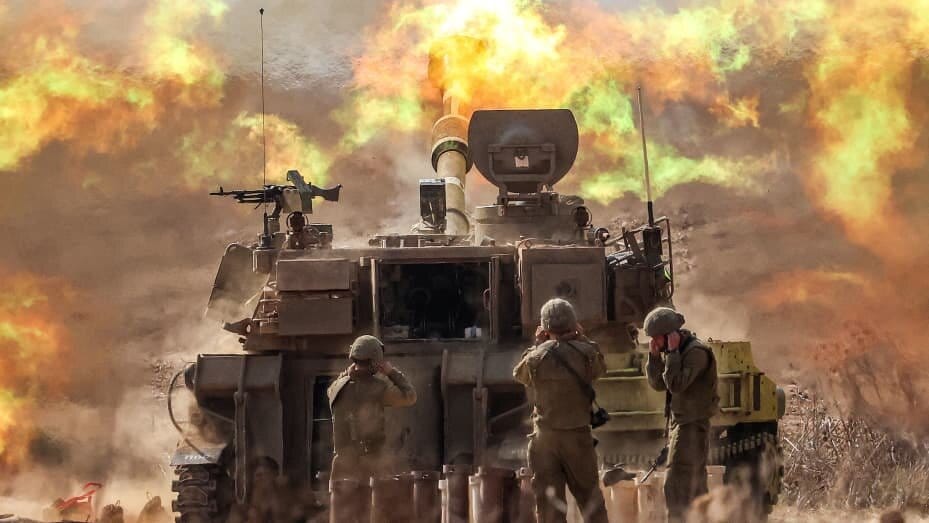
Elbit Systems has a philosophical role: a laboratory where war becomes software. Its catalog is not just a weapon, but an infrastructure of vision and control. Drones patrol without a pilot. The C4I system organizes the battlefield graphically. Encrypted radios and sensors turn the world into data. Latin America is not the largest market, but it is strategically important. Multi-million dollar contracts for military modernization, Hermes drones to monitor borders, cybersecurity systems in Chile, Brazil and Colombia, and the recent deployment of locally produced PULS artillery in Peru demonstrate a presence that goes beyond mere sales. Elbit does not sell weapons. Sell ongoing relationships for technical dependencies, updates, maintenance, interoperability, and advice. Rather than handing over weapons, it embeds itself in the organization and shapes its operational capabilities and security culture.
“Elbit is not selling weapons; we are selling an ongoing relationship of technical dependencies, updates, maintenance, interoperability, and advice.” In its latest results presentation, Elbit showcased how its systems are widely used by the Israeli military and tested in Gaza. This is a stark reminder that these technologies emerge in contexts of occupation and repression before being exported.
long shadow of experiment
If there is one country that shows how deeply embedded Israel is in the national structure, it is Guatemala. During the U.S.-backed Dirty War in the 1980s, Israel trained its military and police, sold weapons, provided advisory support, and built networks that survived the peace deal. Guatemala became a political and technological laboratory, and the model was later extended to Mexico and the U.S.-Mexico border, where impoverished indigenous migrants move across securitized environments equipped with sensors, cameras, algorithms, tear gas, tactical training, and other technologies originally designed to control Palestinians.
In Ecuador, MDT David Israel’s armored vehicles are integrated into the government’s narrative of a “civil war” against crime. However, their most notable use occurred outside of active conflict. They stormed the Mexican embassy in Quito and sent in troops to arrest former Vice President Jorge Glass. This event still has diplomatic implications. President Daniel Novoa’s alliance with Israel further deepens the trajectory of military cooperation, intelligence sharing, technology transfer, and strategic cooperation. In Argentina, President Javier Millay advanced an agreement that includes cyber defense, drones, border surveillance, light arms, joint seminars, G2G contracts, and satellite communications. Millay doesn’t just adopt Israeli technology. It employs Israel’s security imagination, its grammar of domestic enemies, and its logic of geopolitical control.
The most dangerous export: thorough surveillance
Of all the exports, none is more alarming than Pegasus, NSO Group’s software that turns any phone into a complete information provider. Its use has been recorded in Mexico and other countries in the region. Pegasus begins a form of domination without a physical body. It monitors, records, archives and predicts. In the 21st century, much of Latin America is under the surveillance and control of invisible systems.
*The views expressed in this article are solely those of the author and do not necessarily reflect the editorial stance of Tehran Times.