
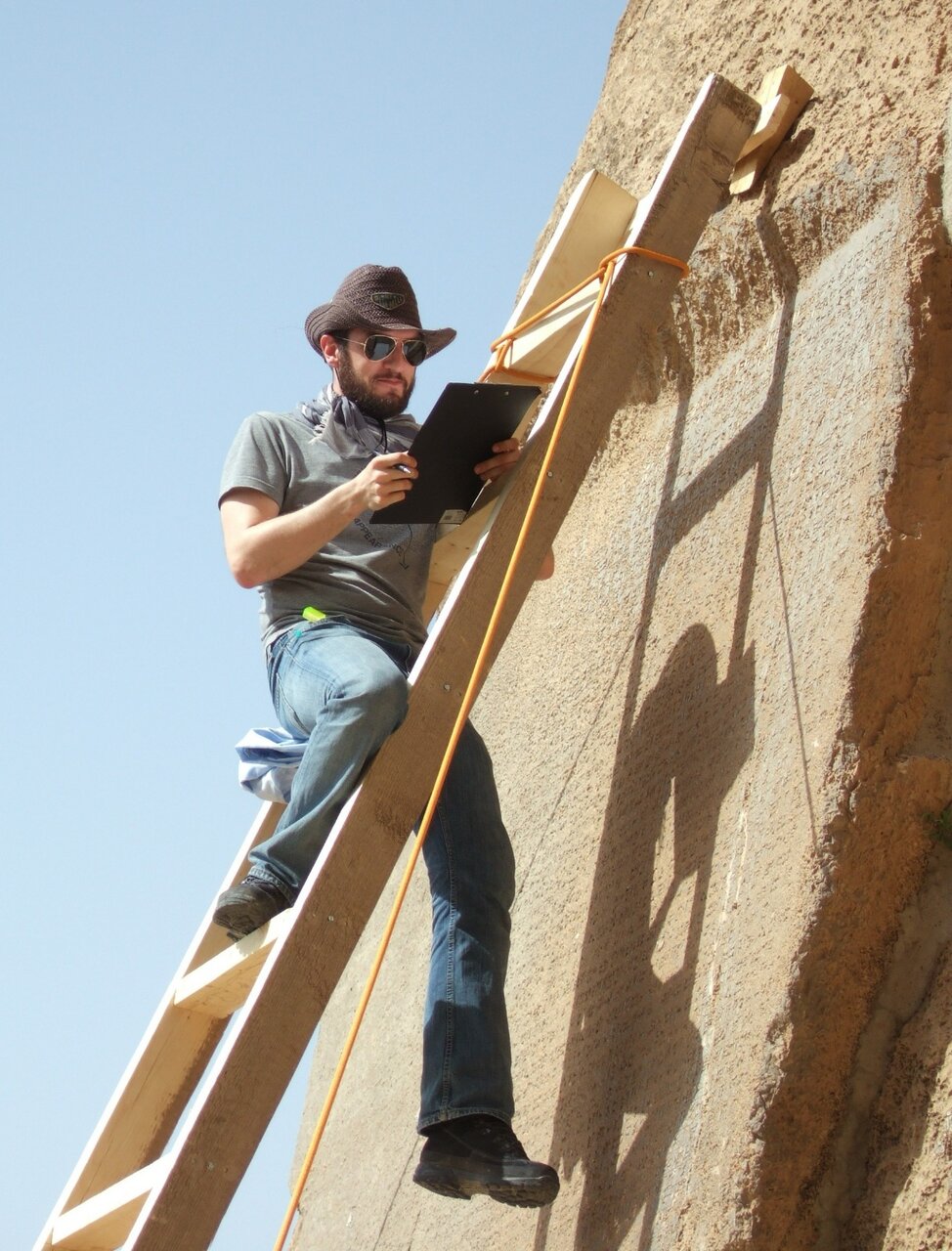
A new study published in the journal IRAQ raises long-held questions about the integrity of the Babylonian version of the famous Bisotun (Behistan) inscription, one of the most important trilingual records of the ancient world.
The study, led by Dr. Johannes Hackl of the Friedrich Schiller University of Jena and supported by the Bisotun World Heritage Base and Iran’s Ministry of Cultural Heritage, Tourism and Handicrafts, suggests that, contrary to popular belief for decades, nearly two-thirds of the Babylonian texts carved into the rock walls of western Iran may have been irretrievably lost.
The Bisotun Inscription was ordered by Darius I of the Achaemenid dynasty in the late 6th century BC and records his rise to power and the suppression of rebellions throughout the Persian Empire. Its Babylonian translation has long been studied alongside Old Persian and Elamite texts as a key to understanding that period. Since 1978, the standard bibliography for this version has been the edition by Elizabeth N. von Voigtlander, which claims to include nearly the entire text.
However, Dr. Hackl’s fieldwork and analysis of early records, made possible in cooperation with Iranian authorities, revealed that the inscription was much more damaged than von Voigtlander’s version indicated. The study concludes that the current state of the Babylonian edition is broadly consistent with that documented by 19th century scholars such as Henry Rawlinson and Leonard King, but that large portions of the text are simply missing. Research suggests that while von Voigtlander’s version is a monumental effort, it seems to overestimate what can be gleaned from the eroded surface and late 20th century latex squeeze she used.
This discovery has important implications for historians and linguists, as many of the unique texts attributed to the Babylonian version may be based on unverifiable data. Dr. Huckle encourages scholars to treat these sections as reconstructions rather than confirmed texts.
Commenting on the important role of local cooperation, Dr. Hackl said, “This study highlights the critical importance of on-site verification and the valuable role of local heritage custodians in preserving and interpreting Iran’s rich history.”
Despite the academic importance of this study and its official recognition, the failure of this study to be explicitly acknowledged in the original publication drew criticism from some quarters. Iranian archaeologist Fereydun Biglari said on social media:
“While an important paper, its value is diminished by the complete lack of awareness of the Bisotun World Heritage Site. Without their cooperation and permission, this study could not have proceeded. Our local institutions and experts deserve due recognition.”
The Bisotun Inscription was added to UNESCO’s World Heritage List in 2006 and remains one of Iran’s most valuable archaeological landmarks. This new research not only revises our understanding of an important historical document, but also highlights the continued need for transparent and collaborative international scholarship.
morning