
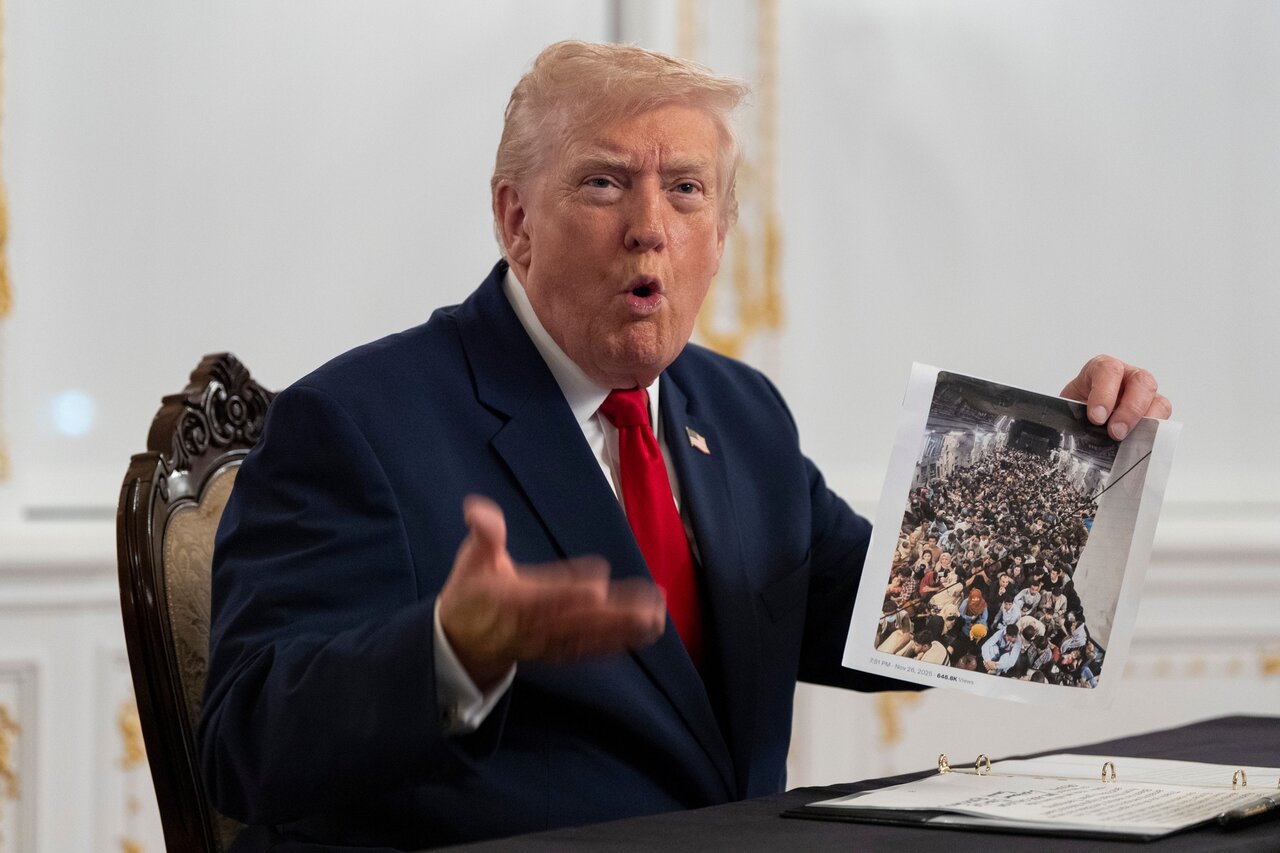
US President Donald Trump announced late Thursday that there would be an indefinite “permanent moratorium” on all immigration from what he called “Third World countries.” This broad and intentionally vague statute was denounced by critics as a racist and legally unstable attempt to exclude immigrants from the Global South.
The order, announced in an angry xenophobic Truth Social post on Thanksgiving night, comes a day after a mass shooting in Washington, D.C., left National Guard specialist Sarah Beckstrom, 20, dead and another soldier fighting for his life.
The suspect, Rahmanullah Rakanwal, a 29-year-old Afghan national who was once part of an elite CIA-vetted unit guarding U.S. troops at Kabul airport, was quickly used by Trump’s administration to justify the most sweeping immigration crackdown of his second term.
Trump wrote that he would “permanently halt immigration from all Third World countries so that the American system can be fully restored,” and vowed to strip federal benefits from non-citizens, denaturalize those who “undermine domestic tranquility,” and deport foreign nationals deemed “public offenses” or “incompatible with Western civilization.”
Hours earlier, U.S. Citizenship and Immigration Services had already frozen all admissions for Afghans and ordered a “full-fledged and rigorous review” of green cards issued to nationals of the 19 countries on the administration’s June travel ban list, including Afghanistan, Haiti, Somalia, Yemen, Iran, Libya and other overwhelmingly poor and non-white countries.
Legal scholars noted that a “permanent suspension” has no legal meaning under the Immigration and Nationality Act and would almost certainly face an expedited court challenge.
Immigration lawyer Abhishek Saxena described the language as an “open-ended restriction with no specified end date” intended to intimidate while maintaining flexibility in the administration.
United Nations officials condemned the move. “We look forward to the United States honoring its commitments under the 1951 Refugee Convention and ensuring due process for asylum seekers,” Deputy Spokesman Farhan Haq said on Friday.
Human rights spokesman Jeremy Lawrence added that migrants and refugees “are entitled to protection under international law.”
Advocates warned of cascading harms, including indefinite family separations, increased scrutiny of pending applications, and audits that could strip longtime residents of their status on flimsy grounds.
Roberto Folin of the Center for Mixed Immigration said the vagueness was intentional, allowing the administration to “indiscriminately intimidate immigrant communities” and treat the ban as a bargaining chip in foreign policy.
The announcement ends a year of relentless restrictions, including a reduction in refugee admissions for fiscal year 2026 to a historic low of 7,500, a November memo ordering a review of 233,000 refugees during the Biden administration, and a travel ban that disproportionately targeted Africa, the Middle East and Latin America.
For millions of people, President Trump’s Thanksgiving message was clear. America, once a beacon for the crowd, is closing its doors—and its language sounds to many as a clear rejection of the non-white, non-Western world.