
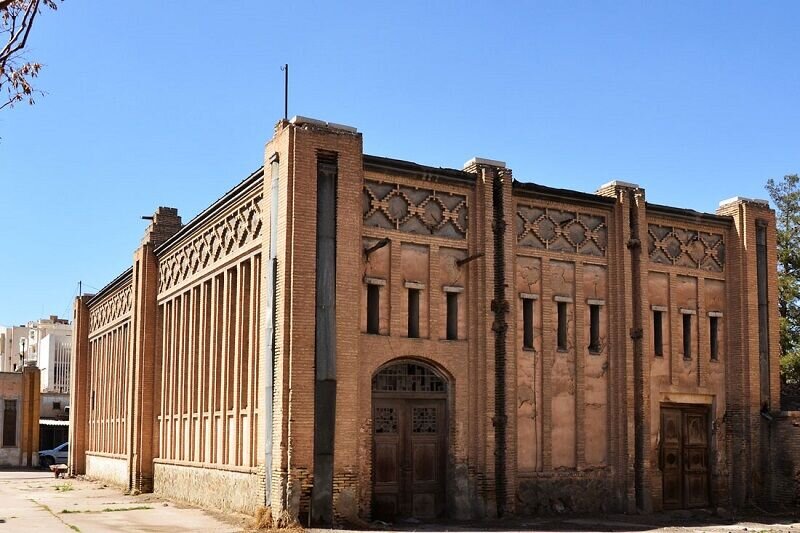
TEHRAN — The historic Isfahan Textile Factory, known as Risbah, once one of the most important centers of the country’s textile industry, will soon become Iran’s largest regional museum. This large-scale cultural project will play an important role in showcasing Isfahan’s history and culture, in addition to preserving its industrial heritage.
Founded in 1932, this factory is considered one of the symbols of Iran’s textile industry during the First Pahlavi era. At its peak, the factory, with an area of approximately 70,000 square meters, was one of the country’s largest and most advanced fabric production centers, ISNA reported.
The main buildings of the factory, including several large sheds and a collection of industrial machinery, were designed in the industrial architectural style of the time and are a large part of Isfahan’s urban identity. At its peak, the factory employed more than 1,000 workers and played an important role in meeting Iran’s textile needs and production.
This factory is known as one of the industrial ruins of the First Pahlavi era, and is now a valuable historical monument. The reconstruction of this complex as a regional museum is of great importance not only to preserve and present the history of the textile industry, but also to introduce the cultural, social and historical aspects of this building.
Converting an abandoned factory into a large-scale museum could be an opportunity to showcase Isfahan’s industrial and cultural history, related research, and the development of cultural tourism.
This work was inscribed on the National Heritage List in 2002 with number 6018.
Ruhollah Seyyed Al Asghari, the province’s deputy minister for cultural heritage, said the Risbakh factory is considered one of the important industrial buildings of the First Pahlavi era and has played a unique role in the history of Iran’s textile industry.
He pointed out that the project to turn the factory into a museum is not just a development project, but also a cultural activity that will help preserve and showcase Iran’s industrial heritage.
“Our goal in recreating this building as a museum is to preserve its historical and structural authenticity. The museum will be a place where the industrial and cultural history of Isfahan and Iran will be told in parallel. In addition to displaying historical artifacts, this project will also serve as a space for research, education and cultural exchange.”
In another part of his speech, he emphasized the close cooperation between the Ministry of Culture and Heritage and the City of Isfahan. “Design plans for the museum have been prepared and the project has made physical progress.”
“During the joint meeting, various issues were considered, including the organization of the surrounding environment, access routes, green spaces and cultural programs. The goal of the Textile Museum is not to be limited to simply displaying artifacts, but to become a major cultural destination.”
Seyyed Al Asghari said that Isfahan, with its rich history and world-recorded works, needs a world-class museum to showcase its cultural capabilities in the best possible way.
The Textile Museum aims not only to display historical works, but also to create opportunities for research and cultural exchange at an international level. This museum has the potential to become one of the important cultural centers not only in the region but also in the eastern part of the country.
He clarified: “With this project, all our efforts will be to preserve the historical and industrial value of Risbah. This building will not be destroyed, but will be restored with the original preserved, and will become a place that tells the history and culture of Iran.”
He further said that turning the Risbah factory into a museum is one of the most important cultural projects in Isfahan and can play an important role in showcasing Iran’s industrial and cultural history and making Isfahan one of the country’s important cultural hubs.
With the start of the implementation phase of the Risbah Museum project, Isfahan is taking a major step towards preserving and showcasing its historical and industrial identity. This project will not only help preserve Iran’s precious heritage, but also provide opportunities for tourists, researchers, and history enthusiasts.
With the completion of the museum, Lisbah will become one of the region’s most important cultural attractions and shine as a new symbol connecting the past and the future in the heart of Isfahan.
The project will definitely enhance the importance of Isfahan as one of Iran’s prominent cultural and historical centers and keep the industrial and artistic legacy of the region alive for future generations.
KD