
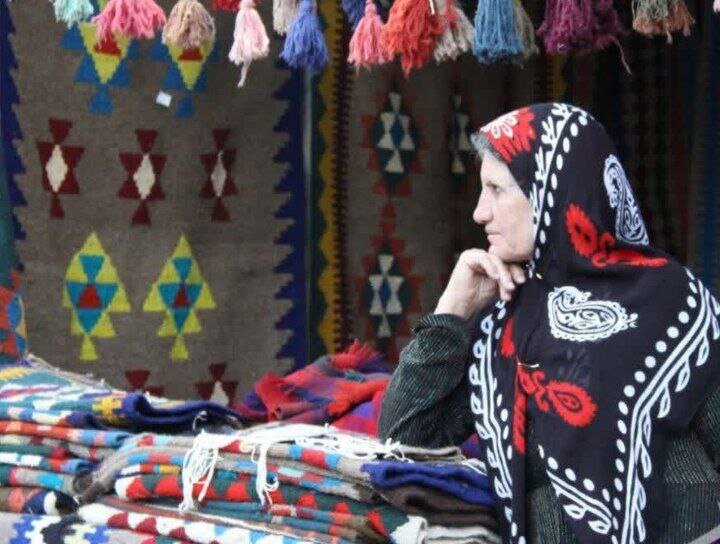
TEHRAN—The customary scarf of Lol women, called Ghorvani, is more than just a piece of clothing. It is a combination of history, veil, and identity that spans 3,000 years of records in the land of Zagros.
Traditional clothing is more than just a collection of fabrics and patterns. It is a living document of national identity, cultural memory and social history, wrote Mair News Agency.
In Lorestan province, women’s clothing, especially authentic Ghorbani scarves, not only has an artistic and aesthetic place, but also carries layers of meaning, history and ancient beliefs of the local people.
In recent decades, waves of modernization and lifestyle changes have marginalized many cultural elements, but this part of Lorestan’s heritage remains intact and continues to exist as a symbol of dignity, humility, and the roots of Iranian culture.
Ata Hassanpour, Director of the Cultural Heritage, Tourism and Handicrafts Department of Lorestan Province, explained that Loli traditional costumes are a collection of colors, diversity and beauty that could embody the spirit of the culture, authenticity and identity of Loli women. In addition to the visual effect, this dress is also perfect in terms of modesty, which truly shows the elegance of a low woman.
He added that each component of this dress, from the headscarf to the bodysuit, slippers and shoes, has a specific place and function, forming a harmonious and unique set.
The cultural researcher added that the headband is about 3,000 years old, or even more, according to research conducted on the basis of archaeological discoveries in excavations carried out in Lorestan, Khuzestan and western regions of the country.
While it is true that this headband is seen on women’s heads in the Lowe, he said that in the past it was also widely used to decorate men’s clothing. He added that the men of Rol would wrap the golvani around their trilby to protect it from the wind during battle, giving it a special awe and effect on the look.
He also said that men also use ghorvani during festivals. They tied it around their hats or hung it around their necks. This shows the important role of this headband in Lo’s clothing culture. “This scarf in Loli culture is not just a garment; it is part of the collective memory of our people, which is also revealed through poetry and music.”
Hassanpour highlighted that the color diversity of Loli’s dress is one of the best features of the outfit. He added that these colors not only create visual beauty, but also represent the vitality, culture and life-loving spirit of the Lo people.
He said one of the components of Lo’s women’s clothing is the gib, a traditional footwear that is very popular among women. He explained that the Gibb is an excellent choice for nomadic living conditions and long trips into nature, thanks to its lightness, strength and comfort.
Today, among young girls, wearing wristbands is both a fashion and an aspect of beauty, but in the past, these decorations were part of the traditional clothing of Lo women. In addition to these wristbands, they also had very small bells hanging from them. The purpose of this bell was not only decorative. When traveling, walking through plains, deserts, forests and meadows, the delicate sound of this bell drove away snakes and scorpions.
He emphasized that this means that the decoration of women’s clothing is not only designed for beauty, but also has a role of protection and security, and is part of Lol women’s consciousness towards nature.
“If you visit the Anthropological Museum in Falakol Aflak Castle, you can see the complete female dress in one of the showcases.”
Hasanpour continued that in addition to all the decorative, aesthetic, and identity features of Lo women’s clothing, the most important feature of this garment was that the Lo women’s hijab was fully observed from head to toe.
It added: “This characteristic is not limited to the province of Lorestan. Rather, such covering and majesty can be found in the clothing of the Kurds, Azari, Sistani, Baluch, and even northern Iran. These are the characteristics of Iranian women, who are both dignified and fully covered.”
This fully covering hijab is not unique to the Islamic era. Rather, it has been here and has roots centuries before the birth of Islam. This fact can be seen in many inscriptions, historical images and Iranian miniatures.
Nahid Parvizpour, a senior official at the Governor General of Lorestan Province, also emphasized the long-standing status of original coverings in the Zagros region. “In the cultural sphere of Zagros, especially among the Lolu, Kurdish and Bakhtiari peoples, traditional clothing has always been a sign of etiquette, dignity and identity for Iranian women, and this meaning has been institutionalized in the hearts and lives of the local people.”
KD