
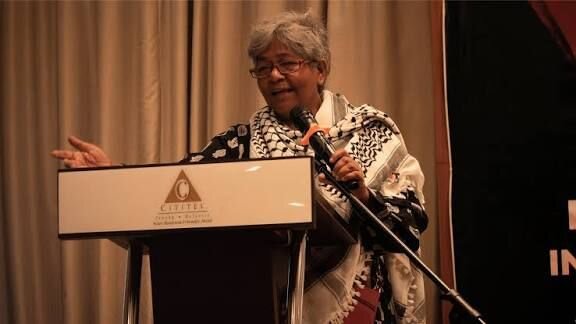
TEHRAN — In a revealing and timely conversation, Azra Talat Said, Secretary-General of the International League of People’s Struggles (ILPS) and one of the chief convenors of the International People’s Tribunal (IPT) in Palestine, spoke about the tribunal held in Barcelona, Spain on November 23-24, 2025.
The two-day tribunal convened activists, legal experts and witnesses to investigate war crimes, environmental destruction, forced starvation and systematic violations of international law in Gaza and occupied Palestine, and handed down a historic verdict aimed at holding perpetrators accountable.
In an exclusive interview with the Tehran Times, Said outlined his personal role in coordinating the court, explained the legal basis for the “right to resist,” and placed Gaza’s plight within the broader global struggle against imperialism. Her testimony reflects ILPS’ commitment to mobilizing public opinion and leveraging legal mechanisms to counter repression around the world.
The text of the interview is below.
As the Secretary-General of ILPS and one of the convenors of the IPT, what specific roles and responsibilities did you personally play during the court process?
In June 2024, the 7th International General Assembly of ILPS passed a resolution to hold a tribunal in solidarity with Palestine. I was elected General Secretary of the 7IA (Seventh International Conference). One of my main responsibilities was coordinating the overall schedule and ensuring deadlines were met.
This includes selecting jurors and prosecutors, calling all delegates, gathering witnesses, and ensuring confidentiality and safety for all involved.
Along with ILPS’ external vice president, I was also responsible for planning, programming, and fundraising. While the legal team dealt with jurors and prosecutors, we were involved every step of the way to ensure the credibility of the courtroom and the safety of all witnesses.
Despite the destruction of Gaza’s infrastructure and severe damage to its land, the resistance is not over.
The “right to resist” was a central legal principle of the IPT. Could you define this right within international law and explain why it is fundamental to courts?
The “right to resist” is recognized in international law, and the ICCPR clearly defines the right to freedom. We were very clear that the struggle for rights is legitimate and that this is a recognized right under international law.
ILPS is an anti-imperialist, anti-fascist organization, so the concept of the “right to struggle” is central to our movement. The “right to resist” has a basis in international law, and United Nations Resolution 1514 (XV) of December 14, 1960 explicitly points to the right to self-determination. Therefore, the ILPS had no difficulty deciding the court on this principle. The main problem is not the law itself, but the fact that many governments do not recognize the law.
The IPT is a people-driven tribunal, but how can we ensure that our findings adhere to reliable legal standards and avoid political bias?
The jury is comprised of prominent legal figures, most of whom are affiliated with bar associations or international legal organizations. They were selected for their professional expertise and ability to apply legal frameworks similar to formal courts.
One of our biggest challenges was ensuring their independence. We were careful not to select people with strong political leanings towards the Palestinian cause so that the court could be independent and impartial. Our focus was to select a jury that clearly understands people’s rights and ongoing global issues, and who will work together based on facts and scientific evidence.
Most of the witnesses were from Gaza, but we also included independent experts with no political affiliation. Testimony came directly from people with first-hand experience, including individuals who lived in Gaza during the court period. Their evidence was combined with reliable sources such as United Nations reports and academic studies.
The prosecutor was internationally represented. They were from the West Asia and North Africa (WANA) region, the United States, and Europe. Prosecutors examined testimony and questioned witnesses and expert witnesses. The Tribunal therefore followed an approach comparable to internationally recognized courts in terms of legal standards.
People continue to resist throughout occupied Palestine.
You emphasize the connections between Palestine and broader global patterns of imperialism. How does Gaza fit into broader structures of Western militarism and neocolonial domination?
What is happening in Gaza is part of a larger colonial project. For example, the India-Middle East-Europe Economic Corridor, announced in India on September 19 and 20, just days before the Al-Aqsa floods on October 7, included a trade route that would connect to Israeli ports through Gaza.
This is part of an overall neocolonial strategy that includes resources, oil, gas, and regional influence. Similarly, the Abraham Accords launched in 2020 with the UAE, Bahrain, Morocco, Sudan, and recently with Kazakhstan reflect a global movement toward normalization that supports imperial interests.
For US imperialism, control of the occupied Palestinian territories is central to control of the oil in the Persian Gulf states and the WANA region. We see the expansion of American imperialism into Venezuela, the world’s most oil-rich country.
You spoke in court about the intentional destruction of agriculture, water systems, and the environment. Could you please elaborate on how these actions constitute a deliberate ecological and humanitarian attack?
Gaza’s agriculture had already been weakened by previous attacks. Since the 2007 siege, the sector has been severely affected. Even before October 7, agricultural production was highly controlled by Zionist organizations.
Immediately after the genocide began in Gaza, fishing boats were deliberately targeted in Gaza, with 99 fishing boats being bombed. Water systems, farm equipment, and agricultural infrastructure were destroyed. This has been reported by various witnesses and expert witnesses and is also well documented by international organizations.
After large-scale bombing campaigns, environmental damage worsened. Trees were uprooted, land was damaged, and access to necessary resources was completely cut off. Expert witnesses compared satellite images before and after October 7, and the devastation was shocking, with green areas almost completely eroded. The land turned black and was almost dead, as if nothing could survive.
During the trial, the lead prosecutor clearly summarized the findings from the testimony. First, agriculture was destroyed, food crops and vegetables could not be grown, water systems collapsed, fishing boats were destroyed, and critical infrastructure such as bakeries, hospitals, doctors, pharmacists, and women’s reproductive health services were targeted. Everything that could sustain life was systematically destroyed.
This is a deliberate strategy, not collateral damage. There is no other explanation. The term methacide was used in court to describe the complete destruction of life, including, of course, humans but also the environment and biodiversity.
As the first day of court progressed, and by the end of the second day, the evidence of devastation, human suffering, genocide, environmental destruction, and forced starvation became clear.
But what I want to emphasize is that even though Gaza’s infrastructure has been destroyed and the land has been severely damaged, the resistance is not over. People continue to resist not only in Gaza but also in the West Bank and throughout occupied Palestine. Individuals, communities and countries around the world continue to come together.
The destruction of Gaza is part of a global pattern of imperial violence.
Do you think public opinion in the West, particularly in the United States and Europe, is really changing? And what role have courts played in that change?
Yes, great changes have occurred among the people. Over the past two years, political education has helped communities understand the history of Palestine, from the 1917 Balfour Declaration, Nakba, and occupation to the ongoing genocide.
People also realized where the weapons were coming from, that the United States, Britain, France, the Netherlands, and Italy were supplying Israel with weapons. The hypocrisy of Western democracies has been exposed. Its hegemonic, colonial and neo-colonial intentions are now very clear.
It is clear that resistance continues in the US, UK and across Europe. There are political prisoners in these countries today because they are rising up against their governments, demanding an end to war and an end to occupation.
What impressed me most was the role of the public. Workers in many countries began blocking arms shipments. The youth movement expanded. In Pakistan, where I come from, the people learned about Palestine’s history from older generations who carried on memories of the 1948 Nakba.
That’s right. Change is occurring among the working class, communities of color, young people, and those already educated about imperialism. In Spain, for example, millions of people strongly support the liberation of Palestine. Millions of people are on the streets in the Netherlands, France and other European countries. Aotearoa (New Zealand), where the Maori people also suffer from settler colonialism, strongly supports the Palestinian resistance movement.
The court plays two main roles.
1. Legal recourse: Providing evidence to human rights and international organizations.
2. Political means: educating and mobilizing people through organizations such as ILPS and People’s Coalition for Food Sovereignty (PCFS).
The court also brought together many organizations that had previously operated separately. There is no doubt that this court will enable further unity and coordination to build a massive mass movement seeking global solidarity against the occupation of Palestine by the US-led Zionist entity.
What is happening in Gaza is not collateral damage, but a deliberate strategy.
Why was Spain chosen to host the trial?
We wanted to hold the tribunal in Europe, close to the people whose governments support genocide. Spain, especially Barcelona, has historically and politically supported Palestine.
It was essential that courts be held in places where people could freely assemble. It would have been difficult to hold it in the United States or some European countries. Barcelona was also the city where the Global Smud Flottra was launched, demonstrating strong support for the Palestinian people.
As a female leader of a political organization, how do you perceive the role of Palestinian women in the resistance?
Women like Leila Khaled will always remain our icons. She attended the 7th International General Assembly of ILPS. I remember telling her how difficult everything was, trying not to cry. She said to me, “No, don’t cry, Azula. You have to fight.”
That moment inspired me. Palestinian women play important roles in all aspects of the resistance: political, humanitarian, medical, environmental, and social. Many people sacrificed their lives.
People like Khalida Jalal, who spent many years in prison, devoted their efforts to political education and activism inside the prison, even as they endured the severe torture characteristic of the Zionist organization.
We also know about civilian women like Razan Zuaiter, head of the Arab Conservation Group. Through international organizations, she has raised awareness of the destruction of food and agricultural production in the Occupied Palestinian Territories and advocated for food sovereignty.
Although they have suffered many displacements and relocations, they have remained steadfast in defending their “right of return” to their homeland. In fact, they are all lighthouses for everyone who fights against the oppression and dictatorship of the motherland and fights for national liberation.
Palestinian women play an important role in resistance, whether through armed struggle or through civil, social and political activism. Their courage is so inspiring.