
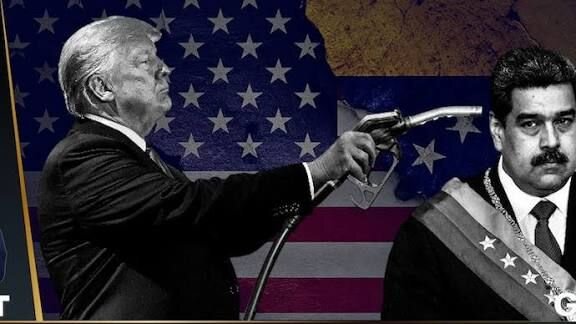
Goa, India – The conflict between the United States and President Nicolas Maduro is one of the most obvious geopolitical conflicts of modern times. It is not a clash between democratic ideals and authoritarianism, as Washington persistently claims. It is not a moral movement to save Venezuela from misrule, nor is it a humanitarian imperative to “restore democracy.”
These are familiar metaphors that have historically obscured American foreign policy’s deeper intentions, from Iran in 1953 to Chile in 1973 to Iraq in 2003.
The real axis of conflict is simpler, more difficult, and more permanent. It controls Venezuela’s vast oil reserves, the largest on earth. The United States cannot tolerate governments that refuse to privatize these reserves, refuse to subordinate energy policy to U.S. interests, and refuse to follow U.S. geopolitical directives in Latin America.
When you strip the conflict down to its essence, the truth is unmistakable. The United States wants Mr. Maduro out of office because he poses a barrier to American access, influence, and control over Venezuela’s oil resources. Those are the ABCs of this story.
Venezuela has more than 300 billion barrels of proven oil, more than even Saudi Arabia. For this reason, Venezuela is too strategically important for the US government to remain outside of US hegemony. The United States has been trying to reverse Venezuela’s energy sovereignty since Hugo Chávez first nationalized oil assets and directed the proceeds to social programs.
Under Maduro, resistance to U.S. pressure has only intensified. Washington’s hostility is therefore structural, not personal. A country with the world’s largest oil reserves located so close to the US coast cannot, according to US strategic thinking, be allowed to pursue an independent path or develop deep relationships with US adversaries such as Russia, China, Iran, and most recently Turkey.
President Maduro’s alliances strengthen multipolarity, which is intolerable for great powers accustomed to treating Latin America as their strategic backyard.
All major US attacks on Venezuela since 2014 must be read through this energy geopolitics lens.
The recognition of Juan Guaido as “interim president” in 2019 was not a demonstration of democratic will. It was a desperate attempt to immediately privatize the oil sector, reverse nationalization, and impose a flexible leadership that would lure US multinationals back to the center of Venezuela’s energy economy.
The plan quickly fell apart. Guaido became a global thorn in the side, abandoned by some in Venezuela’s opposition and eventually by Washington itself. However, the US strategy was not finished. It has simply adapted, moving from the fantasy of declarative regime change to a brutal plan of economic strangulation.
Sanctions have become Washington’s weapon of choice. These were not targeted sanctions, as U.S. diplomats claim, but a comprehensive economic war aimed at crushing Venezuela’s economy. Access to world markets was cut off.
Oil exports were blocked. Financial transactions were frozen. Billions of dollars in Venezuelan assets have been seized abroad. The aim was clear. It suffocated the economy to the point where daily life became unbearable, undermined the legitimacy of the government, and caused dissatisfaction among the people to the point of internal collapse. This strategy follows a long tradition in the United States.
This mirrors tactics used in socialist Chile, revolutionary Cuba, Sandinista Nicaragua, and post-revolutionary Iran. The principle is simple. If you cannot overthrow a government militarily, you must destroy its economy until the people revolt.
However, President Maduro did not fall. He endured through a combination of internal consolidation, external alliances, and a reorganization of the nation’s political institutions. Behind this perseverance lies not only political will but also structural changes in world power.
The world is no longer unipolar. The United States can no longer impose its will in Latin America as easily as it once did. China has become Venezuela’s main partner in oil and infrastructure.
Russia has provided diplomatic support and defense cooperation. Despite sanctions, Iran has helped Venezuela rebuild its refinery capacity and maintain its fuel supply chain. Regional politics also changed.
Mexico, Lula’s Brazil, Petro’s Colombia and several Caribbean countries are resisting U.S. pressure to isolate Mr. Maduro. The hemisphere is no longer united behind Washington. President Maduro’s survival reflects the broader global reality that the United States is no longer the undisputed hegemon.
But the Washington narrative remains locked within an outdated framework. It openly supports authoritarian regimes from Saudi Arabia to Egypt, and even as it stands alongside the apartheid military state of Israel, it continues to speak of “restoring democracy.”
While criticizing President Maduro’s human rights record, he is arming governments that have committed far worse human rights abuses. What is intolerable to the United States is not authoritarianism—indeed, many of America’s allies are authoritarians—but autonomy. The real crime is that sovereignty is exercised without US approval. Maduro’s Venezuela is guilty of disobedience, not dictatorship.
This geopolitical conflict intensified in 2024 and 2025 as sanctions failed to achieve their intended results. As oil prices fluctuate and global supply chains shift due to conflicts in other countries, the U.S. government suddenly faces the limits of its strategy.
Sanctioning the country with the world’s largest oil reserves is risky, especially when global markets are tight. At the same time, the United States does not have the political space to lift sanctions without showing an attitude of surrender. Venezuela thus becomes emblematic of a larger battle over the viability of US sanctions as a foreign policy tool. If Venezuela survives, the credibility of future sanctions regimes from Russia to Iran will be weakened.
Meanwhile, President Maduro used the crisis to reshape the situation inside Venezuela. Sanctions created difficulties, but they also created a strengthening of nationalists, which allowed him to tighten his political control. By positioning himself as a defender of national sovereignty against imperial aggression, President Maduro has cultivated legitimacy even among sectors that might otherwise oppose him.
This is not to glorify his reign. Venezuela’s state institutions are flawed, corrupt, and overbearing. But in the battle between sovereignty and empire, President Maduro’s position resonates across the Global South, with many countries seeing Venezuela’s defiance as reflecting their own historical memory.
Therefore, the head-on conflict between the United States and Maduro is not just a bilateral relationship. It symbolizes the changing world order. It exposes the shrinking reach of American coercive power and the growing confidence of countries seeking to resist American domination.
It foregrounds an important question: Can a resource-rich country survive while refusing to become a vassal state? Venezuela’s experience suggests that, although the path will be tough, survival is possible, supported by global alliances, domestic resilience, and a political project that positions sovereignty as a collective moral imperative.
Ultimately, this conflict is a struggle over the future of sovereignty in the 21st century. It is testing whether the United States can continue to dictate the political direction of the Global South, or whether the emerging multipolar world will allow countries like Venezuela to carve their own path.
President Maduro’s survival, despite the most aggressive regime change movement in recent Latin American history, sends a more powerful message than any public statement. It means that even a small country can still resist a large empire. Head-on confrontations continue, but the outcome can no longer be predicted in advance. The United States can destabilize, sanction, and isolate, but it cannot easily defeat those who refuse to kneel.
(Ranjan Solomon is a political commentator and advocate for global justice.)