
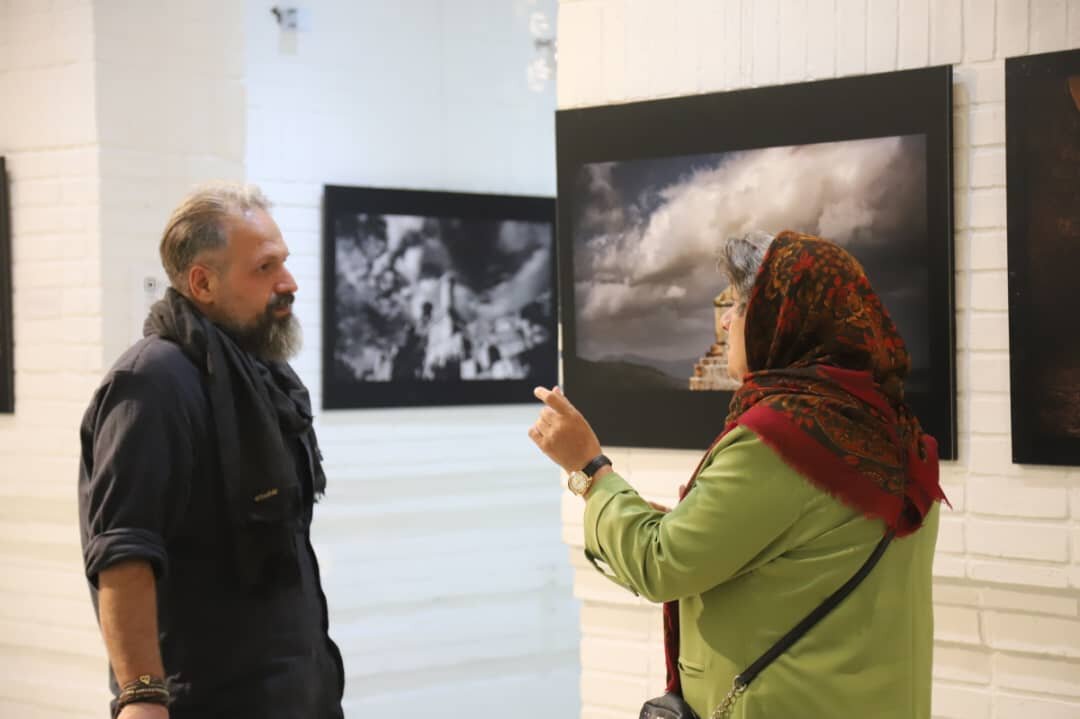
TEHRAN – Iranian-Armenian photographer and cultural heritage researcher Herbert Karim Mashihi is opening a new exhibition titled “Iran Thinks of You” at the Sadabad Cultural and Historical Complex in northern Tehran.
The show brings together a selection of his long-term photographic projects on Iran’s ancient architecture, sacred sites, and historical landscapes, created over years of travel to places such as Chogha Zanbil, Shahr-e-Sufte, Pasargadae, Persepolis, and the ancient city of Yazd, famous for its eye-catching windbreaks.
In a conversation with Tehran Times on Thursday, he reflected on his artistic philosophy, the challenges of documenting cultural heritage, and what he hopes viewers take away from the exhibition. Below are excerpts from the interview questions and answers.
The exhibition title “Iran Thinks of You” is poetic and meditative. What message does this piece convey to viewers and what does it mean to you personally?
“Iran Thinks of You” is an attempt to recognize and re-present Iran as a unified and inclusive cultural landscape. It is a message that embraces the diversity of peoples, historical periods, religions, rituals, and sanctuaries.
The story behind the exhibition is, in fact, one of thousands of different stories that ultimately converge under a single common name: Iran.
Therefore, the locations and titles of the exhibited photos are not specified. The goal is not to refer to a particular geography, but to emphasize that this diversity is unified under one name.
In this exhibition, Iran is everywhere. And it is Iran who “thinks” about the viewers!

Many iconic places and monuments feature in your work. How did you choose those locations and what drew you to them?
By choosing locations such as Chogha Zanbil, Persepolis, Yazd windbreaks, and the country’s historic mosques and other places of worship, I sought to highlight the pillars that collectively form Iran’s national identity. This has always been fundamental to me…. Their importance lies in the fact that many of the ritual practices and ways of life that arose from these sites have survived into modern times, even though we are not always aware of their deep historical roots.
In fact, through a single photograph, I seek to reveal how modern floor plans, columns, architectural practices, and spatial structures continue to connect with thousands of earlier stories. These connections show that modern life still stands on the shoulders of history.
Your prints seem to be very precise and artisanally rendered. What challenges do you face when photographing cultural heritage sites, and how do you aim to convey not only the visible reality, but also the emotion and history behind it?
Heritage photography comes with many challenges. The first and perhaps most important thing concerns the photographer. It depends on how deeply the photographer understands the subject and what kind of relationship he or she develops with the subject.
When a photographer truly understands their subject, understands its history, and recognizes its importance today, honest and unvarnished storytelling becomes possible. This seems to tell the story of what once was and why it has endured.
In addition to these conceptual challenges, there are also practical challenges, such as difficulty in obtaining permits (where necessary), financial constraints, and lack of sustained support from relevant institutions. Indeed, photographers working in the field of cultural heritage often work without financial support, investing their own resources to document heritage that is expensive to preserve and often overlooked.

In the introduction to the exhibition, it was written that architecture is not just a building, but the continuation of human life beyond time. Can you tell us more about this idea and how it is reflected in your photography?
Iranian architecture, and architecture as a whole, seems to be a product of the climate and surrounding nature. An architectural tradition cannot be understood without examining the ecological conditions that shaped it. Colder climates use completely different shapes and materials than hotter climates.
For example, in a sunny region where shade and coolness are important, no one would choose a stone that absorbs and intensifies heat. Conversely, in cold regions, clay and mud are in short supply as they are sensitive to moisture. This is why stones play a central role in cold climates. It absorbs sunlight during the day and slowly releases its warmth at night. It is an intellectual negotiation between matter and nature.
Extending this logic to our time, we see that much of today’s technology and architectural systems are imports (from outside Iran) that were neither designed nor adapted to our landscape. However, traditional Iranian architecture has always been based on a deep understanding of the climate, the environment, and the real needs of the people.
Simply put, such a continuity between place, matter and human life is what I want to reveal in my photographs.

If there was one message or experience you wanted visitors to take away from “Iran Thinks of You,” what would it be?
Throughout my years of photography, thinking about Iran has been my greatest interest. That’s a long-standing problem I’ve always wanted to convey to viewers. We want to remind them of the great civilization of which we are the inheritors.
However, national inheritance, especially cultural heritage, is more than just ownership. It is to sustain, support, protect and advance.
That is why the story of this exhibition begins from within the photographs themselves, inviting the viewer to the challenge of thinking about what they have, what they are responsible for, what they are related to, and what they should give meaning to.
In closing, I can reiterate that one of my deepest wishes is that viewers can feel themselves in the photographs, that is, to see them from their own perspective, not just as a spectator, but as part of the image.
“Iran Thinks of You” will be open to the public at the Sadabad Complex until December 21, offering visitors the opportunity to explore Iran’s architectural and cultural heritage through the lens of Karim Mashihi.
morning