
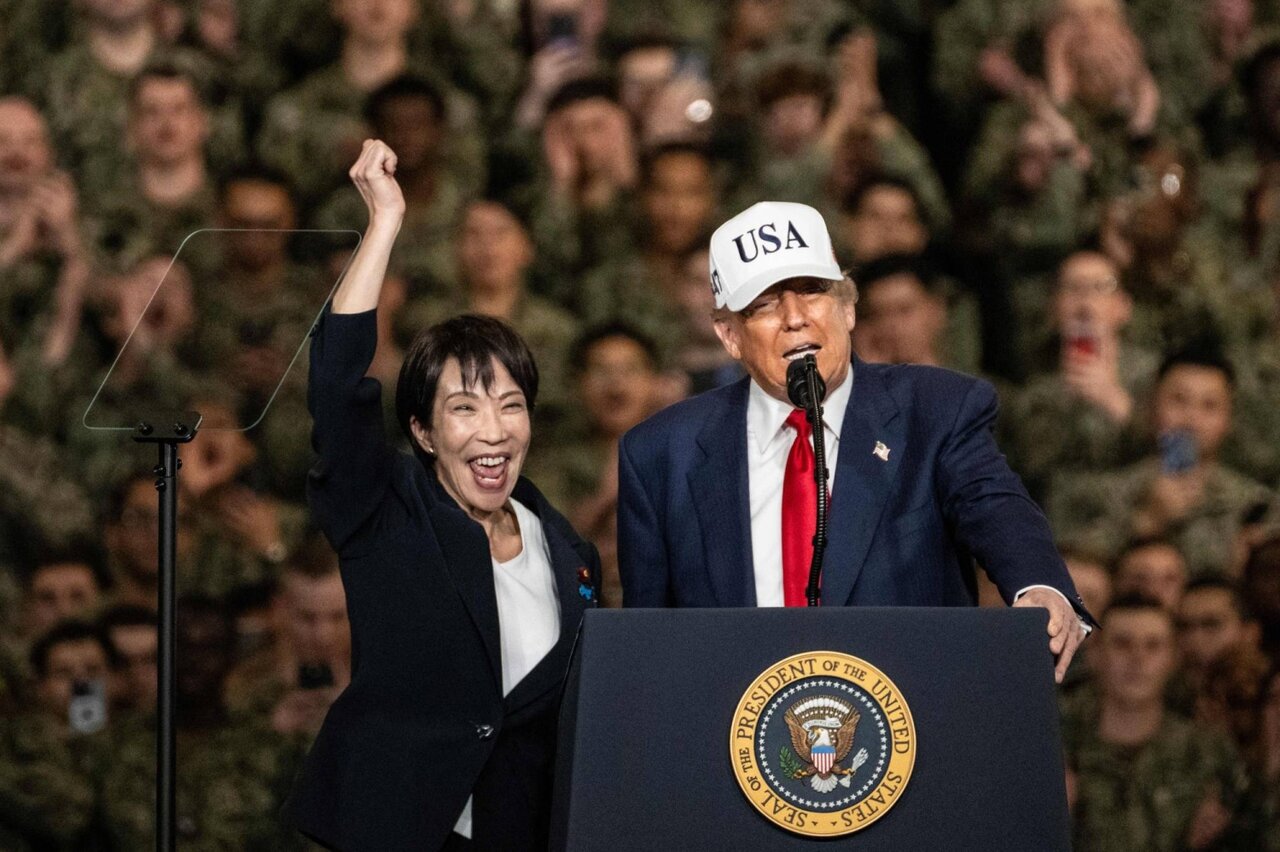
XIAMEI – Relations between China and Japan are undergoing the most severe shock in a decade. Still, the two countries appeared to be slowly moving toward improved relations in 2024 after pandemic restrictions were lifted. This trend has suddenly broken in recent weeks, with a series of diplomatic failures sparking conflict.
The spark was sparked in Tokyo, where Prime Minister Sanae Takaichi publicly declared that a possible Chinese attack on Taiwan posed an “existential threat to Japan.” The statement has far-reaching implications in a region where the Taiwan issue is considered Asia’s most sensitive geopolitical fault line. Moreover, Gaoichi had just visited Taiwanese officials at the APEC summit, just hours after affirming the need for stable relations with the Chinese president. Beijing interpreted her actions as a deliberate signal rather than a diplomatic coincidence.
It is therefore no surprise that China’s response was immediate and strong. Chinese diplomats strongly protested, and China’s Ambassador to the United Nations Hu Kong said Gaoichi was violating international law, endangering world peace and undermining the very postwar international order. Elevating the conflict to the UN level is unusual and shows that Beijing views Japan’s rhetoric as a qualitatively new development. From China’s perspective, such statements go to the very heart of its political identity and sovereignty. The Chinese government continues to demand that the statement be retracted.
Chinese Foreign Ministry Spokesperson Lin Jian said, “If Japan’s basic position toward Taiwan is indeed what was stated in the 1972 Sino-Japanese Joint Statement, can Prime Minister Gaoichi express this position accurately and fully?Why is Japan unwilling to clearly state the promises and legal obligations it has fulfilled?What is the logic and motivation behind this position?Japan has an obligation to explain to China and the international community.” For China, Taiwan is not just a regional issue, but a principle of existence that modern China does not want to relativize.
The Chinese government has since issued travel warnings, restricted tourism and cultural exchanges, and canceled several scheduled events with the Japanese cultural sector. The economic impact on Japan was immediate, with hotels, airlines and retailers reporting sharp declines within days. Japanese travel agencies say they have lost about 80% of their bookings from the Chinese market, one of the most important components of Japan’s tourism industry, which accounts for 7% of Japan’s GDP.
If diplomatic and trade tensions escalate further, both countries will suffer losses as they remain important economic and investment partners.
But thanks to its long-term efforts to strengthen its domestic self-sufficiency and broader economic base, China is in a much better position to absorb such shocks.
The cultural and social dimensions of the crisis reveal its depth. The suspension of cultural exchanges and the cancellation of concerts and film premieres show that the conflict is no longer just about diplomacy. It dealt a blow to exactly what the two countries had long cultivated as a stabilizing space outside of geopolitics. If even this “soft bridge” is crumbling, it signals the beginning of a long-term cooling period in the relationship.
Takaichi’s remarks caused controversy within Japan. Opposition politicians, constitutional scholars, and some academics warned that her position exceeded the legal framework of Japan’s right to collective self-defense. Japan remains bound by Article 9 of its pacifist constitution, and its people are not prepared to accept rhetoric that would push Japan into open conflict. However, Takaichi is gradually abandoning the Japanese government’s long-held policy of “strategic ambiguity” regarding Taiwan. Her tone gives the impression that instead of articulating Japan’s own strategic interests, Japan is blindly following American policy while retreating into militarization.
This rapid change in atmosphere also affected military dynamics. In November, a Chinese Coast Guard vessel sailed near the disputed Senkaku Islands and Diaoyu Islands, but the Japanese government interpreted this as an escalation and urged it to send its own ships and fighter jets. Japan also announced a military buildup on Yonaguni Island, just 110 kilometers from Taiwan. From the Chinese government’s perspective, this is primarily a matter of proactively monitoring an unpredictable environment shaped by Japan’s ambiguous signals. The drone incident near Yonaguni Island only confirmed that changes in rhetoric are rapidly being reflected in military reality.
What we are witnessing today has deeper roots. For decades, Japan has been a central pillar of the US security architecture. Japan’s defense policy, including its position toward Taiwan, is shaped more by U.S. strategic priorities than by Japan’s own autonomy. The US government has responded to recent tensions by providing security for Tokyo, and US diplomacy has taken a firm stance against “any unilateral change to the status quo in the Taiwan Strait.” This framework further limits Japan’s ability to act independently and deepens Beijing’s long-standing distrust of Japanese policy. Considering Japan’s defense posture and its quasi-client state relationship with the United States, the excessive self-confidence and arrogance of Japan’s prime minister become understandable.
America’s objective today is to slow China’s technological rise that threatens America’s global dominance. There is growing recognition in Washington that China is a dangerous competitor in global trade and innovation. This has been accompanied by an increase in China’s military power, which has already surpassed its regional importance. It is quite possible that America’s policy of containment against its major competitors is the root cause of the current crisis. Traditional Anglo-Saxon militarism is constantly on the lookout for “useful fools” in areas of strategic interest, actors that can be used as disposable tools when needed. History provides countless examples of how countries like the United States and the United Kingdom have no friends. They only have servants and rivals.
In this context, it is natural to ask to what extent Japan is able to shape its own foreign policy, and to what extent is it drawn into strategic games orchestrated by other countries? Tokyo risks falling into the position of shouldering the grave consequences of a conflict over which it has no control. And in a region that is already undergoing the greatest realignment of power in modern times, this is a very dangerous place.
The current crisis is not just a momentary conflict, but a manifestation of deeper global change. China has emerged here as an actor defending borders, historical memory, and long-declared principles, and doing so in a predictable and consistent manner, and based on the belief that regional stability depends on clear rules rather than unbalanced and aggressive rhetoric. It also reminds us that global conflicts do not occur in the abstract or suddenly. These often have deep historical roots based on security dependence and geopolitical fantasies. The Indo-Pacific is changing before our eyes, and without a full understanding of its historical and strategic depth, we risk mistaking symptoms for causes.
*Lucia Hubinska is a lecturer at the Institute of Creative Innovation, Xiamen University, Fujian Province, on the southeast coast of China.
(This article reflects the opinions of the author and does not necessarily reflect the views of Tehran Times.)