
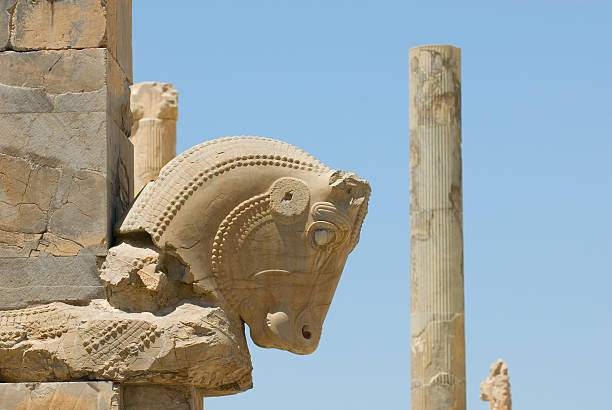
TEHRAN – Iranian restoration teams have begun a new conservation program at the UNESCO-listed Persepolis and nearby Naqsh-e-Rustam ruins, using advanced imaging, special materials and stone analysis techniques, officials announced Saturday.
This project is being carried out by Iranian researchers with scientific support from international organizations. Officials say the work will include laser scanning, 3D imaging, detailed structural analysis of the stone’s surface and the use of environmentally friendly protection materials aimed at slowing erosion.
Persepolis was founded by Darius the Great around 518 BC and served as the ceremonial capital of the Achaemenid Empire (c. 550 – 330 BC). The terrace complex, located about 60 km northeast of Shiraz, was largely destroyed by Alexander the Great in 330 BC. The surviving palace, staircases and cuneiform inscriptions are considered one of the most important archaeological sites of the ancient world.
The royal cemetery of Naqsh-e Rustam, a short distance from Persepolis, contains the tombs of Achaemenid kings carved into the mountainside, as well as later rock reliefs.
Mohammad Javad Jafari, director of the Persepolis World Heritage Site, told Mehr News Agency that Naqsh-e Rustam “needs immediate attention for urgent protection.” He said most of the archaeological research at the site was carried out in the 1950s, and work since then has focused on conservation.
Jafari said a recent study by Shiraz University confirmed subsidence and cracks in the ground in the surrounding area. He said research showed that (soil) movement does not directly affect major rock-cut structures, but could threaten the foundations of some structures.
Restoration experts have also begun a major conservation project on one of Persepolis’s largest inscriptions, said Shahram Rahbar, senior heritage conservator. He told Mair that the inscription had never been repaired since its creation, and that deliberate human damage had been avoided.
Raval said the multi-year project includes stabilizing the back side of the inscription, building a protective canopy and treating the stone surface to prevent movement due to earthquakes and other forces. He said debris and cracks require very precise work, including determining whether to rebuild missing parts or stabilize without rebuilding. Two experts in ancient writing are said to be supervising the injection process.
Larver said the project uses a lime-based preservation material that matches the physical properties of the original stone. These materials are designed to be reversible and have similar hygroscopic and thermal expansion properties, he said. Labar said the material is expensive and must be used at temperatures between 5°C and 35°C, so it can only be applied during a limited period of time in spring and autumn.
Officials reiterated that the new conservation efforts aim to protect the ruins from weathering caused by wind, humidity, temperature fluctuations and increased numbers of tourists.
Persepolis, a monumental ruin at the foot of Kuhe Rahmat (Mount of Mercy) in southwestern Iran, is one of the most important archaeological sites in the world. Recognized as the greatest collection of Achaemenid architecture, urban planning, construction techniques and art, this royal city is a unique testament to one of the great civilizations of the ancient world. Construction of its vast terraces began around 518 BC under King Darius the Great of the Achaemenid Empire. On this platform, successive rulers built architecturally impressive palace structures, including the huge Apadana Palace and the Throne Room (‘Hundred Pillar Room’).
Drawing on Mesopotamian models, Darius I (522-486 BC), his son Xerxes I (486-465 BC), and grandson Artaxerxes I (465-424 BC) built imposing ceremonial complexes on vast terraces that were partly natural and partly artificial. This 13-hectare complex, with its grand approaches, monumental staircase, throne room, reception hall, and auxiliary buildings, is recognized as one of the world’s greatest archaeological sites. The terrace itself is a monumental architectural achievement, with a double staircase, a sculptural frieze, an Assyrian propylaea (monumental gate), a huge winged bull, and the remains of a vast hall. Achaemenid architects supported large open spaces with very thin columns through innovative engineering such as lightweight roofs and the use of wooden lintels. These crowns have elaborate capitals, the most notable being the double bull capital with the front parts of two kneeling bulls placed back to back on a double whorl with their necks extended to support a ceiling beam.
Persepolis served as the governmental center of the Achaemenid Empire, but was primarily conceived as a ceremonial center for royal receptions and imperial festivals. Its great terrace remains as a symbol of Achaemenid kingship, as Darius intended. Portraits of the king appeared repeatedly on this stage, sometimes depicted vanquishing monsters, enthroned over conquered enemies, and endless sculptural processions of soldiers, dignitaries, and tribute-bearers.
morning