
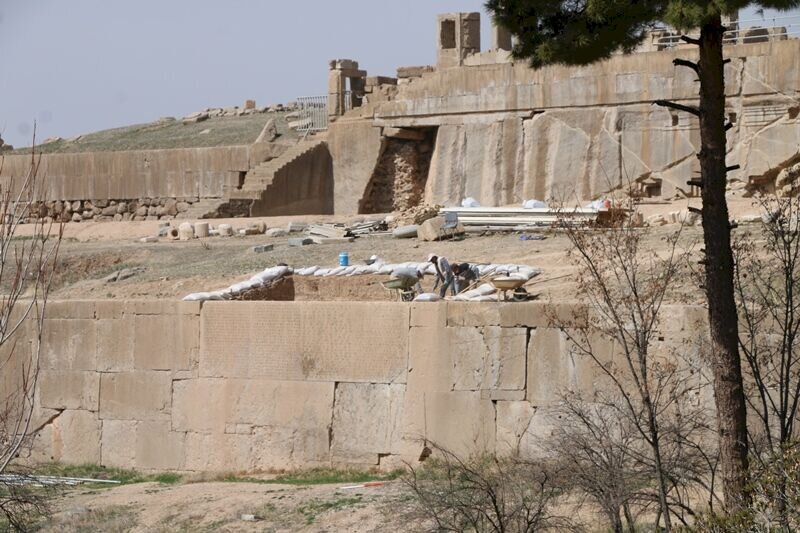
Tehran – Visitors to Persepolis will have access to the wonderful inscription of the Achaemenid king Darius I, written in Nowruz 1405 (March 2026). According to local authorities, the trilingual Luck sculptural reliefs are currently being restored.
Mojtaba Droudi, curator of the Persepolis Museum and an expert on ancient Iranian languages, announced this and said that the inscription is written in three languages and is considered to be one of the first inscriptions of Darius the Great, ISNA reported.
He said that the inscription south of the throne of Darius I was one of the first inscriptions at Persepolis, and that two of the columns were written in ancient Persian, while the other two were alone, and the inscription said that one was Elamite and the other Babylonian.
Regarding the content of the first column, known as DPD, which stands for “Darius, Persepolis, Number D,” Drorudi said, “The column begins with the name Ahura Mazda. Darius introduces himself and ends with the prayer, ‘May no drought, no enemies, no lies come to this land.'”
He added: “This desire expressed by Darius in this inscription shows that during the Achaemenid period our lands also faced problems of drought, and how carefully planned and implemented water management and protection of canals, dams and embankments were, such as the ancient Drozan dam, which dates back to the time of Darius.”
The curator of the Persepolis Museum also commented on the second pillar of the inscription: “This pillar is very interesting. In addition to introducing himself, Darius also mentions the tribes and nationalities that were ruled by the Achaemenid government. For example, he also mentions the Greeks, the Egyptians, and all the tribes that were under his command.”
He added: “In this inscription, Darius advises future rulers that if they wish to never be harmed, they should have the will of the Persian people. If they have the will of the Persian people, their country will never be harmed.”
Drudi went on to explain the period in which this inscription was written, saying, “This text seems to have been written when Darius was completing his collection, since the southern wall, the Achaemenid entrance, was later modified by the construction and reorientation of Xerxes. This inscription was written at the same time as the construction of Takht-e Jamshid.”
Shahram Rahbar, a senior specialist in the restoration of historical monuments, equivalent to a PhD in the restoration of stones and rock artefacts, and responsible for the restoration of the inscription south of the throne of Darius I in Persepolis, also announced that the restoration project of one of the largest inscriptions in Persepolis has begun. “The research, synthesis and restoration of this inscription is being carried out using the latest materials and supplies, in the presence of experts in ancient calligraphy and languages.”
He added that the inscription is one of the largest in Persepolis and, fortunately, had not suffered any human damage until work began.
Photogrammetry studies and scientific research began several years ago, and numerous conservation and restoration measures have been taken during this time, he added.
Raval continued that there are three main areas of inscription restoration. One is to strengthen the back side of the inscription to prevent the risk of collapse or movement due to earthquakes. Second, the design and implementation of a protective canopy. The third option is to directly restore the inscription itself.
KD