
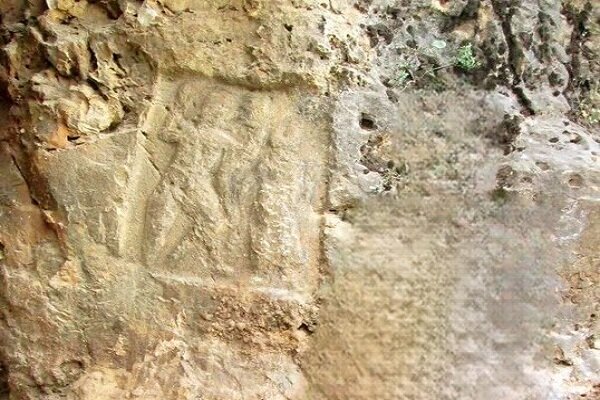
TEHRAN – Newly identified rock carvings of Elimaan have been discovered in the highlands of Kuhe Manar in Andika, southwestern Iran, according to the director of the National Base of Cultural, Industrial and Landscapes Masjed Soleiman.
Ayyub Soltani told Mehr News Agency that this sculptural panel, located in the central district of Andika district, could provide one of the most important clues to understanding the religious and ritual system of the Elima people of the central Zagros region.
Mr. Soltani said that the Elima people are the direct inheritors of the artistic and cultural traditions of the Elamites. Research shows that the group flourished from the decline of Achaemenid power to the rise of the Sassanids, adding that the peak of their influence and autonomy was during the Parthian period. He added that many of the artistic elements of the Sassanids were inherited from the Elimites and Parthians, who carried the traditions of the Elamites and Achaemenids into the Sasanian period.
He said the increasing number of identified Elimaan ruins, tombs, temples and rock carvings across the Bakhtiari Plateau indicates the extent of their territory and the continuity of their cultural presence. He said the newly identified sculptures at Manar offer a new perspective on the group’s belief system due to their unique content.
Soltani further described Andika as a “connection between the mountainous and lowland ecosystems of the Zagros Mountains,” reflecting a zone of exchange between the Elimean cultural traditions in the central and southern regions of the mountain range.
Explaining the technical details of the sculpture, he said the sculptor had prepared an irregular, almost trapezoidal surface measuring 70 x 81 centimeters on the rock face. He said three people are carved inside the frame, but some of the details have been lost due to natural weathering or intentional damage.
According to Soltani, the image on the left depicts a “heroic naked man,” shown in three-quarter profile with a powerful physique. He is depicted holding up a large round object (possibly a ceremonial mace) with his right hand, while holding the central figure by the throat with his left hand.
The central figure is a snake-like creature with three heads and is 83 centimeters long.
Soltani said that on the right side, a man wearing Parthian clothing can be seen from the front. This figure wears long, folded clothing, and resembles the priestly figures found in other sculptures at Elyma.
He said the composition, the sculpting of the chest, arms and thighs, and the figure’s posture suggest a deliberate emphasis on heroic and ceremonial themes. The scene may have been inspired by the mythical battle between Hercules and the Hydra, a motif also seen on the reverse of a Greek coin from 325 BC, he said.
Soltani said the sculpture is scientifically important and unique among known Yerima works. He said the rock’s surface would be severely eroded and some of the inscriptions would be lost, requiring the use of multidisciplinary methods such as next-generation laser scanning and precise mold-making.
Soltani added that physical protection, digital documentation and accurate recording of the scene are priorities for the research center.
According to sources, Elimaean (also known as Elimais or Elamais) was an autonomous state from the 2nd century BC to the early 3rd century AD, often under Parthian rule. It was located at the tip of the Persian Gulf in Susiana (present-day Khuzestan region, Iran). Most of the population is probably descended from the ancient Elamites who once ruled the area.
morning