
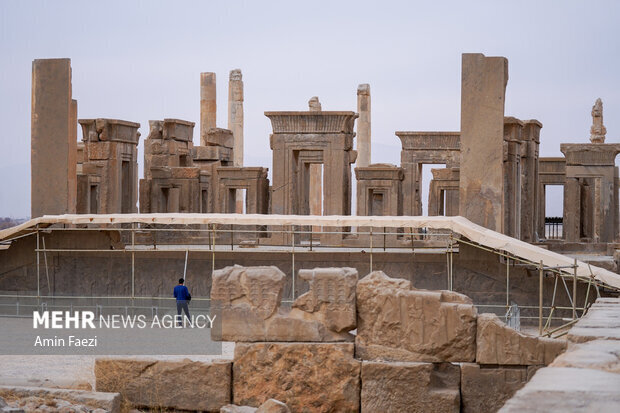
TEHRAN — President Masoud Pezeshkian, who is also the Chairman of the Supreme Council of the Cultural Revolution, declared the national document on cultural heritage, which is the result of the cooperation of the country’s scientific administration, cultural administration and administrative administration.
According to email communication, the document was approved at the 920th meeting in September 2025 and was approved based on the resolution of the 536th special board meeting.
The National Document on Cultural Heritage is a strategic document aimed at strengthening Iranian-Islamic identity, popularizing the protection of cultural heritage, increasing cultural heritage literacy, and promoting cultural diplomacy. It is considered a new roadmap for the preservation, restoration and wise utilization of Iran’s historical and civilizational assets.
The preface to this document states: Cultural heritage today plays an unparalleled role in social, cultural, political and economic development as the most important cultural resource available to society now and in the future. Undoubtedly, as one of the most fundamental pillars of strengthening identity, increasing creativity and self-confidence, recognizing, preserving and benefiting from it in tangible and intangible forms can bring any country closer to recognition of its values, history and sustainable progress.
Reflecting the cultural identity and personality of a society, this valuable heritage includes the past and the work, ways and customs of our ancestors. It expresses human cultural movements throughout history, in the process of reinforcing the dynamics of social excellence and identity, and as a representative of people’s identity and as a reflection and expression of their values. Understanding it prepares the ground for recognizing identity and its cultural movements.
This country’s cultural heritage. In a sense, it is a broad concept that encompasses all the actions and processes of identifying, recognizing, registering, managing, supporting, preserving, restoring, revitalizing, and introducing cultural heritage, which, by passing through the system of processing Iranian rationality and spiritual and religious wisdom, reproduces history in the form of lessons and opportunities today.
Thousands of years of history of Iran and its cultural heritage, despite its ups and downs and many changes and developments, provide humanity with very valuable models of social and spiritual life in the form of different types of cultural heritage, such as architecture, urban planning, literature, art, governance, etc., which, despite all modern perceptions and products, remain important and a path for humanity.
Iran’s cultural heritage is the intellectual and cultural achievement of thousands of years of elites and experts, the identity builder of the Iranian nation, and the common heritage of humanity, a treasure trove of human heritage that has played an unparalleled role and contribution in the formation of world civilization and produced artistic, scientific and civilizational breakthroughs in history. It left a lasting impact on all areas of civilization, including science, art, philosophy, economics, militarism, and governance around the world.
Due to the emergence of geographical and political borders in recent centuries, a large part of this heritage is located outside the current borders of Iran, and its preservation and transmission to future generations is not only a national duty, but also an international and historical responsibility for the Islamic Republic of Iran.
Iran’s cultural heritage is a bridge between ancient wisdom and enlightenment and modern experience, which will strengthen our identity through wise governance and management, and in turn pave the way for material and spiritual progress and the emergence of a new Iranian Islamic civilization.
In this regard, develop and approve the National Cultural Heritage Document as an important step within the macro-strategic framework of the National Cultural Engineering Map and the National Strategy, which focuses on the recognition, preservation and promotion of civilizational heritage and national and ethnic traditions, the strengthening of ethnic-cultural interaction with a focus on Iranian-Islamic culture, the maintenance of national unity and national action with a focus on supporting the cultural activities, cultural heritage, artistic and literary works of the Iranian people. Groups centered around Islamic and Iranian values, especially in border areas based on cultural and territorial plans, could potentially explain the Iranian and Islamic intellectual systems.
This document has been developed as a program document to harness the capacities of various social institutions and organizations in order to lay the foundations for general and specialized knowledge and basic measures for society for the effective protection and application of the cultural significance and values of cultural heritage.
It aims to establish the Islamic Republic of Iran’s role as the custodian of Iran’s cultural heritage and the common treasure of the world, and by trusting and leveraging this unique capital, lay the foundations for the country’s progress and the excellence of world culture as a whole.
KD