
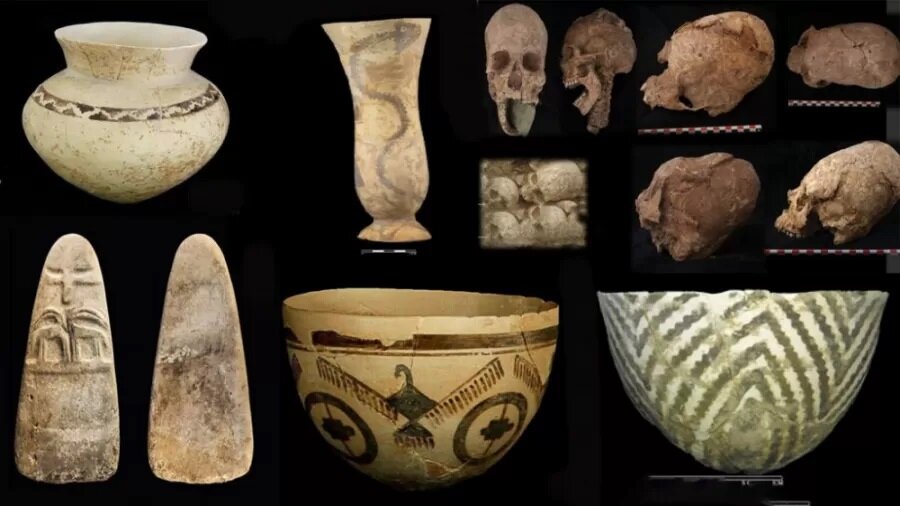
TEHRAN — The ancient Chega Sohra ruins in Dasht-e-Zole, southeast of Khuzestan province, are one of the Persian Gulf’s most important civilizational links, where the world’s first brick tombs, elaborate temples, and unique evidence of the privileged status of women in the 5th millennium BC have been discovered.
Announcing this, Abbas Moghaddam, archaeologist and head of the Chega Sohra excavation team, told Miras Alia (CHTN) that Chega Sohra was first identified in 1971 during a short survey by German archaeologists in Bebahan County and has since been considered one of the important civilizational sites of the Persian Gulf.
“Despite several excavation seasons, we have not yet reached the primitive geological formations of this historic site. However, current discoveries point to an earlier date of the early 5th millennium BC.”
He considered the most important discovery of the excavations to be the unique architecture of the Chega Sohra tomb, adding: “The Chega Sohra tomb is truly an eternal home and an afterlife. It is a completely architectural and magnificent structure built of bricks, whose precise proportions and clever design offer important lessons for us in ancient funerary architecture.”
According to him, the discovery of the world’s first brick tomb in this region is considered one of the most important evidences of funerary architecture in southwestern Iran and the entire Persian Gulf civilized region.
Commenting on the finds in the Chega Sohra residential area, Moghaddam said: “We discovered a large temple in the area, a temple with a prayer platform and an offering platform. A total of 73 raised stones were found on the offering platform. This is because we are deeply religious. This evidence leads us to conclude that Chega Sofra was likely a prominent ceremonial site in the 5th millennium BC.
The archaeologist believed that one of the surprising aspects of the excavations was the discovery of social patterns regarding the prioritization of women’s roles. “We identified a total of 102 burials, more than half of which were of women. The evidence shows that women had a superior status and a decisive role in this society.”
Moghaddam described examples of these burials as follows: “Next to a mass grave of 52 people, we found the burial of a 25-year-old woman named Katun.
The woman was buried with special order and respect, and was accompanied by two symbolic objects: a weight and a sword. This combination is reminiscent of the image of the goddess of justice with scales and a sword. Therefore, our interpretation is that during her lifetime, this woman played a role of authority and judgment in society, maintaining law and order. ”
According to him, “In the 11 brick tombs, the last person buried was a woman, and there are more female specimens than men among the deformed skulls, making the collection a clear demonstration of the female-centered social structure of Chega Sofra.”
Moghaddam believes that one of the most important issues ahead will be the discovery of the site’s main temple, adding: “Based on the evidence, it is certain that the main temple of Chega Sohra exists in a residential area, but it has not yet been discovered. This issue doubles the need to continue excavations.”
Regarding the livelihood structure of this society, he said: “The Chega Sofra people were skilled artisans – metalsmiths, potters, stonemasons, spinners and artists – with a completely subsistence livelihood model. Our findings show that this society had extensive connections with remote areas and imported raw materials such as obsidian, marble and metals from far away.”
“Chega Sohra has not yet revealed to us important parts of its secrets. The primitive geological formations, the great temples, and the details of the socio-economic structure of this society all require continued excavations to reveal a more complete picture of one of the oldest centers of civilization in the Persian Gulf,” the archaeologists concluded.
KD