
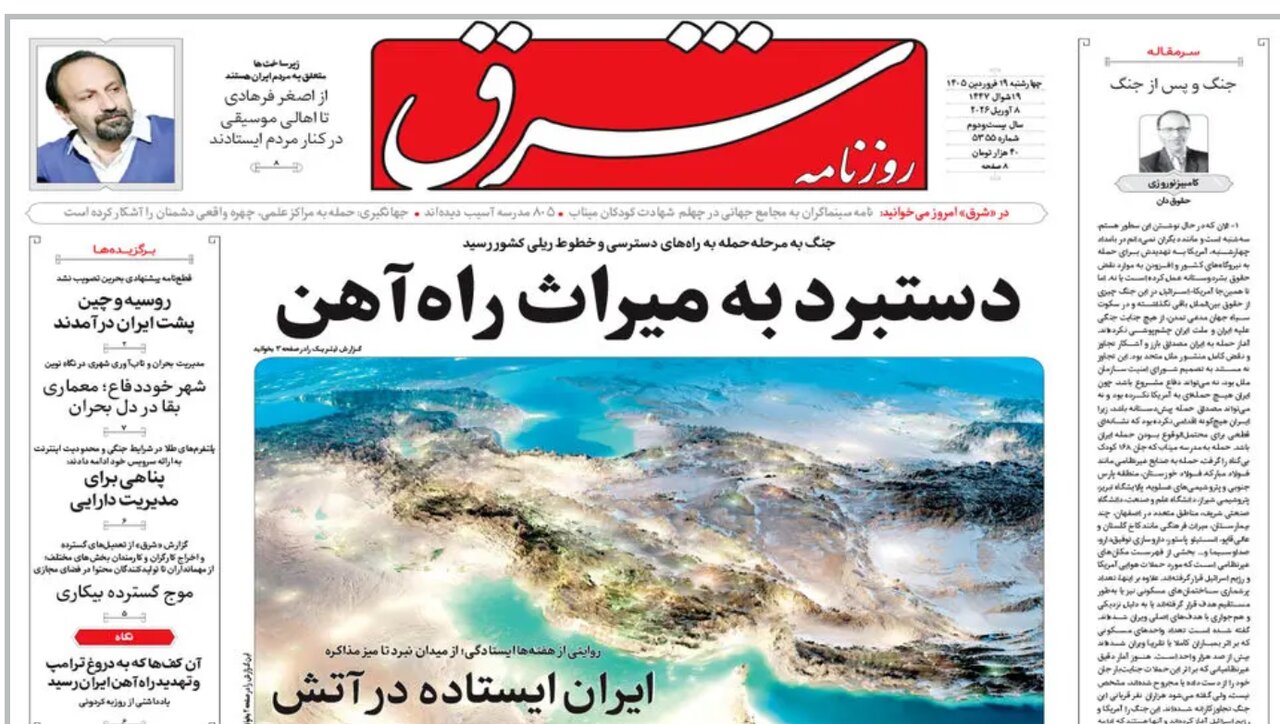
In his editorial, Mr. Sharg references the United States and Israel’s unjust war against Iran. They have left international law untouched in this war and have not refrained from committing any war crimes against Iran.
Attacks on Iran cannot be justified on any legal basis. It has not been authorized by the United Nations Security Council, it cannot be considered self-defense because Iran has not attacked the United States, and it cannot be considered a first strike because Iran has not taken any action that could be interpreted as a clear sign of an impending attack. Under the Convention on the Law of the Sea, Iran has the right to close the Strait of Hormuz. The United States or any other government has no legal right to use force to reopen the Straits or to use such claims as a pretext for war. The editorial concludes that the U.S.-Israeli war against Iran and its people is illegal in every respect and a widespread and clear violation of humanitarian law.
Mr. Etemad: Negotiations are not a sign of weakness, but the result of a change in the balance of power.
Etemad spoke about the war and Iran’s approach to it in an interview with political activist Mohammad Mohajeri. Mohajeri argues that Iran has moved its military capabilities from the theoretical realm to actual battlefield testing. Not only did Iran not collapse under pressure, it continued to fight back, demonstrating that external military threats cannot easily dismantle the country’s political and security structures. No war can last forever. All conflicts eventually reach a point where the parties must negotiate a cease-fire or agreement. By relying on its deterrent capabilities and applying pressure on US and Israeli interests, Iran has established itself as an actor that cannot be ignored. In such situations, bargaining is not a sign of weakness, but the result of a change in the balance of power.
Fahiktegan: Iran’s plan. Using geopolitical means to achieve a sustainable end to war
Fahiktegan reviewed Iran’s plans to end the war. The paper stated: Based on Iran’s general position during the war, Iran’s demands likely include: a complete cessation of the war, access to the benefits of the Strait of Hormuz, lifting of sanctions, and flexibility on its nuclear file. The core of Iran’s plan is to maintain influence in the Strait of Hormuz. The Strait of Hormuz guarantees the financial resources for reconstruction costs, which will be obtained through the collection of tolls and the obligation to compensate the parties. While Iran’s demands may seem surprising given the historical balance of power, this plan is consistent with reality. One of Iran’s key characteristics is its geopolitical ability to confront technology. Because Iran relies on its geopolitical position to successfully resist the pinnacle of global technology in the hands of the United States.
Kayhan: Compromise and negotiation are gifts to the enemy.
Mr. Kayhan expressed his views on the negotiations as follows: It is irrational and unscientific to expect the United States to renounce hostilities and abandon efforts to destroy Iran after a ceasefire. Because attacks on Iran are being carried out to bring Iran into submission, which is pursued by the United States and its allies as a never-ending strategic and long-term goal. The only way to counter it is to resist and make the enemy regret the attack. Therefore, the only result of a compromise or ceasefire is to allow the enemy to regroup and secure the resources needed for the next attack. The two military attacks that occurred in the midst of negotiations are exemplary cases and experiences that should not be forgotten. In other words, ceasefires, compromises, and negotiations are “gifts to the enemy”!
Etelat: Stalled US Iran War Scenario
Contrary to his stated position before the outbreak of war, President Trump is now explicitly threatening Iran with attacks on its economic infrastructure and even setting deadlines for such action. This apparent change in approach reflects, above all, the failure to achieve the war’s original objectives, concerns about its prolongation, and miscalculations in assessing the course and outcome of the conflict. This failure, coupled with the lack of effective cooperation from Western allies, has been particularly evident with regard to the continued closure of the Strait of Hormuz and the United States’ inability to reopen it. However, rather than resolving the crisis, such an approach may push it into a more dangerous phase. At that stage, the boundaries between limited war and regional conflict will rapidly disappear, and the consequences will engulf the entire region and even the international system.