
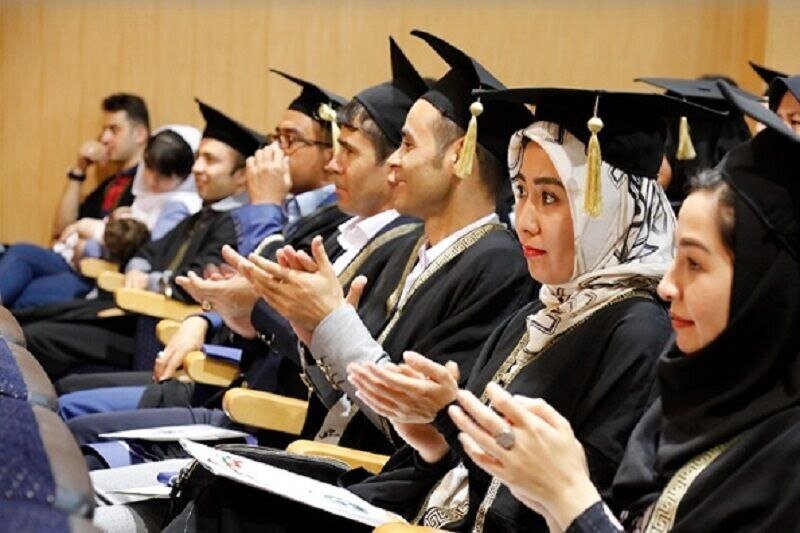
TEHRAN – The Ministry of Science announced that educational programs for foreign university students staying in the country will continue despite the unfavorable conditions caused by the imposed war.
In addition to continuing online education, all universities are being asked to ensure that all international students benefit from their universities’ educational facilities and capabilities by adopting innovative measures, such as preparing offline educational packages, developing summer intensive training courses, and predicting the possibility of completing practical courses in the coming years, IRNA reported.
These measures and plans should be implemented in a manner that ensures that international students do not suffer academic, training, or even financial losses due to the circumstances created by the imposed war.
Before the US-Israel war against Iran, nearly 60,000 international students from 101 countries, mainly from Afghanistan, India, Iraq and Pakistan, were studying in Iran.
Since the US-Israeli coalition’s attacks on Iran began, a series of large-scale attacks on Iranian scientific and academic centers have attracted world attention, including the Iranian University of Science and Technology, Shahid Beheshti University, the Iranian Institute for Space Research, Abbaspur University, and the Pasteur Institute in Tehran.
These attacks go beyond traditional military operations and have far-reaching strategic, cultural, and scientific implications. Analysis of these attacks highlights both foreign powers’ fears of Iran’s scientific progress and the need to emphasize the resilience of local science and knowledge in the face of violence and bombing.
According to reliable legal sources, targeting civilians and civilian infrastructure on this scale could be a clear violation of international humanitarian law. Under the Geneva Conventions and customary international humanitarian law, civilian locations, including schools and universities, are generally protected from attack.
Science Minister Hossein Simai Salaf said more than 30 Iranian universities have come under direct attack from the United States and Israel since the war began at the end of February.
Simai Saraf added that five university professors and more than 60 students were killed in the attack, and called attacks on Iranian infrastructure a “crime against humanity.”
“The main reason why the enemy targeted this sensitive infrastructure is because we did not want access to this technology,” he said, adding that many Iranians abroad have contacted the university and offered to help with recovery funds.
U.N. Ambassador Amir Saeed Irabani accused the United States and Israel of deliberately targeting Iranian universities and scientific institutions in an “unprecedented act of barbarity” and said the attack was a war crime that no amount of threats or military pressure could quell.
In a series of letters to the UN Secretary-General and the Security Council, Iravani detailed the systematic campaign of state terrorism.
He cited the early-morning airstrike on April 6 that caused extensive damage to Tehran’s Sharif University of Technology, which includes the faculties of civil engineering, electrical engineering, and research institutes for nanotechnology and environmental research. The attack follows a similar attack on Shahid Beheshti University on April 3, which damaged the university’s Laser and Plasma Laboratory.
“The deliberate targeting of scientific institutions and universities is a clear violation of international humanitarian law and amounts to a war crime,” Iravani wrote.