
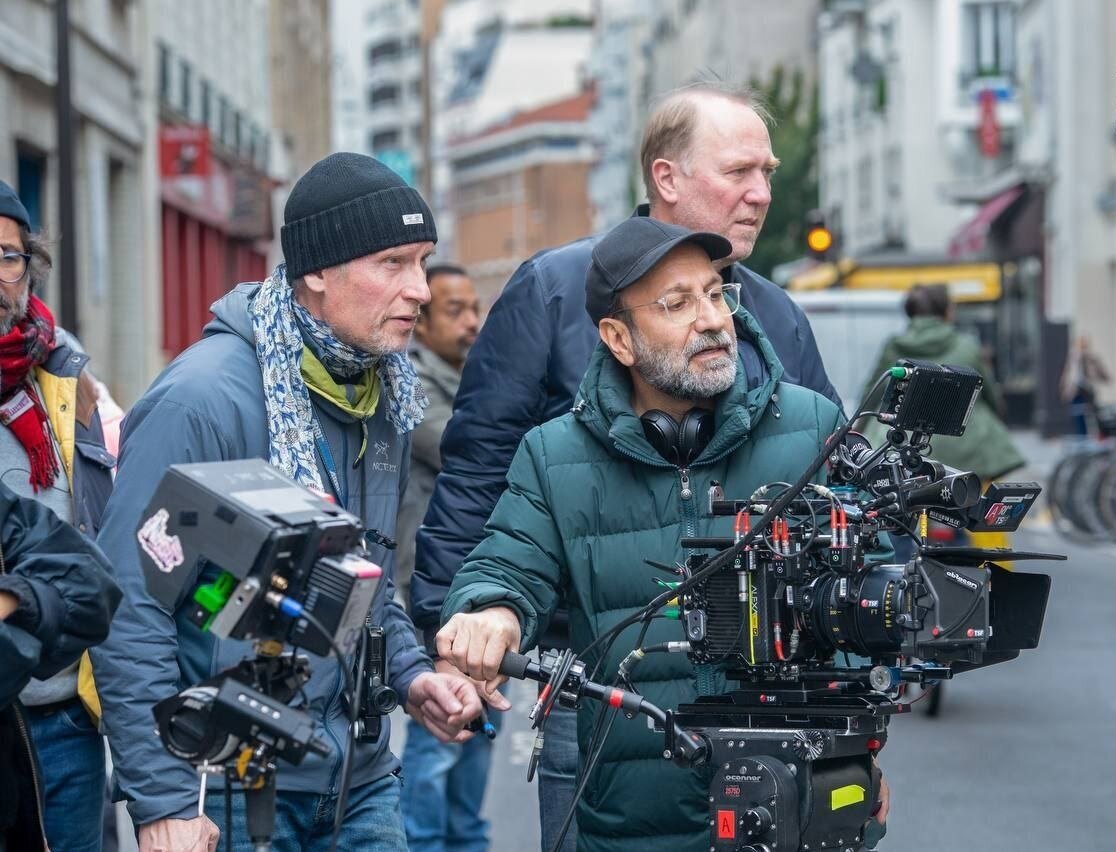
TEHRAN – The Cannes Film Festival has announced the lineup of its 79th author-led competition, including a new film by famous Iranian filmmaker Asghar Farhadi.
Farhadi’s 10th feature film, titled “Parallel Tales,” will compete for the coveted Palme d’Or against the latest works of notable names such as Polish director Paweł Pawlikowski, Japanese writer-director Ryusuke Hamaguchi, American director Ira Sachs, Spanish director Pedro Almodovar, and Romanian director Cristian Mungiu, Honalonline reported.
“Parallel Tales” is Farhadi’s second French-language film, following “The Past” starring Bérénice Bejo, which won the Best Actress award at the 2013 Cannes Film Festival.
The two-time Oscar-winning director’s new film was shot in Paris in the fall of 2025. The cast includes Isabelle Huppert, Vincent Cassel, Virginie Efira, Pierre Niney, Adam Bessa, and Catherine Deneuve.
The story, written by Farhadi, deals with a young man who falls madly in love with an older woman, leading him into a dangerous obsession.
The film, a French-Italian-Belgian co-production, was produced by longtime collaborator Alexandre Mallet-Guy, along with Farhadi and David Levine. This prestigious project will be launched at the upcoming Cannes Film Market by Charèze and UTA Independent Film Group. Charades is handling international sales and UTA Independent Film Group is representing U.S. rights. Sales in France will be handled by Memento.
This is Farhadi’s fifth collaboration with Memento Productions, following on The Past, the Oscar-winning film The Salesman, Everybody Knows, and A Hero.
The 79th Cannes Film Festival will be held from May 12th to May 23rd. South Korean film director Park Chan-wook will serve as the head of the jury for the main competition.
Farhadi, 53, one of Iran’s most prominent film voices, is known for his thought-provoking films that explore social issues. He earned a bachelor’s degree in theater arts from the University of Tehran in 1988 and then a master’s degree in theater directing.
Farhadi won the Best Foreign Film Oscar in 2012 for A Separation (also nominated for Best Original Screenplay) and again in 2017 for The Salesman.
He has been selected for Cannes competition four times for his films The Past, The Salesman, Everybody Knows, and A Hero.
At the 2016 Cannes Film Festival, “The Salesman” won Best Original Screenplay and Best Actor, and “A Hero” won the Grand Prix at the 2021 Cannes Film Festival.
Farhadi’s Spanish-language debut “Everybody Knows,” starring Penelope Cruz and Javier Bardem, opened in Cannes in 2018 and was in competition.
Farhadi was also elected twice in Berlin. In 2009, he won the Silver Bear Award for “About Ellie,” and in 2011, he won the Golden Bear Award for “A Separation.”
Last week, as Iran was fighting a war imposed by the United States and Israel, Asghar Farhadi called on artists and filmmakers around the world in a message to not be silent in the face of the destruction of Iran’s civilian infrastructure and to be a voice to stop aggression against Iran.
His message was a response to US President Donald Trump, who threatened to destroy Iranian power plants, bridges and other critical infrastructure.
President Farhadi stressed that the destruction of these centers is a direct blow to the lives and human dignity of the Iranian people.
“At this sensitive time, I appeal to artists and filmmakers around the world to be advocates in every way possible to prevent a devastating invasion that would lead to the destruction of civilian infrastructure,” he said in a message.
“These infrastructures belong to the Iranian people and are related to their basic daily needs. The destruction of infrastructure is not just the destruction of buildings, it is a blow to human life and dignity.”
“Any attack on a country’s infrastructure is a war crime. Regardless of your beliefs or viewpoints, let us unite our voices to stop this inhumane, illegal and destructive process,” he said.
The United States and Israel attacked Iran on February 28, martyring approximately 3,000 people in 40 days, including Islamic revolutionary leader Seyyed Ali Khamenei, several officials, and military commanders, as well as numerous civilians, including women and children.
The invaders initially claimed the purpose of the attack was to thwart Iran’s nuclear program, but later revealed their true purpose. Israel’s maximalist goal was regime change in Iran, and the United States sought to seize the country’s oil and gas resources.
Therefore, in addition to some military targets, the United States and Israel, in an attempt to force the country to surrender to unjust demands, have launched systematic attacks on civilian infrastructure, including homes, hospitals, refineries, power plants, schools, universities, artistic and cultural spaces, bookstores, museums, and ancient monuments in several cities, causing total or partial damage and injuring innocent people.
The attack prompted a swift response from the Islamic Revolutionary Guards Corps (IRGC), which gradually escalated missile and drone launches targeting Israel and several US military bases in the region.
Iran, the United States, and Israel agreed to a two-week ceasefire on April 8th. In a statement, the Supreme Council for National Security of the Islamic Republic of Iran announced that Iran had achieved a major victory in getting the United States and Israel to accept its 10-point plan.
Foreign Minister Seyyed Abbas Araghchi wrote about “If the attack on Iran ceases, our powerful armed forces will cease defensive operations. For a period of two weeks, adjustments will allow safe passage through the Strait of Hormuz,” he said.
SS/