
TEHRAN – UN Special Envoy Jean Arnault said the international community was not indifferent to the Minab School tragedy perpetrated by the United States and the Zionist regime of Israel, and said the genocide would be recorded in history.
On February 28, the United States launched a missile attack on Shajare Tayebeh School in the city of Minab in southern Hormozgan province, massacring approximately 170 students, mostly between the ages of 7 and 12.
Mr. Arnault visited Iran to witness the war crimes committed by the invaders against Iran in the past 40 days.
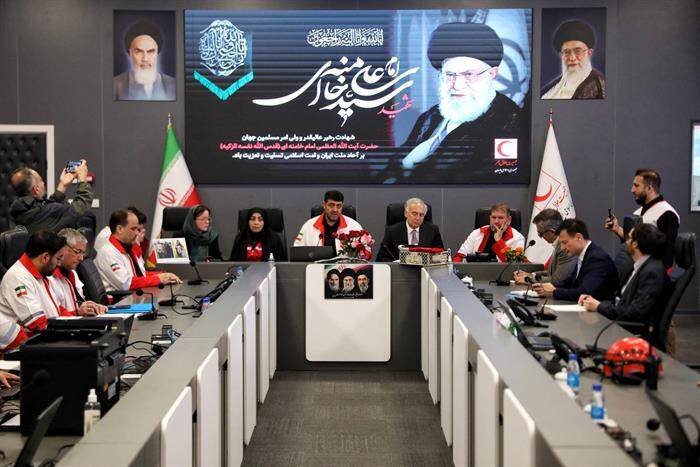
“The world is listening to you,” Arnault said in a meeting with Iranian Red Crescent Society (IRCS) Chairman Pirhossein Kolivand.
Praising the efforts of IRCS, he said: “The performance of my colleagues is a clear demonstration of the sacrifices made under extremely dangerous conditions over the past five weeks.
I’m sure you all have seen and felt that the international community is not indifferent to this tragedy. “Public opinion in many countries, as reflected in numerous surveys, condemns this war and considers its consequences extremely serious,” he added.
“Given the crimes committed and the suffering of women and children as a result of this war, Iran and our colleagues at the United Nations are making great efforts to end this war,” the official stressed.
Kolivand called on the UN envoy to be a voice for the suffering of the Iranian people and to take action to protect the rights of those who lost their lives in this war.
Elaborating on the latest reports on damage to civilian areas and facilities, Mr. Kollivand said: “Six weeks since this war began, 857 schools and educational facilities, 338 hospitals, clinics and emergency centres, 49 relief logistics facilities, 43 ambulances, 20 Red Crescent centers and three Red Crescent helicopters have been hit by missiles, damaged or destroyed.”
He added that four aid workers were killed and many others injured while conducting search and rescue operations for affected people during humanitarian operations in this war.
The official continued: “You are well aware that there are laws that prohibit attacks on these areas under any circumstances and classify targeting these areas as a war crime. But those who enact these laws are the ones who are violating these laws.”
He further said that as an independent body, IRCS submits and reports documents and observations regarding these crimes to the United Nations (UN), the International Committee of the Red Cross (ICRC), the International Criminal Court (ICC), and all relevant international organizations.
The official provided the UN envoy with a map of targets in civilian, residential and commercial areas hit, along with videos showing Red Crescent rescue workers rescuing people trapped under rubble.
Sharing a video of the series of airstrikes near Tehran’s Qatam al-Anbiya Hospital, Kolivand said that it showed the panic of patients and the efforts of nurses and medical staff to evacuate patients and move newborns out of the hospital. At the time of these attacks, 21 patients were undergoing heart surgery at the same time, 16 operating rooms were in operation, and the hospital suffered damage comparable to a magnitude 7.5 earthquake.
“How long should international organizations remain silent in the face of these crimes? We have provided humanitarian aid in these conditions. Who can challenge these documents? I ask all of you who are here to witness these events firsthand to awaken the conscience of the world and fulfill your legal responsibilities like other organizations.”
Indiscriminate war is indefensible and violates the law.
Meanwhile, Mirjana Sporjaric, President of the International Committee of the Red Cross (ICRC), in her statement on hostilities in the Middle East, stressed that indiscriminate war is indefensible and incompatible with law.
Deliberate threats against essential civilian infrastructure and nuclear facilities, whether in rhetoric or action, must not become the new norm of war.
War waged without restrictions is against the law. It is indefensible, inhumane and devastating to all citizens.
Across the Middle East, our teams are witnessing the destruction of critical infrastructure for civilian life. Power plants, water systems, hospitals, roads, bridges, homes, schools and universities are exposed to fire.
Most worrying is the potential threat to nuclear facilities. Miscalculations can have irreversible consequences for generations to come.
I urgently call on States Parties to refrain from using civilians or civilian objects in any military operations. It is their obligation under international humanitarian law.
States must respect and ensure that the rules of war are respected both in speech and action. The world cannot succumb to a political culture that prioritizes death over life.