
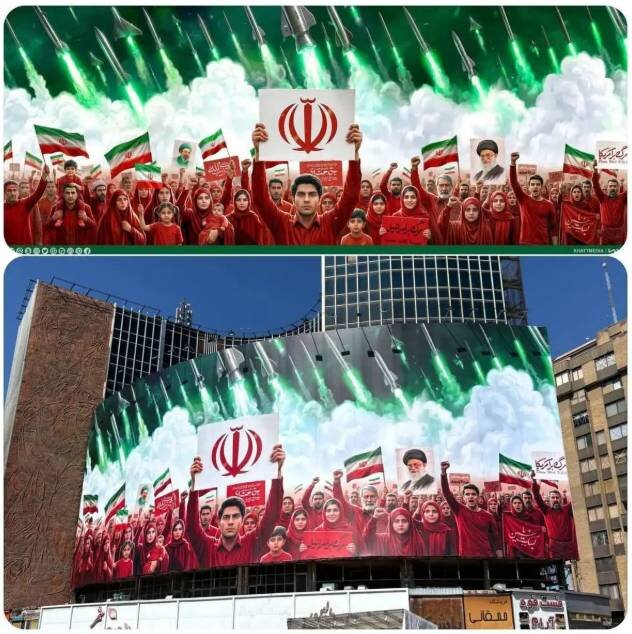
TEHRAN – Several international artists and cultural figures have reacted on social media following US President Donald Trump’s acceptance of Iran’s terms and the April 8 ceasefire announcement, which marks a decisive failure between the US and Israel in the war against Iran.
Robert A. Pape, a political science professor at the University of Chicago, wrote in a post on X: “Here is the currently circulating 10-point peace plan that President Trump has deemed ‘acceptable’. A major strategic defeat for the United States, its biggest loss since Vietnam. It marks the rise of Iran as the fourth center of world power.”
Iran’s 10-point peace plan is as follows: Guarantee that Iran will not be attacked again; a permanent end to the war, not just a cease-fire; a cessation of Israeli attacks in Lebanon; lifting of all U.S. sanctions against Iran; cessation of all regional hostilities against Iranian allies; Iran reopening the Strait of Hormuz; Iran will charge a $2 million fee for each ship passing through Hormuz, and Iran will split these fees 50-50 with Oman, as Iran will establish rules to ensure safe passage through Hormuz, and Iran will use the costs of Hormuz for reconstruction rather than compensation.
British columnist, commentator, journalist, and author Owen Jones also mentioned the plan, writing, “This is Iran’s 10-point plan, which President Trump has accepted as a ‘viable basis for negotiations.'”
“There is no question: this is the greatest strategic defeat for the United States since its rise as a superpower.”
American author Don Winslow wrote of X: “Donald Trump created an international disaster over absolutely nothing, then entered into negotiations to abandon everything.”
This man is a big loser elected by 77 million misguided Americans. America has become weaker under the Trump administration.”
“History was made tonight. The United States lost the Iran war,” Canadian journalist Mark Slapinski wrote in X.
Max Burns, political columnist for MSNBC, The Hill, US News & World Report, and DAME Magazine, wrote of X: “Donald Trump fought this terrible war in Iran, and the end result is a deal that Iran gets: control of the Strait of Hormuz, unlimited uranium enrichment, the lifting of all US sanctions, the lifting of all UN resolutions against sanctions, and cash compensation from the US. Who won again?”
“Frankly, this is a major strategic defeat for the United States, whatever it is,” said Janice Stein, a conflict management professor at the University of Toronto.
He added: “Neither the US nor Israel has met their goals and Iran now controls 20% of the world’s oil and natural gas. This is an incredibly big victory for Iran.”
Famous American author Stephen King wrote in X: “The average price of a gallon of regular gasoline in the United States in February was $2.91; it is now $4.22.”
“This is what happens when you elect a fool to be president of the United States and allow him to go to war without Congressional approval,” he added.
Prominent Egyptian actor Amr Waked highly praised Iran’s resistance in the war imposed by the US and Israel, writing in X: “God bless us the Iranian nation and Iranian missiles.”
Italian film producer Robin Monotti published an image of the tomb of the Minab student martyr and wrote in X: “Melania said of Iranian children, ‘This is all happening for their future, so they’ll be safe for years to come.'”
The United States and Israel attacked Iran on February 28, martyring approximately 2,000 people, including Islamic revolutionary leader Seyyed Ali Khamenei, several officials, and military commanders, as well as numerous civilians, including women and children, over a 40-day period.
The invaders initially claimed the purpose of the attack was to thwart Iran’s nuclear program, but later revealed their true purpose. Israel’s maximalist goal was regime change in Iran, and the United States sought to seize the country’s oil and gas resources.
Therefore, in addition to some military targets, the United States and Israel, in an attempt to force the country to surrender to unjust demands, have launched systematic attacks on civilian infrastructure, including homes, hospitals, refineries, power plants, schools, universities, artistic and cultural spaces, bookstores, museums, and ancient monuments in several cities, causing total or partial damage and injuring innocent people.
On the first day of the attack, Shajare Tayebeh Primary School in Minab, Hormozgan province, became the scene of a devastating massacre. Dozens of girls and boys aged 7 to 12 were starting classes when the school was targeted by a missile attack, which collapsed the building and trapped the children and teachers under rubble. Iranian authorities said the final death toll was 185 people and about 100 injured.
The attack prompted a swift response from the Islamic Revolutionary Guards Corps (IRGC), which gradually escalated missile and drone launches targeting Israel and several US military bases in the region.
In a statement on April 8, the Supreme Council for National Security of the Islamic Republic of Iran announced that Iran had achieved a major victory in getting the United States and Israel to accept its 10-point plan.
Foreign Minister Seyyed Abbas Araghchi wrote about “If the attack on Iran ceases, our powerful armed forces will cease defensive operations. For a period of two weeks, adjustments will allow safe passage through the Strait of Hormuz,” he said.
SS/