
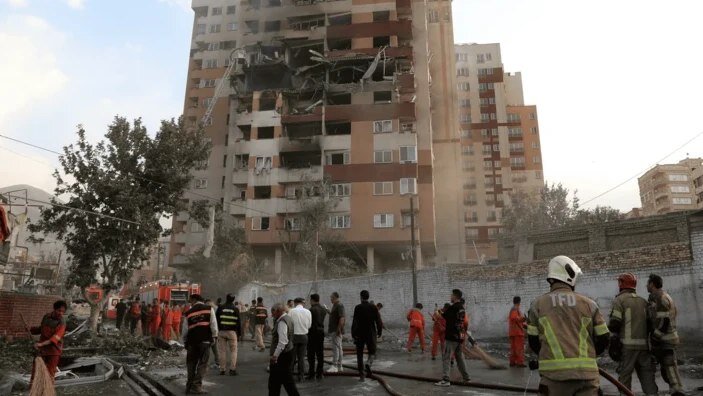
TEHRAN – The Iranian Red Crescent Society (IRCS) and the National Committee for Humanitarian Law (NCHL) have condemned the US and Israeli attacks on the country’s civilian infrastructure.
In a joint statement released on Wednesday, IRCS and NCHL warned of Israeli attacks on critical civilian infrastructure carried out with US support and called for unconditional adherence to the “principles of international humanitarian law.”
“At least eight railways and 59 airports, public facilities, connecting roads, bridges and transportation networks have been targeted in recent attacks,” the statement said.
“Additionally, electrical substations, nuclear power plants, and petrochemical facilities have also been targeted, causing severe disruption to energy supplies, critical services, and the basic needs of the population, resulting in widespread and long-term impacts on the lives, health, and safety of civilians.
The Iranian Red Crescent Society and the National Humanitarian Law Committee emphasize that in accordance with the fundamental principles of international humanitarian law, in particular the principle of distinction, any attacks on civilian property or infrastructure are prohibited and those responsible will be held accountable for gross violations of international obligations.
Targeting infrastructure that primarily serves civilian functions would be a clear violation of these principles.
IRCS and NCHL call on international organizations, such as the United Nations and the International Committee of the Red Cross, to carry out prompt and independent investigations and documentation of the attacks, strengthen oversight of compliance with international humanitarian law, use all legal and diplomatic means to deter these attacks, and provide the necessary basis for accountability and prosecution of those responsible for these violations. ”
The statement also stressed that ensuring safe and prompt access to humanitarian assistance and protecting critical infrastructure is a fundamental responsibility of the international community, and that any disruption in this regard would have irreversible humanitarian consequences.
The report emphasized the need to protect the lives, dignity and safety of civilians under all circumstances and stressed that violations of these principles must not go unchecked.
According to reliable legal sources, targeting civilians and civilian infrastructure on this scale could be a clear violation of international humanitarian law. Under the Geneva Conventions and customary international humanitarian law, civilian locations, including schools and universities, are generally protected from attack.
The attack on Tehran’s Pasteur Institute, a research and public health center that is more than 100 years old and a member of the International Pasteur Network, is a prime example of the targeting of scientific institutions as part of modern warfare. Established in the 1920s, the institute was a regional pioneer in vaccine production and has played a key role in controlling deadly diseases in the region, particularly plague, which originates from wild animals.
In the context of modern warfare, destroying such organizations constitutes an attack on future human capital. Education, research, and technological production form a continuous cycle of national development, and targeting universities, especially those engaged in research related to defense, energy, and strategic technology, is in effect an effort to dismantle the nation’s scientific infrastructure and knowledge production.