
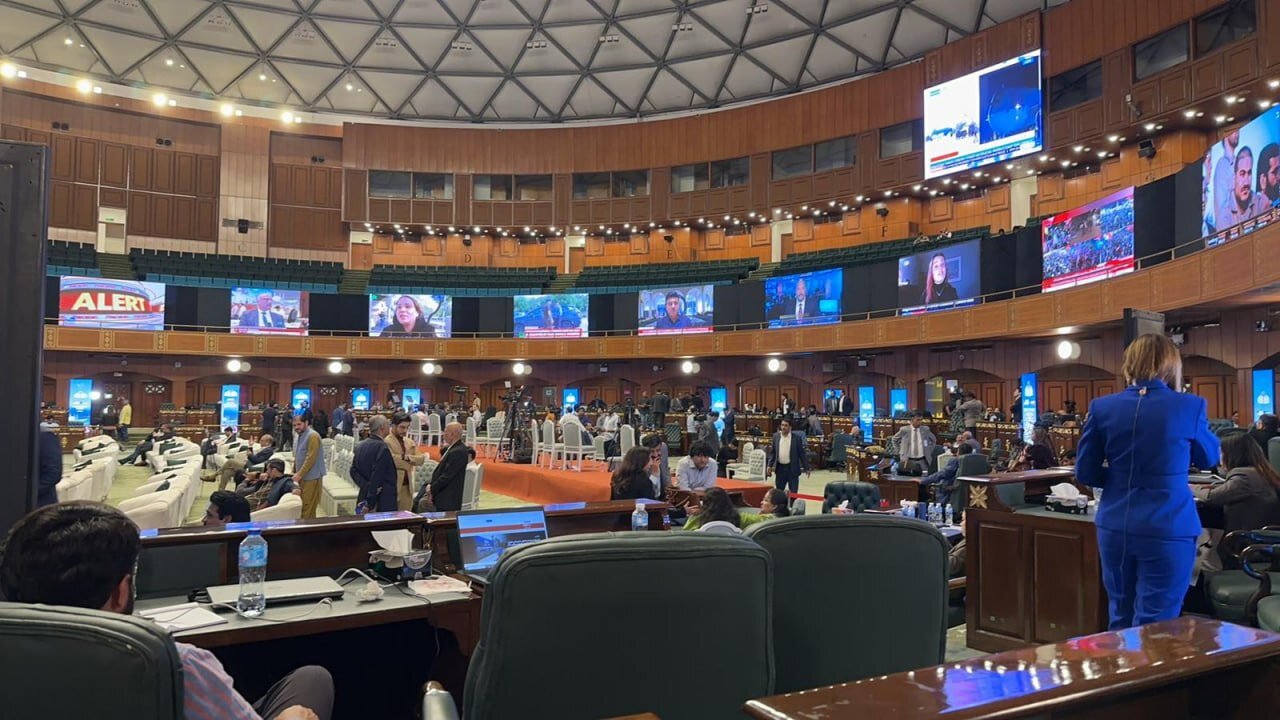
ISLAMABAD – As a Wall Street banker who has spent more than three decades observing the turbulence in the relationship between Iran and the United States, from the 1979 Islamic revolution that reshaped the Middle East to the high-stakes Islamabad talks that are still unfolding as I write these words in April 2026, I have witnessed a cycle of hope and betrayal that no other relationship can match.
Twice in recent memory, American forces attacked Iranian territory while serious negotiations were actively underway. In June 2025, during the first round of Oman-mediated negotiations, which were making cautious progress, the United States launched a devastating airstrike under Operation Midnight Hammer targeting Fordow and Natanz nuclear facilities, as well as the Isfahan Nuclear Technology Center, using bunker-buster bombs and Tomahawk missiles.
Then, in early 2026, further US and Israeli operations dramatically escalated tensions, even as indirect talks continued in Geneva and other venues. Iranian diplomats and officials rightly described these actions as an unprovoked betrayal of the spirit of negotiation. We have sat at the table in good faith and exchanged proposals through mediators, but Washington has chosen the language of force.
The message sent to all Iranian families in Tehran, Tabriz and Shiraz, and to the vast nation of Europe, North America and beyond, was crystal clear. America’s commitments, even in the midst of dialogue, are fragile and unreliable. But Iran is clinging to these Islamabad talks not out of weakness, but out of the deep well of resilience that has characterized our country since the revolution. We choose principled engagement because real strength lies in protecting sovereignty while reaching out for mutual respect.
The historical ledger since 1979 reveals a pattern of American pressure against Iranian patience. After the hostage crisis, the Carter administration froze billions of dollars in Iranian assets. This asset was earned through the sweat of the people and rightly belongs to them. Sanctions accumulated during the 1980s and 1990s were strengthened under successive U.S. administrations, including oil embargoes and extraterritorial measures targeting third-country companies. The 2015 Joint Comprehensive Plan of Action (JCPOA) provided short-lived relief. Iran has scaled back parts of its peaceful nuclear program in exchange for sanctions relief, the International Atomic Energy Agency (IAEA) has verified. Economic indicators have improved markedly, GDP growth has accelerated, inflation has eased somewhat, and ordinary people have glimpsed a more stable future.
But in 2018, the Trump administration unilaterally withdrew and reimposed “maximum pressure” sanctions that strangled trade, medical imports and commercial aircraft spares. Partial freezes were later lifted, including on Qatari holdings in 2023 related to the prisoner exchange. This cycle of broken promises has taken a heavy toll on families struggling with soaring prices, hospitals facing shortages, and technology-hungry industries. But Iran’s “economy of resistance,” built on domestic innovation and strategic partnerships with Russia, China, and regional allies, weathered the storm and proved that a nation rooted in self-reliance and revolutionary ideals cannot be defeated by any external pressure.
Signs of possible movement regarding frozen assets emerged today amid Islamabad negotiations brokered by Pakistan and involving key figures such as Iranian Foreign Minister Abbas Araghchi and U.S. special envoys Steve Witkoff and Jared Kushner. Iranian sources have suggested the US government may agree to unfreeze about $6 billion held in Qatari banks and other overseas accounts, with funds derived from oil revenues blocked since 2018. For Iran, this is no mercy. It is an elementary justice that has long been denied.
These resources can quickly address pressing needs, such as rebuilding infrastructure damaged in recent conflicts, upgrading power generation equipment to alleviate summer power outages, strengthening health systems strained by years of sanctions, and injecting liquidity into small and medium-sized businesses that employ millions of people. The benefits will ripple outward, stabilizing the real world, creating jobs for young people, and allowing scientists and engineers to focus on progress rather than avoidance. For the Iranian diaspora, many of whom maintain deep emotional and cultural ties despite living abroad, such relief would mean new confidence to invest in their homeland and support their families without the shadow of economic isolation.
From an American perspective, it is in its practical self-interest to respect asset releases and pursue durable agreements. Persistent conflicts have cost Washington trillions of dollars in losses in the Middle East, but have shown nothing but instability. The negotiated settlement promises lower volatility in global oil prices, which are critical to U.S. consumers and industry, safe passage through the Strait of Hormuz, through which a significant portion of the world’s energy flows, and reduced exposure of U.S. forces to regional risks. No longer will American lives be needlessly put at risk for policies that have repeatedly failed to achieve regime change and obedience. Instead, Washington could direct resources to domestic priorities and rebuild trust damaged by policy reversals that have alienated even traditional allies.
Actual outcomes depend on realism and reciprocity. Any durable agreement would need to include gradual and verifiable sanctions relief in sync with Iran’s peaceful nuclear program monitored by the IAEA. Iran has consistently affirmed its commitment not to pursue nuclear weapons, to fully comply with non-proliferation norms, and to assert its inalienable right to enrich energy and medical isotopes under international safeguards. Explicit and legally binding guarantees against future unprovoked military attacks, whether by direct U.S. operations or effective proxies, are non-negotiable. A broader regional détente should address proxy dynamics without requiring Iran to abandon its legitimate defense posture or its role as a stabilizing force in West Asia. Iran’s negotiating team approaches negotiations from a position of strength, drawing on decades of diplomatic experience and deep knowledge of red lines rooted in national dignity. The U.S. side must recognize that political appointees and business figures are often confused, and that bullying tactics and last-minute betrayals only perpetuate mistrust.
Confidence-building measures can accelerate progress. Immediate lifting of asset freezes in the coming weeks, combined with mutual easing of tensions such as easing restrictions on humanitarian trade, will demonstrate its seriousness. A structured timeline (likely 45-90 days for initial sanctions relief in exchange for enhanced non-intrusive IAEA access) provides measurable milestones. Mechanisms to prevent interference by third parties, such as clear communication channels and dispute resolution forums, are essential. Regionally, an understanding to secure shipping lanes while respecting sovereignty could reduce flashpoints in and around the Persian Gulf.
The benefits of peace extend far beyond governments. For Iran and its resilient people, success means economic revival. These are: reintegration into global markets, access to advanced technologies for sustainable development, modernization of infrastructure and bright prospects for the next generation. Families in Isfahan and Mashhad will see stable prices, improved education and health care, and the dignity of a sovereign state where they are treated as equals. Diaspora communities such as doctors, engineers, and entrepreneurs working abroad would be able to channel their expertise and capital more freely, strengthening bonds rather than harboring the frustrations of isolation.
For ordinary Americans, the benefits are equally tangible. Avoiding another multitrillion-dollar quagmire, predicting energy costs that ease inflationary pressures at the pumps and factories, and restoring diplomatic credibility after years of unilateralism that isolated Washington on the world stage.
Iran has never sought domination or endless conflict. The 1979 revolution was fundamentally about independence, justice, and resistance to external interference. We have continued to defend our borders and principles with determination, and we have repeatedly extended olive branches when respect has been shown. The practical suggestions for both parties are straightforward and based on mutual benefit. First, treat negotiations as a dialogue between sovereigns, rather than a zero-sum game. Second, prioritize verifiable and irreversible sanctions relief over vague promises. Third, include sunset clauses with review mechanisms to build long-term trust rather than permanent suspicion. Fourth, to explicitly address the humanitarian aspects and ensure that medicines, food and civil aviation spares can flow unhindered. Fifth, promote a parallel economic path through third-party guarantees, perhaps involving Chinese, Russian, or European actors, to insulate any deal from future U.S. domestic politics.
These Islamabad talks are likely to span important days with a trilateral element involving Pakistan’s mediation, and the world will be watching closely to see how they unfold. Iran is ready. We are resilient after decades of pressure, ready to protect our core interests, and open to a dignified peace that heals our wounds and charts a stable future for our region. If the United States finally learns from its past betrayals and respects its business, both countries and their people will emerge as winners. Winners do not impose conditions, and losers do not submit. It’s just that two proud civilizations are choosing dialogue over drones and cooperation over confrontation. Ultimately, the choice lies with Washington. True to its revolutionary spirit and historical depth, Iran waits with cautious hope, unwavering dignity, and quiet confidence that justice and resilience will prevail.
(This article was written before negotiations between Iran and the United States in Pakistan ended inconclusively due to excessive demands on the American side)
Mir Mohammad Alihan was the first Muslim founder of a Wall Street investment bank. Author of 6 books, former Federal Advisor to Pakistan