
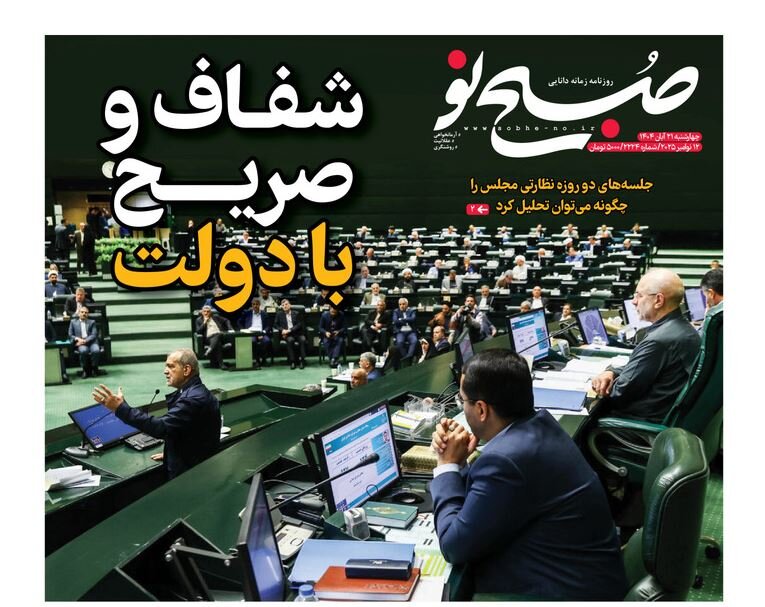
TEHRAN – In an interview with Sob-e-No, Middle East expert Mosaddegh Mosaddeghpour said Israeli Prime Minister Benjamin Netanyahu is seeking support from President Trump and other Western countries to start a new war with Iran.
The analyst claims that President Trump and his team have provided maximum cooperation to the Zionist regime and that without this support Israel would have faced major challenges. Prime Minister Netanyahu has once again gotten the green light from the Americans and is making great efforts to provoke a conflict with Iran and draw the West into a potential war with Iran. Apparently he can’t move on without war. He is always trying to establish or maintain a wartime state. If the war stops, the situation will become very difficult for him and he may be defeated and unable to obtain a favorable result. A few days ago, it was announced that all Israeli actions against Iran were under President Trump’s supervision. President Trump intended to send a signal that Israel was his tool and that he could attack it again if he wished. Such statements are both a threat and an invitation to negotiate. In any case, relationships between players can be very complicated.
Sazandegi: Syrian new actor
Mr. Sazandegi investigated the visit of Syria’s new ruler, Ahmad al-Sharaa, to the United States. This visit should be seen as a turning point in the history of Damascus’ relations with the Western world. It could signal an acceptance of a new reality and the beginning of a new engagement between Syria and the West. Syria has been a close ally of Iran for decades, but there are now clear signs that Damascus is distancing itself from Tehran. Observers believe hidden tensions between Damascus and Tehran are gradually pushing Syria away from the “axis of resistance” and toward normalizing relations with the West. Iran may be the biggest loser in this geopolitical shift. During the Syrian civil war, the Iranian government spent more than $50 billion supporting Damascus, from military and arms aid to infrastructure reconstruction and financing the Assad regime. But now, with Syria’s foreign policy pivoting, it is unlikely that there will be any return on that investment. Countries such as Türkiye, Qatar, and Saudi Arabia are gradually being replaced by Iran. Actors who are influential in the Arab world and have close ties to the West. As a result, Syria is back in the Arab world and rebuilding its relations with the West, a process that continues with the visit to Washington.
Armand et Meri: Good mediator!
Armaan-e-Meri analyzed the Iran-US negotiations and wrote: Some analysts believe that a new conflict between Iran and Israel could erupt at any time, so Iran takes a special view of the negotiations and refuses to negotiate in the shadow of war. In reality, even though tensions between Iran and the United States have declined in recent weeks, neither side has withdrawn their positions. According to recent statements by Ali Larijani (Secretary of the Supreme Council for National Security), Iran is not responding to the United States, but it must find a solution to this “neither war nor peace” atmosphere. This is where mediation becomes relevant. To break out of the current situation, both sides need to enter a new phase, select a trusted mediator and begin negotiations. The mediator, who can quietly move between parties away from media attention, could create the conditions for President Trump to soften his stance on zero percent enrichment. Which countries or individuals can influence President Trump is a question that must be determined by diplomacy.
Iran: Strategic first strike by Iran
In its commentary, the Iranian newspaper referred to the Islamic Republic’s deterrence capabilities following the 12-day war started by Israel and later joined by the United States. The paper wrote, “The U.S. government is trying to impose a potential negotiating framework by offering a disproportionate and unachievable set of demands, ranging from curbing Iran’s missile program to limiting its regional role.” In the shadow of the 12-day war and developments that took place in its final days, a significant change in the dynamics of the battlefield appeared in Tehran’s favor. Any military action against Iran would therefore be significantly heavier and more unpredictable in costs than before. The high level of readiness and restructuring of Iran’s military infrastructure in the postwar period reflects a major shift in the logic of deterrence, which has now evolved into a phase of strategic initiative and preemption. The Iranian government has turned deterrence into a positive concept in its national security principles. This change is evident in the restructuring of military planning models and the expansion of strike capabilities. Now, displays of power are designed to shape enemy perceptions of the costs of military adventures.