
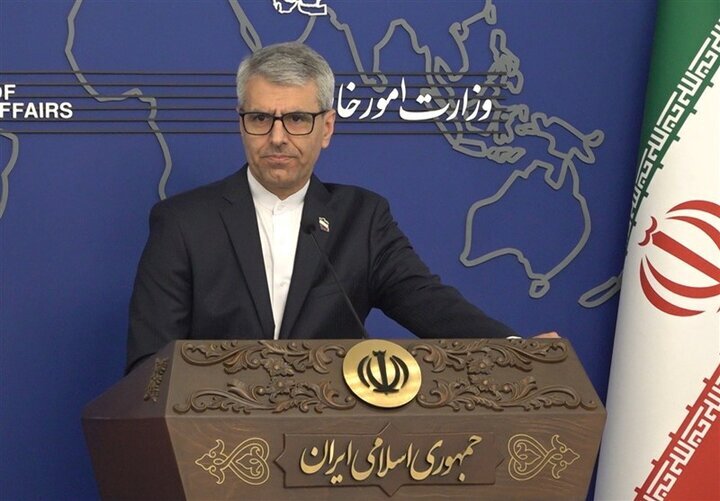
TEHRAN – Foreign Ministry Spokesman Esmail Bakaei addressed a wide range of political, legal and regional issues at his weekly press conference on Monday.
Among the topics he addressed were President Trump’s recent acknowledgment of his role in June’s war with Iran, Iran’s accession to the NPT, Israeli aggression in the region, and other regional tensions.
“Trump’s confession is evidence of war crimes”
Bakkai referred to US President Donald Trump’s recent public admission that he personally authorized the June 13 attack on Iran, saying the admission amounted to a “clear admission of an international crime.”
“From the beginning, we had no doubts about U.S. complicity. Now, with the president of the United States publicly confessing, the matter can no longer be denied. We immediately entered this confession as part of our war crimes record.”
“It will be used as clear evidence in relevant international tribunals.”
He confirmed that Iran is “pursuing all legal avenues” to prosecute the United States for its involvement in the invasion.
Before going to war with Iran, US President Donald Trump succeeded in getting the country to engage in indirect negotiations over its nuclear program. This was in contrast to the president’s first term, when Tehran rejected such negotiations after withdrawing from the 2015 Iran nuclear deal and reimposing sanctions against Iran. But the U.S. president started the war just days before the sixth round of negotiations was scheduled to take place in Oman.
“Iran will continue to fulfill its obligations to the NPT.”
Baquay reiterated that Iran will continue to fulfill its obligations as a party to the Non-Proliferation Treaty (NPT).
He said IAEA inspectors visited several nuclear facilities last week, including the Tehran research reactor.
“A new request by the authorities will be referred to the Supreme National Security Council,” he said, adding: “The situation in Iran after the recent attacks is exceptional and cannot be treated as normal.”
He criticized European countries for “invoking snapback mechanisms” despite the Cairo agreement, which paved the way for cooperation.
Bakuayi also discussed the upcoming IAEA Council meeting, noting that Iran expects the three European member states to continue to align with the hostile US policy.
He stressed that Iran’s representative in Vienna was in close contact with member states ahead of the meeting.
The snapback mechanism was formally activated in late August by the European signatories to the 2015 Joint Comprehensive Plan of Action (JCPOA) – the UK, Germany and France. On September 19, the UN Security Council voted against permanently lifting pre-JCPOA sanctions against Iran. On September 27, the Security Council also rejected a resolution proposed by Russia and China, which remain signatories to the JCPOA along with Iran after the US withdrew in 2018, to delay the reimposition of sanctions. The next day, E3 announced that UN sanctions against Iran had been officially reimposed.
“The Israeli regime’s claims about the alleged assassination plot are absurd.”
Regarding the Israeli regime’s claims about an alleged plot to assassinate the Mexican ambassador, Bacaei called the accusations “so ridiculous that there is almost no need to respond.”
He added that Mexican authorities and intelligence agencies have also officially rejected the claim.
“Similar false incidents have been fabricated before, including in Australia, and such baseless claims have been used to undermine long-standing bilateral relations with Iran,” he said.
Unnamed senior U.S. and Israeli officials told news outlets late last week that the Islamic Revolutionary Guards Corps (IRGC) had been planning to assassinate Israeli envoy Einat Krantz Naygar starting in late 2024 and was active until mid-2025.
“Lifting sanctions is a constant condition for Iran.”
In response to President Trump’s statement that Iran seeks sanctions relief, Bakkai emphasized that demanding sanctions relief is “the legitimate and inherent right of the Iranian people.”
“Sanctions are a crime against humanity that the United States should not approve of,” he said.
“Iran has always taken the position that confidence-building regarding its nuclear program must be accompanied by the lifting of all imposed sanctions.”
He reiterated that sanctions relief will remain Iran’s basic condition in future negotiations with Western countries.
“Engagement with Europe continues and US aggression will leave long-lasting effects.”
Baquay emphasized that Iran’s diplomatic engagement with Europe is not conditional on the nuclear issue.
“Our embassy in Tehran and its special envoy remain active. We continue to cooperate in areas of mutual interest,” he said.
Regarding U.S.-Iranian relations, he said, “Our cautious approach is shaped by decades of experience. The United States has a long record of aggression and crimes against Iran, and now publicly acknowledges those crimes. Iran was attacked during negotiations, and President Trump’s admission confirms a direct role for the U.S. government.”
“NATO’s accusations are a projection of their own misconduct.”
Bakuayi rejected NATO’s recent allegations against Iran, Russia and China, calling them “projections of their own illegal activities.”
“Who is really violating human rights and the UN Charter? Iran or NATO?” he asked.
“Over the past year, NATO lawlessness has become a recurring pattern. The Secretary-General’s comments are nothing short of shameless scapegoating.”
Bakuayi’s statement came in response to recent comments by NATO Secretary-General Mark Rutte, who claimed that Iran and Russia were undermining the world order.
Prime Minister Rutte claimed on Thursday that Russia is a “threat” to blockchain, adding: “Russia is not the only one trying to subvert global rules. As you know, Russia is collaborating with China, North Korea, Iran and others. The two countries are increasing their defense industry cooperation to an unprecedented level.”
“International conference focusing on US and Israeli crimes will be held in Tehran”
Baquai said an international conference entitled “International Law Under Attack and Aggression” will be held in Tehran next week to draw world attention to the military attacks against Iran by the US and Israeli regimes.
Bakuayi said the next event, organized by the Ministry of Foreign Affairs’ Center for International Studies, will bring together experts and representatives from various countries to consider the legal implications of recent developments.
“The focus will be on the joint military aggression against Iran by the United States and the Zionist regime. This conference aims to raise international awareness, as this act of aggression is not just against an independent nation, but against the very foundations of our shared human existence,” he said.
“This represents a dangerous survival of unilateralism that threatens the world order.”
“Iran stands ready to assist in de-escalating tensions along its eastern border.”
The spokesperson said Iran was “deeply concerned about the escalation of the situation along its eastern border” and had offered to mediate between Pakistan and Afghanistan.
“We have expressed our readiness to help de-escalate tensions, and our foreign ministers have already held telephone talks with both sides,” he said.
The remarks came after a series of violent border clashes last month left dozens dead in the deadliest fighting since the Taliban took over Afghanistan in 2021.
Pakistan and Afghanistan signed a temporary ceasefire in Doha on October 19 during the first round of peace talks mediated by Qatar and Turkey. However, a second round of negotiations in Istanbul ended without any progress towards a long-term settlement.
A third round of talks resumed in Istanbul on Thursday, but collapsed soon after. Pakistan’s Defense Minister Khawaja Asif later told Geo News that the talks were “ended” and the Pakistani delegation had “no plans for future meetings.”