
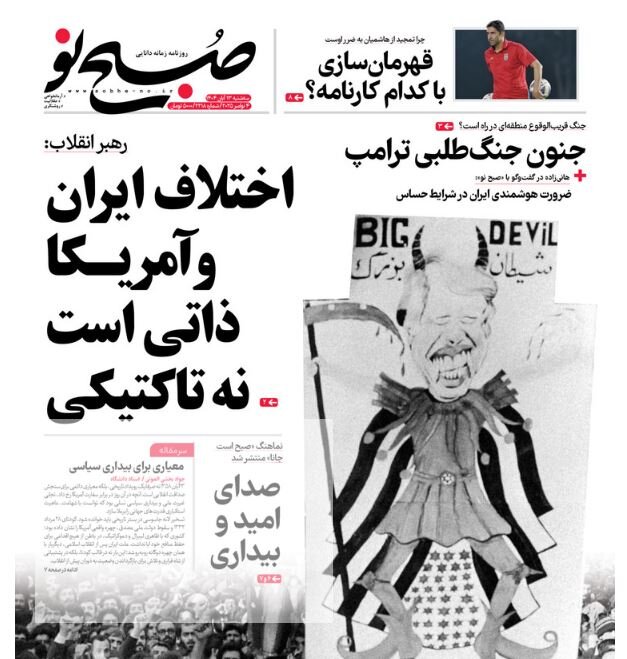
TEHRAN – Sob-e-No analyzed the simultaneous activation of a regional mediator to re-mediate dialogue between Iran and the United States.
According to the newspaper, Qatar, Oman and Egypt are each engaged in mediation for different reasons. Qatar wants to reaffirm its importance as a key regional actor following the blowback Israel inflicted on the Gaza war and its mediating role. Doha aims to revive its diplomatic influence by linking Gaza files with Iranian-US documents. Oman continues to serve as a traditional channel for secret message exchange and maintains its long-standing role in sensitive communications. Egypt’s involvement carries a clear political message. Cairo does not want Qatar and Oman to monopolize diplomatic achievements in mediating between Iran and the West. Each mediator plays a unique role. Qatar aims to maintain its political course, Oman facilitates the transfer of sensitive messages and helps reduce security misunderstandings, and Egypt focuses on managing the technical and legal aspects of the negotiations. If these three channels continue to operate in parallel, the risk of strategic miscalculation in the region could be reduced, paving the way for Iran and Washington to reach a limited but functional understanding. Until then, regional diplomacy will be in a state of “active suspension,” with all parties striving to avoid large-scale conflict.
Batan-e-Emruz: Rising barriers to Israel resuming war against Iran
One of the factors that distinguishes the possibility of a new conflict from the June 12-day war is the changing attitude of major regional and global players, particularly West Asian countries, China, and Russia, toward Israel’s military actions against Iran. Following Israel’s attacks on Syria and Doha (to assassinate Hamas leaders), the regime’s far-reaching plans for regional domination were exposed, along with the US strategy to rebuild order in West Asia. As a result, regional countries have come to view Israel as a major threat to regional stability. Experts believe that if Israel launches a new attack against Iran, the regional reaction will be very different from that during the 12-day conflict. Although it remains unclear whether war is imminent or in Israel’s plans, available evidence suggests that the conditions for a new military attack against Iran are becoming more difficult for Tel Aviv. In summary, while an Israeli attack on Iran remains a possibility, it is clear that the obstacles facing such an operation have increased significantly. If a new war breaks out, the losses to Israel could far exceed those suffered in the previous conflict.
Etemad: Chabahar is a strategic asset for Tehran and Delhi
Mostafa Zandier, senior South and Central Asia analyst, explored the implications of the US government’s recent decision to extend sanctions waivers for India in an interview with Etemad. Zandier emphasized that Chabahar is a strategic maritime port for Iran and has great economic and geopolitical potential. For India, Chabahar serves as a key gateway to Afghanistan and Central Asia, forming a key element of its regional connectivity strategy and complementing the North-South transport corridor. However, realizing the full potential of this route requires sustained investment and mitigation of political and sanctions-related risks. Although US sanctions have influenced India’s decision-making, New Delhi’s approach to Chabahar has consistently followed a strategy of “balanced and gradual engagement”. Zandier argues that the recent six-month waiver reflects the US government’s calculations to counter China’s growing influence. Going forward, India’s engagement with Chabahar is expected to remain prudent and pragmatic, including continuing operations under exemptions, phasing in investments in stages, managing sanctions risks, and maintaining its role in the regional transport network.
Donya Ektesad: Engagement with Iran is strategically essential
In an interview with Donya Ektesad, senior Middle East analyst Aliabarzan Mohammadi spoke about the emergence of a coalition among several southern Persian Gulf states advocating for the resumption of Iran-Washington talks. He argued that calls for renegotiation, particularly from the foreign ministers of Bahrain and Oman, reflected broader efforts to promote regional balance as the world order shifts towards multipolarity. Given recent developments in global and regional power relations, a return to Oman-mediated talks could yield several important outcomes, including reduced military risks, potentially reducing the likelihood of a confrontation between Iran and the United States or Israel. It would also improve maritime security, energy market stability, and strengthen Iran’s integration into regional security frameworks, which could reduce counterproductive conflicts and foster cooperation. Conversely, if negotiations are abandoned or fail, regional trust may be undermined and extra-regional actors with divergent interests may disrupt the process. In essence, these talks may signal a transition from a unipolar to a regionally rooted multipolar order, but full realization will require time, institutional development, and concrete guarantees.