
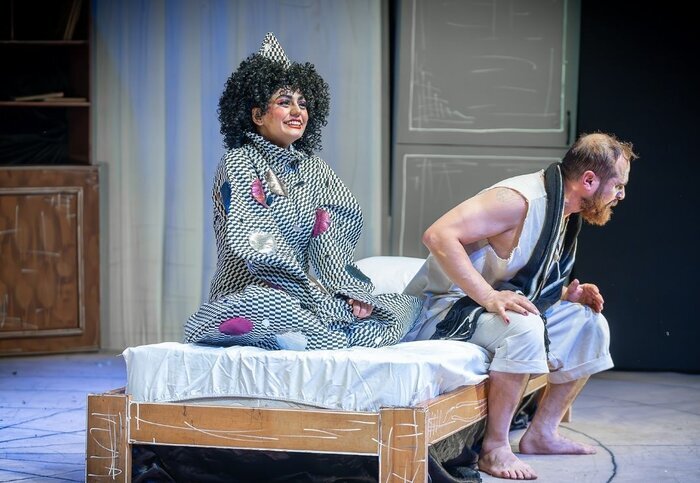
Tehran – The adaptation of Czech writer Franz Kafka’s novel “Trial” is currently on stage at the Homa Theatre Hall in Tehran.
Written by Mohammad Charmshir and Farhad Mohandespour, Shahrouz Delafkar is the director of the play, renamed “Joseph K.”
Behrouz Panahandeh, Pezhvak Imani, Raha Hajizenal, Sahar Abdolmaleki, Ehsan Rezvani and Ehsan Rezvani are key members of the cast who will remain on stage until July 30th.
“The Trial” is an original novel written between 1914 and 1915, and was published posthumously in 1925. Considered one of Kafka’s most influential works, it explores justice, guilt and the absurdity of bureaucracy. The novel records the mysterious and tragic experiences of a bank clerk. The bank clerk feels unexpectedly arrested by an opaque authority for an unspecified crime. Throughout the story, Kafka delves into the existential unease of facing a legal system that remains almost inaccessible and impossible for both Joseph and the reader. In particular, Kafka has never completed the novel, but it contains chapters that seem to serve as a sudden, perhaps symbolic conclusion.
Kafka’s “trial” was heavily influenced by Russian novelist Fyodor Dostoevsky, particularly “crime and punishment” and “brother Karamazov.” Kafka himself sees Dostoevsky as a “blood relative,” reflecting the common strength of his quest for guilt, morality and human suffering. Like Kafka’s other unfinished works, “The Castle” and “Amerika,” the novel remains incomplete, and Kafka’s original manuscript consists of loose pages that are compiled into the stories he knows today by his friend and literary enforcer Max Brod. Brod’s editing was necessary due to Kafka’s habit of destroying his own works. And the original manuscript is currently housed in the Museum of Modern Literature in Marbach, Germany.
The story begins on Joseph K.’s 30th birthday. Surprisingly, he is not incarcerated, but is permitted to continue his daily life, causing him to become confused and increasingly uneasy. Over the course of the novel, Joseph tries to understand the accusations against him. It remains shrouded in mystery. His interactions with a wide range of people, including lawyers, court officials, acquaintances, and more highlight the surreal nature of the maze and often judicial process. He visits courthouses hidden in a dilapidated building, meets strangely behaving officials, and faces constant frustration and disillusionment.
Through his ordeal, Joseph encounters a series of iconic episodes, including a failed attempt at appeals, a meeting with a court painter named Titorilli, who provides questionable legal advice, and a tragic visit to a priest who tells the famous parable “before the law.” As the story progresses, Joseph’s life becomes more and more intertwined with the absurdity of the system, and his sense of guilt and helplessness deepens. Despite efforts to clear his name, the opaque authority remains far apart and indifferent.
The novel pinnacles the death of Joseph outside the city, where he is murdered by two men who unexpectedly arrive at a secret meeting. They stab him in the heart, strangle him, and kill him with the last hopeless words: “Like a dog!” Kafka’s “trial” remains a powerful all-talk of the human condition, demonstrating the terrifying and often incomprehensible nature of authority, justice and guilt in modern society.
sab/