
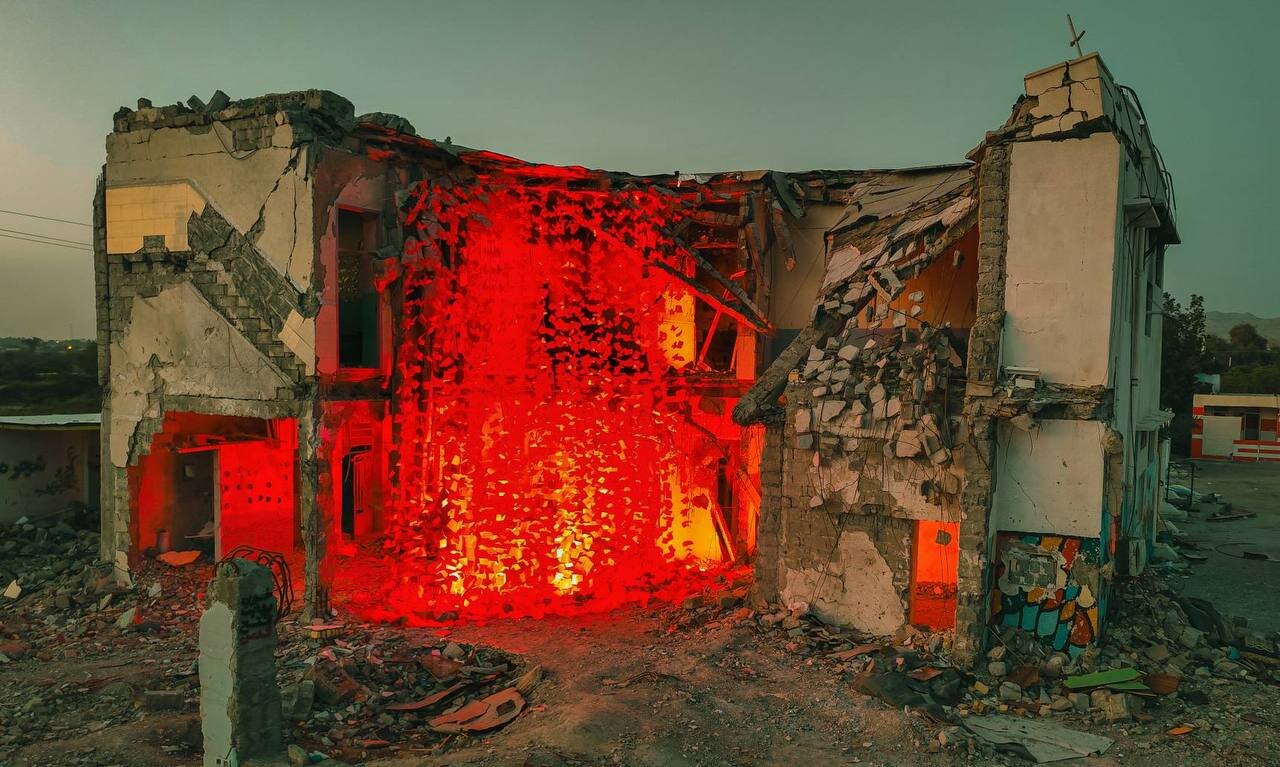
TEHRAN – To honor the memory of the young students martyred in recent tragedies and commemorate the 40th day of their martyrdom, a conceptual art installation featuring 2,000 red butterflies and a symbolic crimson page has been unveiled at the site of Shajare Tayebeh Primary School in Minab.
Reaching a height of 9 meters amidst the wreckage, the installation serves as a visual narrative of the Ascension, designed to honor the memory of children and break the silence of the tragedy, transforming it into a timeless story of innocence and ascension.
The project, titled “Monument to the Children of Minab Martyrs,” is organized by the Center for Islamic Architecture and Art of the Arts Department of the Organization for the Promotion of Islamic Ideology.
Mostafa Momeni Rad, Director of the Center, shared the vision behind this initiative. “Despite the challenges posed by the current wartime situation and severe time constraints, we were determined to create a temporary installation that could provide comfort to grieving families and give voice to this immense grief through the language of art,” he said.
Designing a memorial that reflected the depth of Minab’s parents’ grief was not an easy task. Momeni-Rad explained that the creative team reviewed countless photos and testimonials and considered 10 different proposals before finalizing the current design.
“The core concept was inspired by children’s bloody books and notebooks,” he said. “The installation depicts these pages being drawn skyward and gradually transforming into 2,000 red butterflies, creating a delicate contrast between the grace of the butterflies and the harsh violence of the ruins.”
The installation consists of 2,000 crimson translucent pieces suspended by 72 hanging cords and reaches a height of 9 meters under the school’s broken roof. These red butterflies symbolize the names of martyrs who refused to disappear in the dust of tragedy.
He emphasized the emotional connection formed by the martyrs’ families he visited during the installation process.
“It was very meaningful to us to see the families deeply resonate with the metaphorical representation of their children’s ascension,” he said. “It confirms that we are on the right path to recording this event in the collective memory of our nation.”
The current installation is designed to be temporary, with the possibility of eventually rebuilding the school or converting it into a museum, he added.
He concluded that negotiations have already begun with local authorities to install a permanent monument either in Minab’s public square or plaza.
On February 28, Shajare Tayebeh Girls’ Primary School in Minab, Hormozgan province, became the scene of a devastating massacre as the United States and Israel launched an offensive against Iran.
Dozens of girls and boys aged 7 to 12 were starting classes when the school was targeted by a missile attack, which collapsed the building and trapped the children and teachers under rubble. Iranian authorities said the final death toll was 168 people and at least 95 injured, making it one of the deadliest days of the conflict.
As images of the tragedy circulate on social media, U.S. and Israeli authorities try to distance themselves from the massacre, but detailed forensic and digital investigations paint a very different picture.
Analysis by Al Jazeera’s Digital Investigative Unit, using more than a decade of satellite imagery and recent video clips, reveals that the school is a distinctly different civilian facility, isolated from the adjacent military facility for at least a decade. Additionally, eyewitness testimony and satellite-based analysis confirmed that the school had been triple-tapped by three separate deliberate attacks, leaving no doubt as to the nature of the attacks.
The international community is faced with mounting evidence of responsibility for this atrocity, with investigations by major global news outlets such as The New York Times, BBC Verify, CBC, and NPR all concluding that the United States was responsible for the attack.
These findings raise fundamental questions about the intelligence used to justify the bombings, as the pattern of attacks suggests they directly targeted civilian educational institutions. The Minab School tragedy is now sobering evidence of the invasion’s enormous human cost and is the focus of calls for international accountability.
SAB/