
TEHRAN – Iran’s Minister of Culture and Islamic Guidance Seyyed Abbas Salehi has criticized U.S. President Donald Trump’s escalating rhetoric and self-deifying social media presence, characterizing the U.S. leader’s actions as a modern manifestation of the “pharaoh complex” that historically heralds the impending doom of tyrants.
In a post shared to his X (formerly Twitter) account on Monday, Salehi highlighted what he described as an alarming and delusional progression in Trump’s public persona. The minister’s remarks came in the wake of a series of provocative social media posts by the US president following recent verbal attacks on Catholic Church leaders.
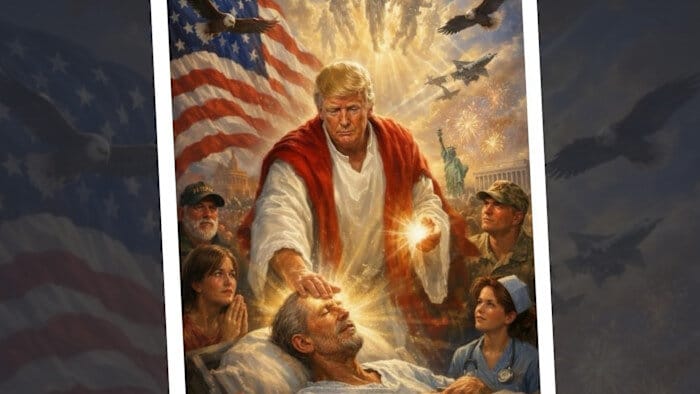
“Trump posted this image after attacking the Pope!” Salehi wrote, referring to the controversial visual shared by President Trump. “President Trump has become King Trump and now thinks of himself as Christ Trump. It doesn’t look like he’s going to claim divinity soon! And this is the end of the Pharaoh’s path.”
The Minister of Culture’s reference to “Pharaoh” is based on deep history and Quranic metaphors. In Islamic thought, the figure of the pharaoh represents the pinnacle of human arrogance, a ruler blinded by absolute power who ultimately declares himself a god and meets complete destruction. Salehi cited this image to suggest that President Trump’s transformation from politician to self-styled savior reflects a dangerous disconnect from reality, often seen in the last desperate stages of autocratic regimes.
Pope Leo XIV recently issued a harsh moral condemnation of the ongoing US-led and Israeli-backed military invasion of the Islamic Republic of Iran. In a widely circulated message, the pope said threats to “wipe out Iranian civilization” were “truly unacceptable” and violated the most basic tenets of international law and humanitarian morality.
In a characteristically defiant move, President Trump lashed out at the spiritual leader of 1.3 billion Catholics. In a televised speech and subsequent social media frenzy, Trump claimed to be “not a fan” of the Pope, labeling him “weak” and “out of touch” with modern security realities. The conflict reached a new level of contention when President Trump shared an AI-generated image of himself wearing a Biblical robe, performing what appeared to be a miraculous act of healing, effectively identifying himself as Jesus Christ.
President Trump has angered a global, interfaith audience by attempting to co-opt the image of Jesus Christ, who is revered in Islam as a great prophet and symbol of peace.
Earlier, President Massoud Pezeshkian also expressed strong opposition to the desecration of religious symbols and insults to the Pope, saying they were an insult to all “free-thinking people” regardless of their beliefs. The president said such actions would only further isolate the United States on the world stage, alienating even its traditional allies in Christendom.
As the United States continues its aggressive stance against Iran, Washington’s rhetoric has taken on an increasingly messianic and apocalyptic tone. Analysts warn that the mechanisms of rational diplomacy will fail if political leaders begin to demand spiritual veneration as well as political loyalty.
Minister Salehi’s warning that this path represents the “end of the road” serves as a reminder that throughout history, the more rulers try to elevate themselves above human condition, the more certain they are to eventually collapse. For now, the international community watches with anxiety as the gap between the White House’s “sacred” self-image and geopolitical reality continues to widen.
On February 28, Islamic revolutionary leader Ayatollah Khamenei was martyred in a joint attack by the United States and Israel that targeted key Iranian state facilities. Later, Mojtaba Khamenei was appointed as the new leader by the Council of Experts.
The tragedy extended beyond political leadership to civilian infrastructure. In one of the most devastating attacks, 168 children were martyred and 95 others injured when Shajare Tayeva Primary School in Minab, Hormozgan province was attacked. These strikes destroyed numerous homes while directly targeting cultural and educational centers.
These attacks caused irreparable damage to residential and cultural areas across Iran. Many schools, theaters, libraries, and cultural institutions were completely destroyed or severely damaged. Iranian families living in cities such as Minab, Tehran, Isfahan, Hamedan, Tabriz and other areas are facing the devastation of having their homes destroyed and losing loved ones. Nevertheless, the spirit of resistance and resilience of the Iranian people is strengthening. Continuous efforts are underway to rebuild and preserve the country’s cultural heritage.
SAB/