
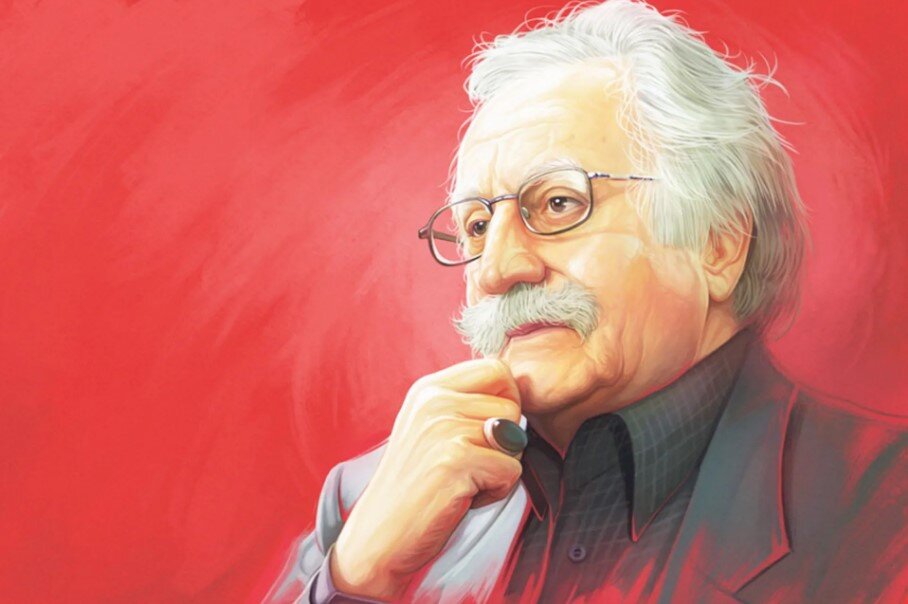
Famous Iranian miniatureist and painter Tehran Mahmoud Falshuan passed away on Saturday at the age of 96 in a hospital in New Jersey, USA, Persian media reported.
Farshuan left this world and left a rich heritage that shaped Iran’s cultural and artistic landscape.
Born in Isfahan in 1930, he was celebrated as one of the most prominent figures in modern Iranian art, known for his exquisite works inspired by Persian literature and religious texts.
Falsch’s journey into the world of art was marked by exceptional talent and unwavering dedication from an early age. His father, a prominent figure in the carpet industry in Isfahan, recognized the extraordinary gifts of his son and took him to the Mirza Aka Emami workshop, where the potential of a young artist was first discovered. From that moment onwards, the pursuit of excellence and spiritual expression began through art.
After training under a well-known master and graduating from the art school in Isfahan, Falshuan traveled to Europe to further study Western art at museums. He was passionate about his art collections, often carrying a bag full of books and tools, and was known to stay until closing time.
Back in Iran, Farshuan began working in the Tehran Art Department, and later served as director and professor in the Faculty of Art at Tehran University. Although he lived in New Jersey, he maintained regular visits to Iran and continued his artistic pursuit.
Farshchian’s work is renowned for its intricate craftsmanship, combining traditional Persian miniature techniques with innovative elements that breathe new life into classic themes. His art vividly captures the souls of Persian poetry, religious stories and spiritual symbolism, creating visually surprising, profound and meaningful compositions. His mastery lies in a delicate balance between tradition and innovation. It evokes vibrant flowing lines, circular motifs, and emotions, creating dynamic colors that transcend cultural boundaries.
Throughout his illustrious career, Falcien artwork has traveled through globes exhibited in prestigious cities such as Paris, New York, Chicago and Tokyo. Many of his works are talented by Iranian officials as symbols of Iran’s rich cultural heritage. His contributions earned him many accolades and reaffirmed his status as a national treasure.
Falshuan also created some of the most moving visual interpretations of Ashura’s tragedy in contemporary art. His works, such as “Ashura’s Evening” and “The Standard Bearer of Truth,” capture the spiritual sorrow, sacrifice and solidity of Imam Hussein (AS) and his companions, transcending mere illustration.
With its intricate details, dynamic composition and stunning use of colour and symbolism, Falsch transforms the canvas into a sacred space where sadness and hope are intertwined. These paintings not only preserve Kalbala’s historical memory, but also evoke timeless lessons of faith, justice and resistance in oppression.
Falsch’s influence spread beyond his brush. He served as professor and director of the Faculty of Art at Tehran University in Iran, forming a generation of artists who continue to advance his artistic vision. His works are housed in the Mahmoud Faschtian Museum at Sadabad Palace, which was launched in 2001, and showcases more than 50 masterpieces of his masterpieces.
In 1955 he married Niyaduk Kavami and had three children. Ali Morad, doctor. Psychologist Leila. and Fateme.
Despite his international recognition, Faschtian remained rooted in his Iranian identity. His art inspired Persian poetry, the Quran, sacred texts of Christianity and Judaism, creating a universal language of spiritual artistry. His ability to blend tradition with modernity, along with scholars like Italian art historian Umberto Bardini, describes him as “a phenomenon and a pivotal point of Iranian art.”
He made a significant contribution to promoting Iranian art internationally, and was often invited to speak at universities and cultural institutions around the world. Several books and academic articles have been published about his work, solidifying his legacy as a master artist.
His name has been placed on the UK list of outstanding intellectuals of the 2000 years of the 21st century, and collectors feel it is a great honor to own one of his works.
Farshtian was one of 40 Iranian artists who were honored by the Iranian National Library and Archives for their outstanding works created over the past century about the tragedy of Asura.
News of his death cast a shadow of sadness on the cultural community of Iran. Many express their sadness, emphasizing that the loss of such a bright person leaves an irreplaceable void. The Ministry of Culture and Islamic Leader, together with many cultural institutions, honours his monumental contributions and calls him a symbol of Iran’s resilience, spirituality and artistic brilliance.
As Iran bid farewell to one of his most precious artists, the Mahmoud Falsh legacy continues to inspire. His art is rich with symbolism, spirituality and timeless beauty, with beacons of Iranian cultural identity, lights the paths of future generations.
sab/