
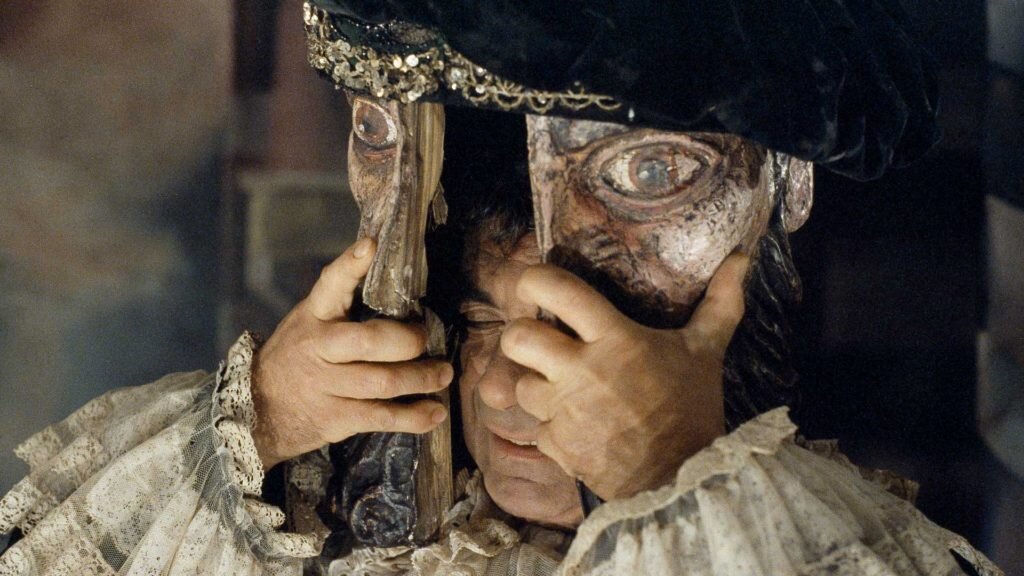
Tehran – “Faust” is a 1994 drama film by Czech film director Jansvankmajer, and was reviewed on Thursday during a session at the Cinemathek of the Iranian Artist Forum (IAF).
The film was screened and followed by a review session.
“Faust” is a unique cinematic adaptation of a legendary tale, blending live-action footage with surreal animation sequences to explore themes of seduction, morality and human stupidity. The film is a joint international production with support from the Czech Republic, France, the UK, the US and Germany.
“Faust” draws inspiration from both classical and folk traditions, interweaving elements of Goethe’s 1808-1832 plays and Christopher Marlow’s 16th century tragedy, along with traditional Czech folklore.
The film’s story is infused with modernism and absurd sensibilities, creating a dark, humorous, kafkaesque atmosphere. Standing against the background of Prague, the city’s unforgettable architecture and moody streets serve as a fitting setting for the all-talented journey of the story. Although the tone is dark, the film also incorporates humor, balancing the sense of despair and satirical wit.
The story begins on a desolate Prague morning. This is in stark contrast to the lively activities of urban commuters. The unknown figure, played by Petrchepek, embodies the anonymity of everyday citizens, emerges from the metro station. On his seemingly normal day, he makes an uneasy turn with a chance encounter. Two men will distribute flyers. One is a unique map with marked locations. The man, not frankly or perhaps indifferent, dismisses the flyer and returns to his modest accommodation.
His entrance is quickly separated by a jarring event. An unexpected and unsettling explosion of black cockerel from the doorway. This premonition foreshadows the ominous events that will continue. Inside, within the scope of his small apartment, he discovers an uneasy abnormality. It is a chunk of bread containing eggs. Discoveries, seemingly harmless, make an ominous turn when they crack eggs and become empty. This act of emptiness is literally and symbolic, foreshadowing the void and uncertainty that consumes the story.
The scene escalates rapidly with sudden, violent changes in the atmosphere. The light flickers irregularly, the wind shows the outside, and the things in the room begin to fly – a chaotic, unsettling display of forces beyond human control. Sudden violent changes in the atmosphere suggest the confusion of ordinary things, indicating the invasion of something unusual and potentially dangerous. The man, caught up in this wilderness of chaos, looks out the window and witnesses the uneasy sight unfolding across his small apartment. The scene is now full of foreboding, leaving readers with anticipation and fear, and wondering what will be revealed in the next act of the unfolding story.
The unsettling interaction between the ordinary and extraordinary is highlighted by the anonymity of the characters, seemingly insignificant events, and a sudden eruption of confusion. Empty eggs, black cockerels, and unstable weather all contribute to a sense of foreshadowing, suggesting something abnormal and potentially dangerous is happening. Now firmly established in an environment of anxiety, the story predicts readers the revelation of the importance of maps and the nature of looming threats.
The film was shot in a location in Prague’s historic old town and filmed the architecture of the city’s atmosphere that enhances the film’s mystical and surreal qualities.
“Faust” was filled with aggressive critical receptions and scored 73% on Rotten Tomatoes based on 11 reviews. It was praised for its ingenious visuals, atmospheric storytelling and philosophical depth. The film was featured in a specific section of the United Nations at the Cannes Film Festival in 1994, highlighting its artistic importance.
He also won awards at various festivals, including the Kecskemét Animation Film Festival, which won an adult audience awards, and the Czech Critics Award for Best Animated Film. He also won three Czech lions and was nominated for four more. At the Karlovy Vary International Film Festival, “Faust” was nominated for the prestigious Crystal Glove and won a special Jue Award, solidifying its position as an important work in Czech and international films.
sab/