
Tehran – Relationships with Iran’s Islamic Republic, the Russian Federation, and other countries with a shared approach can truly lay the foundations of a multipolar world and society.
Salech traveled to St. Petersburg at the invitation of his Russian counterparts, attended the 11th United International Forum of Culture, met with Russian cultural figures and visited major artistic and academic institutions.
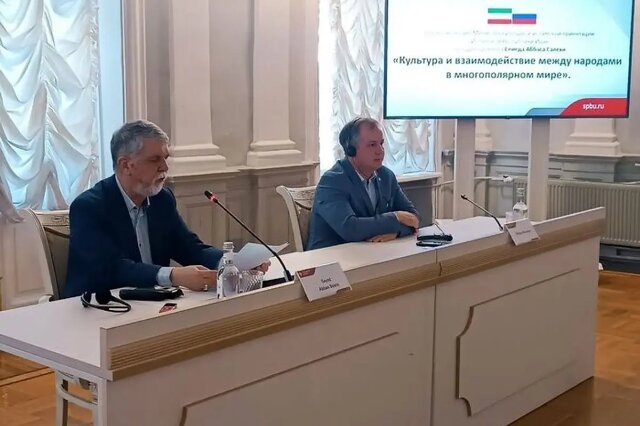
On September 12, he toured the historic St. Petersburg State University, founded 301 years ago, and discussed with the university’s executive committee on how to enhance bilateral academic and cultural cooperation. The Minister also gave lectures to professors and students entitled “Cultural and Human Interaction in Multipolar Society.”
Salech praised St. Petersburg as a city of global knowledge and culture, highlighting the pivotal role of culture in human development. “Today, development is not just about economics and politics,” he said.
The Minister argued that authentic and enduring progress must be measured not only economically but also in freedom, dignity and human prosperity. He warned that development without justice led to oppression, citing Gaza and Palestine as examples, stressing that individuals and states should not be sacrificed for the benefit of others.
On bilateral connections, Salech emphasized his efforts to acclimate both Iranian and Russian younger generations to each other’s literary and artistic heritage. He emphasized that the multipolar world must also be cultural as well as political and military. “The foundation of a multipolar world is cultural plurality. Iran and Russia must understand each other’s values and achievements, along with thousands of years of civilization.”
Salehi also reflected the deep-rooted historical connections between the two countries, from manuscript exchanges and early printing to shared inspiration for literature and art. He noted that Iranian audiences were deeply involved in Russian classics, from Tolstoy and Dostoyevsky to Tchaikovsky, and recalled how Persian poetry influenced figures such as Pushkin. “This interaction has always been two-way,” he said. “It shapes not only literature, but theatres, film, music and visual art.”
In pursuit of an expanded university exchange, Salech proposed establishing a new chair in Russian Persian literature and Iranian Russian language, as well as a joint programme of anthropology and arts. He emphasized the importance of direct literary translation between Persian and Russian, along with greater efforts to translate not only classics but contemporary works.
The Minister also advocated digital cooperation to maintain and share cultural tourism and digital cooperation as a platform for closer contact with people. “Today, bloggers and online creators from Iran and Russia can present more authentic images of our country than international media,” he said.
During the visit, Salech received a catalog of Persian manuscripts from the university, highlighting the long tradition of Russian Iranology. He noted that while some Orientalism schools are associated with colonial agendas, Russian iranology often pursues true understanding and dialogue. Over the past three centuries, Russian scholars have produced over 10,000 works in Iran, which Salech describes as “the lasting foundation of long-term academic cooperation.”
Finishing his speech, Salehi emphasized that cultural connections are deeper and more resilient than purely political or economic relationships. “When relationships are rooted in culture, economic and political ties become stronger and more sustainable. Iran and Russia share such ties.
Photo: Iran’s Minister of Culture and Islamic Leader gave a lecture at St. Petersburg State University on September 12, 2025.
SS/SAB