
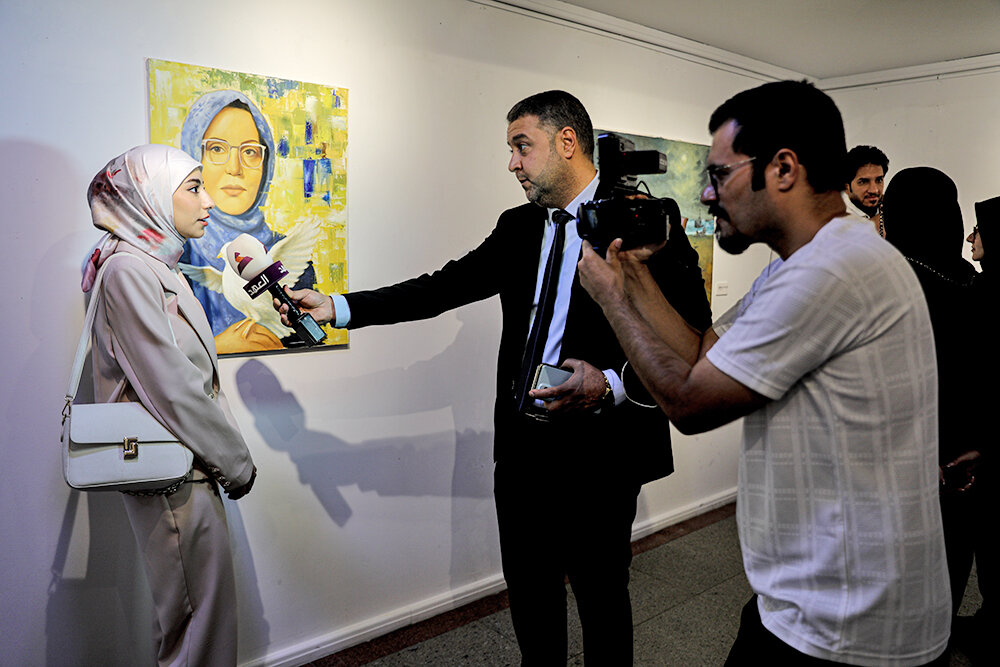
Tehran – The opening ceremony of the “Art Against the War on Art” exhibition features works by Iraqi artists reflecting the martialism of artist Mansole Alikani, one of the victims of Israeli regime’s atrocities, and was held on Sunday at the Art Bureau, a decentralized Islamic Ideological Organization.
The exhibition featured 24 works created by Iraqi artists, including works produced in painting workshops dedicated to the memories of Martyr Mansoureh Alikhani and other victims of Israeli assault, Mehr reported.
We exhibited Zahra Hassan, Rasil Ahmed, Morteza Riyaz, Abdul Rahman Hussain, Sattar Jabbar Al-Zameli, Mohammad Kate’, Maryam Ahmed Hassan, Adel Khaled, Ahmed Samir, Farah Issam and Mohammad al-Hasnaw.
At the opening ceremony, Seiyed Ahmed Shuber, director of the Beit Al Jamallil Hunn Art Centre in Baghdad, said that Manso Rail Crab was a talented painter whom he taught in Israel’s recent attack on Iran. “To her honor, we organized a symposium in Baghdad in July this year entitled “Art Against War.” ”
“Twenty-five Iraqi artists participated in the symposium and produced 25 works. The first exhibition of these works was held in Baghdad, and the second is being held today in Tehran with the invitation of a colleague from the Art Bureau,” he added.
Shubbar further noted the possibility of holding similar exhibitions in other countries, highlighting the need for diplomatic coordination and formal invitations for such events.
Regarding the impact of the exhibition, he said: “Art exhibitions like this serve as a powerful reflection on important events. Art is a universal language that can convey messages across boundaries in many ways, and is extremely effective in providing meaningful stories.”
“Where the soul meets at the intersection of words and colors, young artists and veteran artists gathered in an open painting session that lasted seven days to give meaning to “art against war.” This was not just a workshop, it was a moment of reflection and aesthetic protest. The canvas became the battlefield, the words became the shield, and the colour became the screams that illuminated the darkness of war,” reads some of the exhibition.
“We aimed to demonstrate that conflict in wars is not achieved with weapons alone, but that we can be at the forefront and portray what artillery cannot erase. This empathetic experience was born out of respect and respect between Iranian Islamic Republic and Iranian artists.”
“I believe this exhibition is more than an artistic event. It is a spiritual will that affirms that art can withstand and beauty can challenge ugly. When combined with Arabic calligraphy, sculpture, painting and weaving, it can declare that the human spirit is stronger than war.
Back in July, the exhibition was also held in Baghdad. Beit Al Jamallil Fan Art Centre held a weekly symposium dedicated to Iranian painter Manso Ralelic Crab. The event brought together Iraqi artists to honor her memory, condemn violence and emphasize the power of art in promoting peace, resistance and cultural exchanges amid local conflict.
Following the Zionist regime’s aggressive attack on Iran, Mansore Alikani lost his life during an Israeli attack on Tehran’s residential area.
Alikani was a student at Master Kazem Charipa and was a prominent figure in the field of painting, who was also involved in training and research. She had painted a picture of Asura, the day Imam Hussein (AS) and his companions had taught Martyr at the Battle of Karbara in 680 AD.
Early on Friday, June 13, a series of terrorist attacks carried out by the Zionist regime targeted Tehran and several other Iranian cities, bringing the martial arts of many military commanders, scientists and innocent civilians.
In response to the Savagezionist attack, Iran’s Islamic Republic launched Operation True Promise 3 on Friday night, unleashing a barrage of missiles on the occupied territories.
Israel attacks target areas within Iran, which were not military facilities, resulting in the tragic loss of the lives of innocent civilians, including women and children. The incident sparked rage not only among Iran but also among international observers.
sab/