
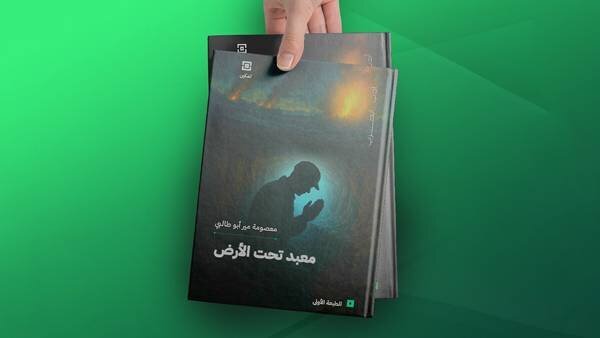
In collaboration with Tehran- The Sacred Defense Week (22nd-29th September), Ayatollah Seyed Ali Khamenei, an Arabic translation of the book “Underground Temple,” written by Masoumeh Mir-Aboutalebi and decorated with awards from leaders of the Islamic Revolution, has been published in Dar Temkeen Publishing House in Iraq.
Originally published by Jamkaran Publishations in Iran, the Underground Temple tells the lesser known chapter of sacred defense set in the Iran-Iraq War period (1980-1988). The story unfolds while the complicated knots in war effort are miraculously unraveled by Martyr Gholam-Hossein Rayat Rokn Abadi.
This story follows the quest of a young man to discover his true self under the soil. A dismayed, lonely young man, Elias strives to change the way others perceive him. Exhausted by the constant relief from his uncle, he became increasingly isolated and retreated.
The overwhelming attention in comparison to the rest of his mother’s mother has shattered his pride, and he is now determined to prove that he is neither cowardly nor powerful. Elias embarks on a journey until well sinker Haji Gollum Hossain arrives in his village, introducing a new world that demands courage and courage. His acquaintance with Haj Gholam-Hossein leads to unexpected and transformative events in Elias’ life.
In January, the book awards by Ayatollah Khamenei were presented at a ceremony at Lokun Abado Village, Mabod, Yazd State.
In his admiration, Ayatollah Khamenei described the book’s subject matter as noble and innovative.
“The novel’s theme is unique and innovative, and its writing is fun and fascinating,” the leader said in his praise.
“Dealing with the vital and influential aspects of sacred defense is a necessary effort that the novel’s eloquent author has achieved,” he noted. He added, “The contribution of well sinkers from Yazd has been emphasized many times by Martyr Sayyad Shirazi. However, the importance, subtlety and challenges depicted in this book were not fully understood by us or others like us.”
“These artists will wave their jockeys, as God has the mercy and favour of God,” he concluded.
Between 1980 and 1988, Iran-Iraq was marked locally as a sacred defense and was launched by the orders of former Iraqi President Saddam Hussein almost 19 months after the victory of the Islamic Revolution.
The conflict had a major impact on Iranian society as it mobilized both the military and civilians in a unified effort to defend the newly established Islamic Republic.
The term “sacred defense” reflects the spiritual and patriotic nature of conflict, emphasizing the belief that protecting your homeland is not only a physical battle, but also a spiritual duty.
sab/