
For over 700 days, Tehran withstanded some of the most savage attacks in human history. To the warriors, even when touched by the bomb, they are slowly asserted by the dagger of the starvation, and endure women and children who have been sacrificed at the expense of the true master of the regime.
“Gaza” – A name that resonates more with the ears of today’s humanity than ever before. For two years, the Zionist regime has craved the blood of women, children and civilians, saturating all the canvases that attempt to portray Gaza’s reality in their favorite colour, red.
In a dark world where human rights principles seem outdated and the United Nations offers no regrets and concerns, a diverse group of people broadcast the truth about Gaza’s slaughterhouses, defeating Zionist media scientist, reporting under fire, thousands of miles from those thousands of miles away, mirrors reflecting genecles.
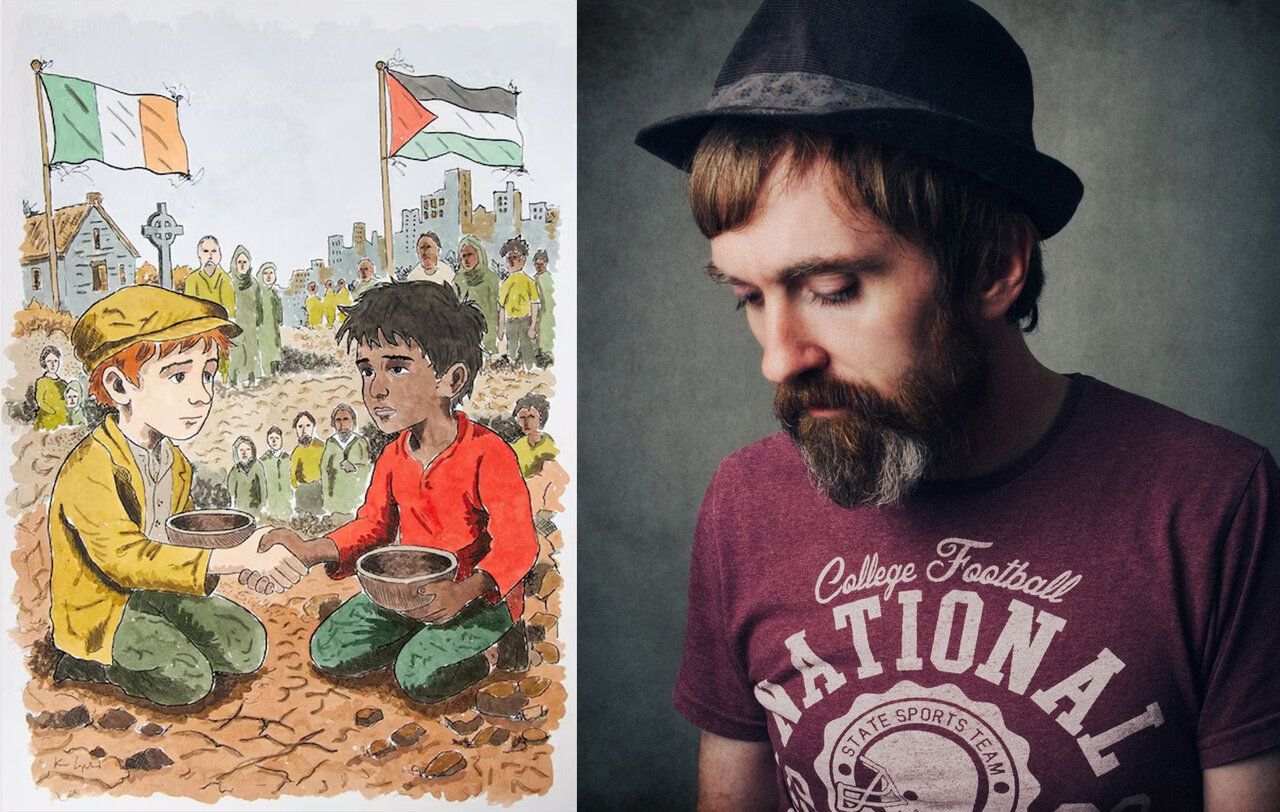
Irish political illustrator Kevin Copeland is one of the artists who has caused the unique frames of the suffering of the Palestinian people on the canvas through the genocide of Gaza.
One of his paintings, titled “What links Ireland and Gaza?”, has attracted the attention of audiences around the world by arranging the bitter experiences of colonialism for both Palestinians and Irish people.
The Tehran Times conducted an exclusive interview with Copeland. This is shown below.
How can painting as an artistic form function as a channel to express the pain of oppressed Palestinians and to convey the stories of their suffering to the world?
For me, art has the ability to bring the subject back to the bare bones. It removes the noise of politics and media spin and focuses on the raw pain of what is happening in Palestine – the destruction of the house, the sadness of the family, the suffering of the Gazan masses. Painting is a way of telling stories that speak directly to our shared humanity. No translation is required. It is not dependent on statistics. It simply holds a mirror that forces us to see and feel.
What I’m trying to do is to pause the viewer for a while and create a piece that brings my sympathy to the photo. When someone sees the eyes of a child filled with tears, or is a symbol of loss and resilience, it becomes difficult to turn away. Although art cannot resolve conflicts, it continues to live the story of a oppressed person, reminding the world that the person behind every headline is a person worthy of being witnessed in pain.
One of the paintings, named “What Links Ireland and Gaza,” has attracted a lot of attention. What do you think is the reason for this?
I live in a town in northern Ireland called Delhi. Its location is where history is marked by occupation and conflict. Growing up here, I couldn’t escape the sight of soldiers on the streets, the constant pressure on the community, and the weight of injustice carried by ordinary people. The experience has shaped how I view the world and gave me natural sympathy to others living under similar conditions.
When I created “that links between Ireland and Gaza,” it came directly from that connection. The people here don’t need explanations to understand the similarities – they instinctively feel them. I think that’s why the painting resonated so strongly. It was born from a shared experience of the struggle for loss, resilience and dignity, giving visual language to the already existing bond between Ireland and Palestine.
What inspired you to focus on the political themes of your art, instead of social issues, nature, or other subjects?
I’ve started painting and drawing, and although I still love that type of art, I always feel more attracted to creating works. Politics that grew up in Delhi were not far away. It was part of everyday life. So when I began drawing seriously it felt natural to use it as a way to explore conflict, fraud, and human costs of both.
Artists like Banksy have had a huge impact on me. The way he uses sharp contrasts and strong symbolism to tell stories is something I really admire. His work doesn’t just sit quietly. It sparks debate and challenges people. That approach pushed me to find my own way of using art as a voice. He now creates weight-carrying works, gives space to stories that could induce thought and otherwise silence.
Did your response to Palestinian-related artwork encourage you to continue your artistic journey?
Yes, absolutely. I have received so many warm messages from the people of Gaza. I am grateful for shedding light on their struggle. To be honest, like most people, I feel a bit uncomfortable at times as I don’t just draw a few photos. Sometimes we feel helpless. But I also came to believe that even small acts can be big if we are all standing together.
For me, art is my way of showing solidarity. We can’t change what’s happening on earth, but we can use our knowledge of design and communication to shed light on people’s stories. If one of my drawings helps to hear even one voice, I will be happy. And that keeps me moving.
I once spoke to the Irish documentary Garry Keene. He told me about “anti-colonial Irish DNA” and it was really fascinating. What do you think about that?
Yes, there is no doubt about our anti-colonial DNA. Growing up in Ireland, you are surrounded by history. The stories of occupation, loss and resilience are never far apart. It shapes how we see the world. We have developed an instinct to recognize injustice and feel solidarity with people living elsewhere.
Our own experiences were not just about street conflicts. It was also about our language being silent, the closure of GAA games (Irish Sports) and the erosion of our culture. This leaves scars left by generations passed from generation to generation.
To me, that doesn’t mean Ireland is stuck in the past, but that means we have a natural empathy. Our history has given us a true understanding of how it feels to deprive you of your culture, your land and your rights. That’s why I think it’s why many Irish people feel a strong connection to Palestine. It’s not far from us – that’s what we understand in our bones.
Photo: The photo of this combination includes “What links Ireland with Gaza?” (l) and an image of its creator, Irish political illustrator Kevin Copeland.
AH/SAB